How to Use Credit Card Points: A Step-by-Step Guide to Getting Real Value
How to Use Credit Card Points: A Step-by-Step Guide to Getting Real Value
You've earned the points. Here's how to turn them into real value instead of leaving cents on the table.
Written by
Bestmoney Staff
The BestMoney editorial team is composed of writers and experts covering a full range of financial services. Our mission is to simplify the process of selecting the right provider for every need, leveraging our extensive industry knowledge to deliver clear, reliable advice.
Reviewed by
Jackie Lam
Jackie Lam is a credit card writer for BestMoney.com and is based in Los Angeles. Her previous writing experience includes work for various publications. Additionally, Jackie is an accredited AFC® financial counselor and educator with a passion for helping artists, freelancers, and gig economy workers manage their finances.
Only2.8% of credit card accounts forfeited any rewards in Q4 2024, down from 4.8% in 2015, as more issuers move toward non-expiring rewards, according to the CFPB. So the real risk with your points usually isn't losing them, it's redeeming them for far less than they're worth.
A point can be worth anywhere from under0.4 cents to more than 2 cents, depending on the program, and premium-cabin flight redemptions can push that even higher. That gap is wide enough that the same 50,000 points might be worth $300 or well over $1,000, depending entirely on how you redeem them.
You openyour card's rewards page, see a six-figure points balance, and have no idea what to do with it. Cash back? A flight? Transfer it somewhere? A gift card and a business-class flight can draw from the same point balance and land a mile apart in value, and issuers rarely explain that clearly at checkout.
Points Aren't Meant to Sit
Points don't get more valuable just because you hold onto them. Programs can change redemption values and rules, so accumulating hundreds of thousands of points without a plan isn't necessarily a win. The goal isn't to die with the most credit card points; it's to use them for things you would otherwise spend real money on.
This guide walks through how points actually get their value, theredemption methods on the table, and how to pick the right one for what you're trying to do.
Key Insights
How your points and miles actually get priced, and why the same balance can be worth wildly different amounts.
Which redemption methods reliably pay off and which ones quietly waste your points.
How to use transfer partners without needing to become a hobbyist.
A simple framework for picking the right redemption for your situation.
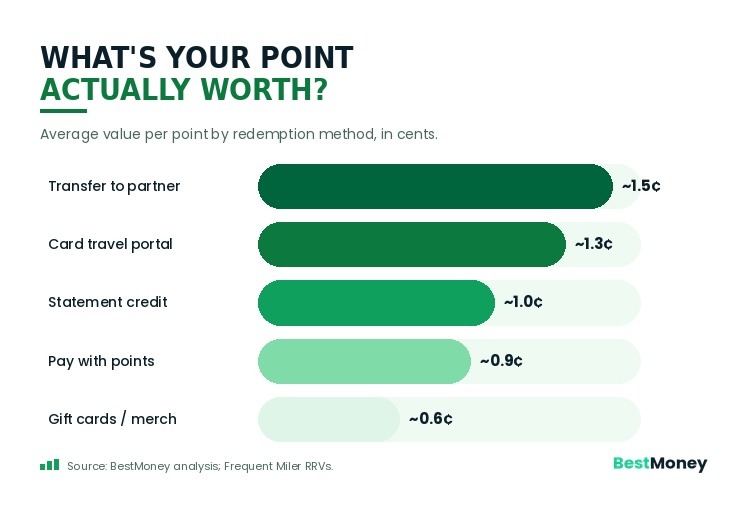
Redemption Methods at a Glance
Redemption Method
Typical Value per Point
Effort Required
Best For
Gift cards / merchandise
0.2–1 cent
Low
Avoid unless nothing else is available
"Pay with points" at checkout
~0.7 cent
Very low
Convenience only, rarely the best value
Statement credit
~1 cent (varies by card)
Low
Simplicity, especially on cash-back-style cards
Card travel portal
1.5–2 cents
Low
Decent value with minimal effort
Transfer to airline/hotel partner
1.5–3+ cents (higher for premium cabins)
Medium–high
Maximizing value, if you have flexibility
Where the Ceiling Comes Off
Direct redemptions from card programs come with a fixed value the programs assign, correlated to how much those redemptions cost them. However, with points transfers to partner travel programs, the card programs don't control their pricing outside of the transfer ratios, so the ceiling comes off.
A point isn't currency. It's a voucher, and the issuer or loyalty program decides what it's worth every time you redeem it.
Here's how that works in plain terms:
Cash-like redemptions (statement credits, gift cards): Most issuers price a point around 1 cent as a baseline.
Transfers to a specific flight, hotel night, or partner: The loyalty program prices it using its own award chart instead, which has nothing to do with the 1-cent baseline.
For example: A premium-cabin flight that costs $4,000 in cash might book for 80,000 points, putting the value at 5 cents per point. A $150 economy seat booked with the same 80,000 points values them at under 0.2 cents. Same points, wildly different outcomes, depending only on what you redeem them for. That 5-cent example sits near the top of the range; most transfer redemptions land closer to 1.5–3 cents per point.
"The ideal state is to always beat the 'cash out' value, which is the value for redeeming your points for a cash-equivalent type of redemption, for example, a bank transfer or statement credit. For airline programs, the values they assign to their redemptions come down to the cost of those redemptions. Some programs supplement their costs with higher fees in the form of fuel surcharges to make the economics work, particularly when they're providing high-value redemption opportunities," explainsJimmy Yoon, Head of Points Intelligence atpoint.me.
A Cautionary Tale: Financial plannerChris Diadoto, CFA, CMT, CFP, founder of WELLth Financial Planning, banked about $5,000 in Southwest points and another $4,000 in Marriott points a few years back, without traveling much or actively using them. Marriott then devalued its points by about 25%, leaving his balance worth considerably less, and the points are still sitting unused. Southwest made its own changes around the same time, introducing dynamic pricing and cutting free checked bags.
Should You Transfer to a Travel Partner?
If you have flexible travel dates and don't mind spending 20 minutes comparing award charts: Transfers usually win.
If you want to redeem in under a minute with no research: A statement credit or the card's travel portal will get you close to the transfer-partner value without the legwork.
How We Approached This Guide
We built this guide by comparing current award pricing and point valuations across major transferable-points programs,Chase Ultimate Rewards,American Express Membership Rewards,Capital One Miles, andCiti ThankYou Points, and their airline and hotel partners, cross-referenced against independent point-valuation research and regulatory guidance from the Consumer Financial Protection Bureau (CFPB).
We prioritize primary sources: issuer terms, loyalty program award charts, and regulatory reports, over third-party estimates. Where valuations differ across sources, we show a range rather than a single number, because actual value depends on the specific redemption you book.
We revisit this guide as programs change their transfer ratios or award charts. Several major issuers adjusted transfer partnerships in the first half of 2026 alone.
The Full Breakdown: Every Redemption Method Compared
Statement Credits
You apply points directly against a purchase, usually at close to 1 cent per point. Some cards restrict this to specific categories (travel, dining); others allow it against any purchase.
BestMoney verdict:Statement credits are the simplicity option. They're rarely the highest-value redemption, but they're never a bad one either, which makes them a reasonable default if you don't want to think about it.
Card Travel Portal
You book flights, hotels, or rental cars directly through your card issuer's travel site, redeeming points at a fixed rate, commonly around 1 to 1.5 cents per point, sometimes boosted to as high as 2 cents on select bookings for premium cards.
BestMoney verdict: The travel portal is the middle ground: better than cash-like redemptions, easier than transferring, but you're paying for that convenience in lost value compared to a well-timed transfer.
A common redemption trap happens right after a big points haul.
The First Sign-Up Bonus Trap
Someone gets their first sign-up bonus or a decent amount of points, then either gets anxious or impulsive and redeems for a very average booking in the portal because the banks make it so easy and tangible. That usually locks in something close to 1 cent per point. Meanwhile, in many of these cases, being a bit more strategic and transferring those same points to an airline or hotel partner to book would've landed the same exact booking for half the amount of points. The trap works because people often don't realize the true value and power of their points, especially when it's new to them.
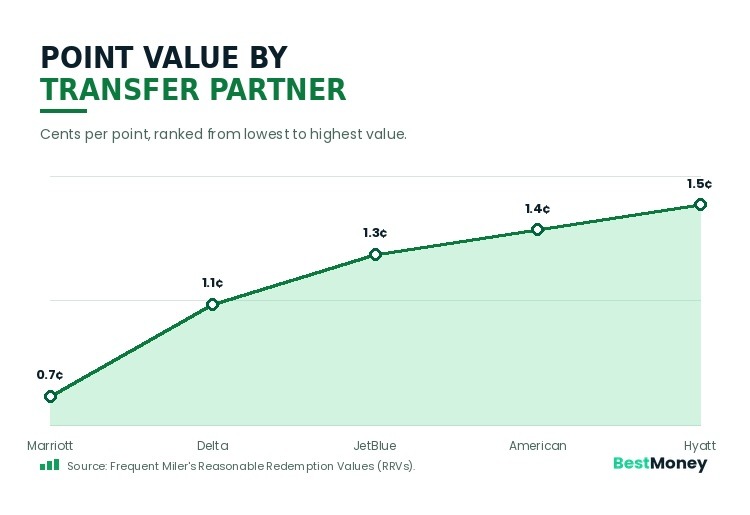
You move points at a set ratio (often 1:1) into a partner loyalty program, then book using that program's own award chart. This is where the largest value is available, particularly for premium-cabin flights and higher-end hotel stays, but it takes research, and the transfer is usually final.
BestMoney verdict: This is the highest-ceiling option and also the one most likely to go wrong without a plan. Don't transfer speculatively, confirm the award space is actually there before you move the points.
A major redemption trap is ignoring taxes and fees on award flights.
Weigh Points Against Taxes and Fees
One business class flight might cost 30,000 points but come with over $1,000 in taxes and fees, while another might cost 50,000 points but only $100 in fees. The second option is often the better deal despite the higher points cost.
Cid suggests comparing both points and out-of-pocket costs, setting a rough value target for your points, and always checking transfer partners before booking.
"Pay With Points" at Checkout
Many card, airline, and hotel apps let you cover a cash purchase with points at checkout, at a rate the app sets. It's the most convenient option and typically the lowest value outside of gift cards.
BestMoney verdict: Treat this as a last resort. If you're at the "pay with points" screen, pause and check whether a transfer or portal booking would stretch the same points further.
As earning points has gotten easier, programs have made spending them just as easy, often right at checkout, where the value is usually worse than the "cash out" value, according to Yoon. "Being able to use your bank points via Amazon, as people sometimes make a mistake in redeeming their points instead of charging the balance to their card, as they didn't pay attention to the checkout pages," he says.
Gift Cards and Merchandise
You trade points for a gift card or physical item, generally at the lowest rate of any redemption option.
BestMoney verdict: Skip this unless you have a small points balance that isn't worth the effort of a better redemption, or a card that has no other redemption option.
How Do You Choose the Right Redemption for You?
Fly or stay in hotels a few times a year and want simplicity: Stick to statement credits or the card's travel portal. The value gap versus transferring usually isn't worth the research time for occasional travel.
Chasing premium-cabin flights or high-end hotel nights: Learn your card's transfer partners and their award charts. This is where transferring pays for the time it takes. Ourtravel credit card guide breaks down which cards give you the most useful partners.
Prefer cash back over travel: Most of the transfer-partner strategy here won't apply to you, and that's fine. Focus on statement credits, and avoid gift cards, which is still an easy way to lose value even on a cash-back-style card.
Three questions to ask before you redeem:
What's the cash price of what I'm about to book, and what does that make my points worth per point?
Is there a transfer partner that would stretch this further, and is the award space actually available?
Am I redeeming because it's the best value, or because it's the easiest button to click?
What Mistakes Do Cardholders Make Most Often?
According to Yoon, a few common blunders show up again and again:
Not staying flexible: Premium cabin availability has gotten harder at the lower rates because airlines have been successful in selling those seats to cash-paying customers, he says, so flexibility on dates, routing, and airline is essential.
Not "gardening" your reservations: Check your booking every four weeks after you book. "Schedule changes can happen and airlines don't always reissue the tickets properly," which can leave you scrambling at the check-in counter, he explains. On the upside, if your flight drops in price under dynamic pricing, you can sometimes rebook and pocket the points difference for a future trip.
Not reviewing your confirmation right after booking: Most airline programs give a 24-hour free cancellation window. Catch a wrong date or misspelled name in that window, and it's an easy fix. Miss it, and "these changes become more difficult later on," he says.
Is a Cash-Back Card a Better Fit Than Points?
Not everyone should bother optimizing points at all. It's a fair question to ask before you sink time into transfer partners and award charts.
The Case Against Points
Charles Sachs, CFA, CPA, CEO atImperio Wealth Advisors, argues that a straightforward 2% cash-back card often beats the hassle. "It can be difficult to consistently get more than 2% of real value from credit card points, especially once you factor in redemption restrictions, changing valuations, and the effort required to maximize them," he says. "You know exactly what you're earning, there are no points to track or optimize, and you can use the cash however you want."
If You Keep Points, Don't Let Them Sit
Catherine Valega, CFP®, CAIA, EA atGreen Bee Advisory, cashes hers out on a schedule instead of waiting for the perfect redemption. "If you can, cash in on all points at year-end, which you can put toward holiday expenses," she says. "Depending on your accumulated points, it can be several hundred dollars to several thousand accumulated for use at holiday time."
Your Next Steps for Using Your Points
Check the value of what you already have: Log into your card's rewards portal and compare the cash value of your top two redemption options before you click anything.
Compare cards if you're still choosing where to earn points: BestMoney'stop rewards credit cards can help you find one whose points fit how you actually travel.
See how you stack up against other cardholders: BestMoney'ssurvey on travel rewards going unused found 45.1% of travel cardholders let points expire unused, and fewer than half have ever transferred to a partner program.
When it comes to making the most of your credit card points, flexibility is one of the most powerful tools anyone playing this game has at their disposal, says Romito.
Your Questions, Answered (FAQs)
What's the best way to redeem credit card points?
It depends on your points balance and how much research time you're willing to spend. Transferring to an airline or hotel partner usually delivers the most value, but statement credits or the card's travel portal are solid, low-effort options if you want simplicity.
Is it better to use points for cash back or travel?
Travel redemptions almost always beat cash-like options such as gift cards or "pay with points" at checkout. If your card only offers cash back, statement credits are typically your best option among cash-like redemptions.
Do credit card points expire?
It depends on the program, and it's getting less common. Only 2.8% of credit card accounts forfeited any rewards in Q4 2024, down from 4.8% in 2015, as more issuers move toward non-expiring rewards. Chase Ultimate Rewards and American Express Membership Rewards don't expire as long as the account stays open, but check your specific card's terms either way.
How much is one credit card point actually worth?
Most issuers price a point around 1 cent for cash-like redemptions, but the real value ranges from about 0.4 cents (gift cards) to 3 cents or more (premium travel transfers), depending entirely on how you redeem it.
Should I transfer my points before I have a specific trip booked?
Generally, no. Points sitting in a transfer partner's program are exposed to that program's futuredevaluations, and speculative transfers lock you into one program's options instead of keeping your choices open, says Yoon. The exception: if you redeem through the same program often and a transfer bonus is running, moving points ahead of a trip can pay off, but that's mainly for people who already know their redemption patterns well.
Can I combine points from different cards or programs?
Most transferable-points programs (Chase,Amex,Citi,Capital One) let you pool points across cards within the same issuer's ecosystem. However, you generally can't combine points across different issuers or unrelated loyalty programs.
Why Trust BestMoney?
BestMoney exists to make financial decisions less overwhelming. Our editorial recommendations are informed by original survey data, research, the latest .gov financial reports, and credit card expert insights.
This article was fact-checked by Jackie Lam, a personal finance writer based in Los Angeles and an accredited AFC® financial counselor. She specializes in helping artists, freelancers, and gig economy workers with their finances, with in-depth experience writing about budgeting, investing, frugality, and money.
Contributors:
Melissa Cid is a consumer savings expert atShopHer Media and Savings.com, and a credit card hacking enthusiast. She's been in the credit card game for years and has redeemed points for close to the equivalent of $100,000 in travel.
Chris Diadoto, CFA, CMT, CFP, founder ofWELLth Financial Planning, is a longtime credit card hacker who frequently recommends clients take full advantage of card benefits and bonuses.
Easton Price, CFP atProsperity Wealth Planning, helps clients make thoughtful financial decisions, including managing debt, paying off credit cards responsibly, and making the most of rewards.
Nick Romito is the founder ofPoints Theory, a personal finance and travel site covering points and miles, money, and intentional living. He left the corporate world in 2025 to focus on this full-time, and his insights are based entirely on his own bookings and redemptions.
Charles Sachs, CFA, CPA, CEO atImperio Wealth Advisors, helps small business owners and high-income individuals keep what they earn.
Catherine Valega, CFP®, CAIA, EA atGreen Bee Advisory, helps high earners and high-net-worth families align their spending and saving with their goals. She's a self-described "points skeptic" who has never personally used points toward travel.
Jimmy Yoon is a travel expert and Head of Points Intelligence atpoint.me, the leading award travel search platform for points and miles. Self-taught in points and miles since age 15, he previously spent over 10 years with the PointsPro team helping clients with award travel.
Expert interviews: Melissa Cid, Chris Diadoto, Easton Price, Nick Romito, Charles Sachs, Catherine Valega, and Jimmy Yoon.
Editorial Note: This content is not provided or commissioned by the credit card issuer. Any opinions, analyses, reviews or recommendations expressed in this article are those of the author alone, and may not have been reviewed, approved or otherwise endorsed by the credit card issuer. This site may be compensated through a credit card issuer partnership.
Written byBestmoney Staff
The BestMoney editorial team is composed of writers and experts covering a full range of financial services. Our mission is to simplify the process of selecting the right provider for every need, leveraging our extensive industry knowledge to deliver clear, reliable advice.