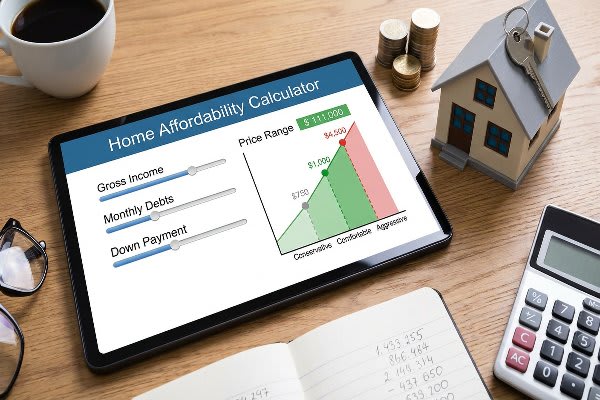
Your income and debts set a max monthly payment. Here's how to use the calculator and read every number in your results.
Written by
Bestmoney Staff
The BestMoney editorial team is composed of writers and experts covering a full range of financial services. Our mission is to simplify the process of selecting the right provider for every need, leveraging our extensive industry knowledge to deliver clear, reliable advice.
Use this home affordability calculator to turn your income, monthly debts and down payment into a home price you can realistically afford. Below, we walk through each field, explain every number in your results and show how lenders read the same math.
Rates matter here. The 30-year fixed rate averaged 7.28% on Oct. 1, 2026, up from 6.34% a year earlier, perFreddie Mac's Primary Mortgage Market Survey. That means the same income buys less house than it did a year ago.
Once you have a price range, you cancompare mortgage lenders to see which rates and terms fit your budget.
Key Insights
The calculator finds your max housing payment from your income and debts, then turns it into a home price.
The calculator caps total monthly debt at 36% of your gross income, including housing.
Rates near 7.28% (Freddie Mac, Oct. 2026) mean your income buys less home than it did a year ago.
Fannie Mae allows total DTI up to 45% (manual) or 50% (automated) for some borrowers, so a lender may approve more than feels comfortable.
Budget separately for closing costs, maintenance and utilities. The calculator doesn't include them.
Your Info:
Loan info
7.28
%
Other Costs
How this home affordability calculator works
This calculator estimates your realistic home buying power by balancing your income, debts, and mortgage terms to find a comfortable monthly payment. It uses a standard 36% debt-to-income (DTI) ratio benchmark to gauge affordability. The final estimate considers your pretax income, existing debt load, down payment, chosen loan rates and terms, plus ongoing property costs like taxes and insurance.
Uses your income, debts and expenses to estimate a debt-to-income ratio
Assumes a fixed-rate mortgage with level monthly payments over the full term
Includes estimates for property taxes, insurance, HOA fees and PMI if provided
Does not account for closing costs, maintenance, repairs or future income changes
Tip: Treat this as a starting point, not a final approval amount. Before you make an offer on a home, talk with a lender or mortgage broker to get preapproved and confirm how much you can safely borrow.
Your Info:
Enter your details to see how much house you can afford
Fill in your income, monthly debts, expenses, down payment, interest rate and loan term to estimate an affordable home price and monthly mortgage payment.
Tip
Make sure all fields are filled in with realistic values for your situation. If you’re not sure about property taxes, insurance or HOA fees, start with estimates and adjust as you learn more.
Home affordability calculator results are estimates for general informational purposes only and are not financial, lending, legal, or tax advice. This tool is not a mortgage quote, offer to lend, pre-approval, or credit decision. Estimates are based on the information you enter and certain assumptions and may not reflect your actual costs or eligibility, including closing costs, lender fees, maintenance/repairs, utilities, or changes to taxes/insurance/HOA/PMI. Actual loan amounts, rates, down payments, and approval decisions are determined by individual lenders based on your full application and credit profile and are not guaranteed. Review your budget carefully and consult a qualified mortgage professional before making decisions.
How Do You Use the Home Affordability Calculator?
Fill in your details, and the calculator finds the most you can spend on housing and the home price it supports. You don't need to enter a payment unless you want to test a lower one.
Enter your income and debts. Add your annual pretax income and your monthly debt payments, such as car loans, student loans, personal loans and credit card minimums.
Add your other regular bills. Put costs like childcare or insurance premiums in Monthly recurring expenses. They count toward your total monthly commitments, even though lenders may not see them on your credit report.
Enter your down payment. Use only the cash you'll have left after closing costs, not your total savings.
Set your loan terms. Change the interest rate to one a lender has quoted you. The field starts at 7.28%, the Oct. 1, 2026, Freddie Mac average. Then pick your loan term, such as 30 years.
Enter your monthly property taxes, homeowners insurance and HOA fees. Use numbers for the area where you plan to buy.
Add PMI if you're putting less than 20% down. The calculator doesn't estimate private mortgage insurance for you, so ask a lender for a monthly figure. For an FHA loan, enter the monthly mortgage insurance premium here instead.
Choose a target payment, if you want one. Leave Target monthly payment (optional) at 0 to see your max. Or enter a lower payment you'd prefer. If your target is higher than your max, the calculator uses your max instead.
One more tip: property taxes and insurance are entered as fixed dollar amounts. If your home price changes a lot, update them so your payment stays accurate.
How Do You Read Your Results?
Your results show the housing payment the calculator used, the home price it supports and the 36% limits behind it. Here's what each line means.
Result
What it means
Affordable Home Price
Your loan amount plus your down payment.
Loan needed
How much you'd borrow, based on your principal and interest payment, rate and loan term.
Monthly mortgage payment
The housing payment used for your home price: your target or your max, whichever is lower. It includes taxes, insurance, HOA fees and PMI.
Principal and interest
What's left of that payment after taxes, insurance, HOA fees and PMI. This part pays down your loan.
Total monthly commitments
Your housing payment plus your debt payments and recurring expenses.
Debt-to-income ratio
Your total monthly commitments divided by your gross monthly income.
Down payment %
Your down payment as a share of the home price.
Max total monthly payments
36% of your gross monthly income. This is the most the guideline allows for all debts combined.
Max affordable housing payment
What's left for housing after your debts and recurring expenses.
Max principal & interest
What's left for the loan itself after taxes, insurance, HOA fees and PMI.
If Max affordable housing payment shows $0, your debts and recurring expenses already use up 36% of your income. To raise it, pay down debt or cut recurring costs. A bigger down payment raises your home price, but not your max payment.
Where Should Your Numbers Come From?
The more your inputs match real quotes and local costs, the closer your result will be to what you'll actually pay.
What Interest Rate Should You Enter?
Enter the rate a lender has quoted you, if you have one. If not, use a current average. The 30-year fixed averaged 7.28% in Freddie Mac's Oct. 1, 2026, survey.
Your actual rate depends on factors like credit score, debt levels, loan type and down payment size. Borrowers with stronger credit profiles generally qualify for lower rates. If your quote looks high, review theseways to get a lower mortgage rate.
How Should You Estimate Taxes, Insurance and HOA Dues?
Use local numbers whenever you can. Property taxes and insurance vary widely by state and city. Check recent tax bills for homes in your target area, and ask an insurance agent for a quote.
Which Monthly Debts Should You Include?
Start with the debts on your credit report. Lenders typically count recurring debts, many of which appear on your credit report, according toFannie Mae's monthly debt guidelines.
Your real budget also includes costs like childcare, subscriptions and retirement contributions. Adding them to Monthly recurring expenses gives you a more realistic picture of what you can comfortably afford. Because debts weigh heavily in your result, it helps to understandhow your debt-to-income ratio affects your mortgage.
What Is the 28/36 Rule, and How Does the Calculator Use It?
The 28/36 rule is a budgeting guideline that keeps housing at or below 28% of gross monthly income and all debt at or below 36%. It's built on your debt-to-income ratio (DTI), the share of your gross monthly income that goes to debt payments.
Think of your monthly income as a pie. DTI shows how big a slice your debts take before you pay for groceries, savings or anything else. The rule suggests:
No more than 28% of gross monthly income on housing costs (mortgage, taxes, insurance, HOA).
No more than 36% on total monthly debt payments, including housing.
The calculator applies the 36% limit only. It subtracts your debts from 36% of your income and gives you the rest as your max housing payment. It doesn't check the 28% housing limit separately, so if you have little or no debt, your max housing payment can go above 28%.
For example, with a gross monthly income of $7,000, 28% is $1,960 for housing and 36% is $2,520 for total debt. If your non-housing debts are $600 per month, that leaves $1,920 for housing under the 36% limit. Here the 28% and 36% limits land close together. With no debt, the 36% limit would allow $2,520 for housing, well above the 28% figure.
If you want the stricter budget, check that your housing payment stays at or below 28% of your gross monthly income. TheCFPB's guide to deciding how much to spend on a home suggests setting your own comfortable housing budget before you shop.
What DTI Do Mortgage Lenders Actually Allow?
For conventional loans sold to Fannie Mae, the maximum total DTI is generally 36%. It can rise to 45% or 50%, depending on underwriting. Those limits come from theFannie Mae Selling Guide's debt-to-income ratio rules.
In plain terms, a lender may approve a bigger payment than the calculator's 36% limit suggests. Fannie Mae's limits apply to your total DTI, and the guide doesn't set a separate cap on housing costs alone.
Underwriting path
Max total DTI
Conditions
Manual underwriting
36%
Standard maximum
Manual underwriting
45%
Borrower meets credit score and reserve requirements
Desktop Underwriter (automated)
50%
Loan is underwritten through Fannie Mae's Desktop Underwriter
Beyond ratios, lenders also consider:
Cash reserves: Savings left after closing, often measured in months of mortgage payments.
Credit profile: Credit score and how much of your available credit you use.
Down payment and its source: How much you put down and whether funds are your own savings or documented gifts.
How Much House Can You Afford on Your Salary?
On a $100,000 salary with no other debt, BestMoney's calculation puts your home price near $347,000 under the 28% housing guideline, or about $446,000 at the calculator's 36% limit. BestMoney ran the same math for other common salaries, using these assumptions:
A 30-year fixed rate of 7.28%
A 20% down payment, so no PMI
Taxes and insurance estimated at 1.5% of the home price per year (our assumption, not a cited figure)
No HOA dues or other monthly debt
BestMoney's Calculation: Home Affordability by Income, 2026
Annual salary
Home price at 28% for housing
Home price at 36% for housing (calculator max, no debt)
$50,000
About $174,000
About $223,000
$75,000
About $260,000
About $335,000
$100,000
About $347,000
About $446,000
$150,000
About $521,000
About $669,000
The gap between the two columns is the difference between a comfortable budget and the most the calculator allows. Treat these figures as starting points. Existing debt, a smaller down payment with PMI, or HOA dues would lower them. Enter your own debts, down payment and local costs in the calculator above for a personal estimate.
How Do Your Rate and Down Payment Change Your Budget?
A higher rate shrinks the loan your monthly budget can support, while a bigger down payment adds to the price you can pay.
How Much Buying Power Does a Higher Rate Cost You?
A rate jump from 6.5% to 7.28% can cut about $30,000 from your loan amount. Say you can spend $2,500 a month on principal and interest on a 30-year fixed mortgage.
At 6.5%, that payment supports a loan of about $395,500, according to BestMoney's calculation. At 7.28%, the same payment supports about $365,400. That's why it pays to enter a real quote from a lender.
Yes, your loan type shapes your DTI limits, down payment and loan size, so it can shift your price range.
How Do Conventional Loans Affect Your Budget?
Conventional loans follow the Fannie Mae DTI limits covered in the lender section above. Loan size matters too.
The 2026 baseline conforming loan limit for a one-unit home is $832,750, according to theFHFA's 2026 conforming loan limit announcement. If you need to borrow more in most areas, you'd generally look at a jumbo loan.
What Should You Know About FHA Loans?
The CFPB points borrowers making a low down payment toward options such as FHA loans, as noted in its PMI explainer.HUD Handbook 4000.1 sets FHA underwriting standards.
To estimate an FHA loan in the calculator, enter your planned FHA down payment and put the monthly mortgage insurance premium in the PMI field. Then ask lenders how they apply HUD's standards to your file.
How Do VA Loans Change What You Can Afford?
VA loans often let eligible borrowers buy with no down payment, according to theVA's purchase loan guidance. That applies when the sales price isn't higher than the appraised value, which can put a home in reach sooner. Learnhow a VA loan works before you set your budget.
What Costs Doesn't the Calculator Include?
The calculator doesn't include closing costs, maintenance, repairs, utilities or future changes to your income. First-time buyers often underestimate these costs. To avoid surprises, plan separately for:
Closing costs: Fees and prepaid items you pay when you close. Set this cash aside before you decide how much to enter as your down payment.
Maintenance and repairs: Costs vary with the home's age and condition, with older homes often needing more.
Utilities: Heating and cooling a larger space typically costs more than renting, especially in extreme climates.
HOA dues: Monthly association fees and special assessments can change over time.
Transportation: Longer commutes or additional vehicles can significantly increase annual costs.
Many people use their calculator result as a ceiling rather than a target. Choosing a less expensive home may leave budget room for goals like retirement contributions and emergency savings, depending on your circumstances.
If you carry high monthly debt, pay it down before stretching your DTI.
If you're a veteran or service member, check whether a VA loan lowers your upfront costs.
If you're moving up, count expected sale proceeds from your current home toward your down payment.
Your Questions, Answered (FAQs)
How much house can I afford with a $100,000 salary?
BestMoney's calculation puts it near $347,000 if you keep housing at 28% of gross income, or about $446,000 at the calculator's 36% limit. Both assume a 7.28% rate, 20% down and no other debt.
Why is my home price lower when I enter a target payment?
Your home price is based on your target or your max, whichever is lower. A target below your max means a smaller loan, so a lower price. Leave the target at 0 to see the most you can afford.
Is the 28/36 rule what lenders use to approve me?
No. It's a budgeting guide, and Fannie Mae allows total DTI up to 45% or 50% for some conventional borrowers.
Do I need 20% down to buy a home?
No. Many loans allow less than 20% down, though conventional loans with less down may require PMI.
Should I include bonuses or overtime in my income?
No. A calculator gives you an estimate, while a lender preapproval verifies your income, credit and assets.
Why Trust BestMoney on This?
We built this guide on primary sources, our own survey and our own calculations, and we state every assumption.
BestMoney's editorial team reviewed Freddie Mac's rate survey, FHFA's 2026 loan limits, CFPB homebuying and PMI guidance, HUD's FHA handbook and the VA's purchase loan guidance. We checked Fannie Mae's Selling Guide on DTI (B3-6-02), monthly debts (B3-6-05), income (B3-3.1-01) and bonus income (B3-3.3-02).
We also drew on our July 2026 survey of 1,055 respondents on homeownership beliefs. Our salary and rate examples use a 30-year fixed loan, 20% down and 1.5% yearly taxes and insurance.
The BestMoney editorial team is composed of writers and experts covering a full range of financial services. Our mission is to simplify the process of selecting the right provider for every need, leveraging our extensive industry knowledge to deliver clear, reliable advice.