Americans took out a record 8.41 million unsecured personal loans in the second quarter of 2026, up 22.7% from a year earlier, according to TransUnion’s Q3 2026 Credit Industry Insights Report. TransUnion says that growth is “being fueled by a larger number of smaller loans, particularly among subprime consumers.” Subprime borrowers are those with lower credit scores.
In my experience covering personal loans, borrowers with lower credit scores often face higher origination fees, as well as higher interest rates. By comparing APRs across your offers, not just interest rates, you see the full cost before you agree.
Here’s how APR works, how it differs from your interest rate, and how to compare offers.
Key Insights
- APR is the number to compare because it includes upfront fees, so a 12% loan with a 5% origination fee (about 15.6% APR) can cost more than a 14% loan with no fee.
- APR assumes you’ll keep the loan for the full term, so a no-fee loan may come out ahead if you plan to pay it off early.
- Your credit score, income, loan term, and lender can all affect your APR.
- An origination fee usually comes out of your loan, so you may receive less cash than you borrow.
What Does APR Mean on a Personal Loan?
APR stands for annual percentage rate. According to the Consumer Financial Protection Bureau (CFPB), it’s “a measure of the interest rate plus the additional fees charged with the loan,” including origination charges and other fees charged when the loan is made.
Lenders don’t get to pick whether to show you this number. The federal Truth in Lending Act requires them to disclose the APR before you finalize the loan, and every lender follows the same federal rules to calculate it. That makes it useful for lining offers up side by side.
Good to Know: Your APR appears on a Truth in Lending disclosure, along with a line labeled “Amount Financed.” That’s the net amount of credit you receive after any upfront fees. It may be lower than the amount you applied for if the lender deducts an origination fee upfront.
Most types of personal loans have a fixed APR, meaning the rate stays the same for the life of the loan and your monthly payment won’t change. That predictability is one reason some people choose a personal loan over a credit card, where the rate can change and the balance can keep growing.
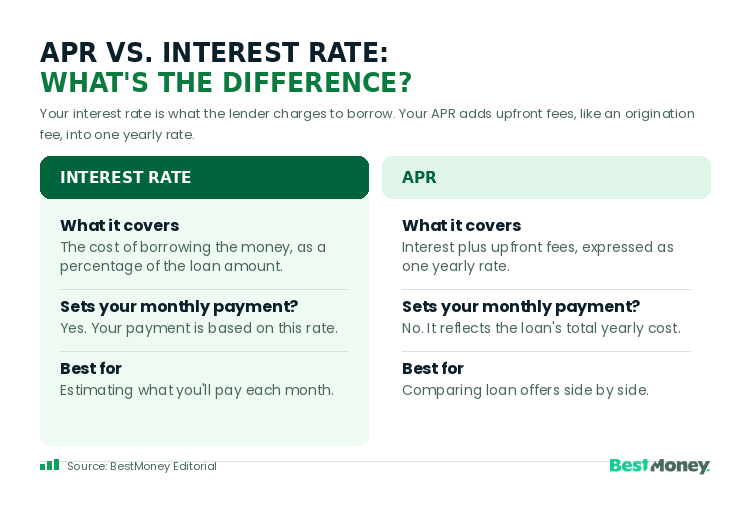
APR vs. Interest Rate: What’s the Difference?
Your interest rate is what the lender charges you to borrow the money. Your APR combines the interest rate with upfront fees, such as an origination fee, and expresses the total as a yearly rate.
“The interest rate tells you the price of the money. The annual percentage rate (APR) tells you the price of the loan,” said Ali Zane, credit expert and CEO of Imax Credit Repair. If a lender doesn’t charge an origination fee, the APR and the interest rate will be the same, so a sizable gap between the two is your cue to look closely at the fees.
How Do Fees Change the Real Cost of a Personal Loan?
An upfront fee can make a loan with a lower interest rate cost more overall, and it can shrink the cash you receive. The biggest fee on most personal loans is the origination fee, a one-time charge for processing the loan. It’s usually a percentage of what you borrow, and many lenders deduct it from your loan before you receive the money.
Here’s an example. You want to borrow $10,000 over three years and get two offers:
- Loan A: 12% interest rate with a 5% origination fee. The lender keeps $500, so you receive $9,500, but you still repay the full $10,000 plus interest. The APR works out to about 15.6%.
- Loan B: 14% interest rate with no fees. You receive the full $10,000, and the APR is 14%.
Loan A looks cheaper at first glance because of its lower rate, and that rate does save you about $350 in interest over three years. But the $500 fee leaves you about $150 behind, and you get $500 less cash. If you compared only interest rates, you’d pick the more expensive loan.
Timing matters, too. “If you think you will pay the loan off early, a slightly higher interest rate without an [origination] fee may actually save you money,” said David Kassir, a fiduciary financial advisor and managing director of Manna Wealth Management. “It all depends on your plans.”
The Expert Tip: If you need a specific amount in hand (say, $10,000 to cover a bill) and your lender deducts the fee upfront, you may need to borrow a little more to end up with enough. A personal loan calculator can show how an origination fee affects your payment and total cost.
What Is a Good APR for a Personal Loan?
A “good” APR depends a lot on your credit, but a few benchmarks can help:
- Personal loan average: The Federal Reserve puts the average rate on a two-year bank personal loan at 11.90% as of August 2026. An offer at or below that may be competitive.
- Credit card average: The average credit card rate at commercial banks was 21.19% across all accounts over the same period.
- The 36% limit: The National Consumer Law Center describes 36% as the dividing line between affordable small-dollar loans and “unaffordable, potentially predatory ones.” The Military Lending Act also caps most consumer loans to active-duty service members and their families at 36%, including most fees.
A gap like the one between a personal loan and a typical credit card APR may be a big reason so many people use personal loans to pay off credit card debt.
From My Experience: Years ago, I took out a personal loan to pay off a high-interest credit card because I wanted a fixed payment and a set payoff date. My card balance had lowered my credit score, so I had to shop around for a good offer. The rate I got was in the single digits, compared with roughly 22% on my card, though rates were generally lower back then.
What Affects the APR You’re Offered?
Lenders look at several factors to decide how risky it is to lend to you. The lower the risk, the lower your APR is likely to be.
- Your credit score: This is usually the biggest factor. Borrowers with strong credit tend to qualify for the lowest rates, while those with fair or poor credit typically pay more.
- Your income and existing debt: Lenders want to see that you can comfortably afford a new payment. A lower debt-to-income ratio (the share of your monthly income that already goes toward debt) can help.
- Loan term: Shorter loans often come with lower rates, though your monthly payments will be higher.
- Loan amount: Some lenders price small or very large loans differently.
- Collateral: A secured loan backed by something like a savings account may come with a lower APR, because the lender takes on less risk.
Every lender weighs these factors differently, so the same borrower can get noticeably different offers. Reviewing the common personal loan requirements before you apply can show you what to improve first.
How to Compare Personal Loan APRs
Keep these points in mind when you line up offers:
- Prequalify with several lenders: Many lenders let you check your likely rate with a soft credit check, which doesn’t affect your credit score the way the hard inquiry does that lenders use when you formally apply. Credit expert Ali Zane suggests getting at least three loan estimates and comparing them by APR first.
- Compare loans that match: APRs are only a fair comparison when the loans are similar. An upfront fee is spread over the life of the loan, so the same fee makes a five-year loan’s APR look lower than a three-year loan’s.
- Check the fine print on fees: See whether an origination fee is deducted from your loan or added to your balance. Prepayment penalties and late fees aren’t included in the APR, so check for those too, especially if you plan to pay the loan off early.
- Look past the monthly payment: The payment needs to fit comfortably in your budget, but a lower payment can hide a more expensive loan, so compare how much you’ll repay in total, too.
- Watch for scam signals: A lender that won’t clearly show you the APR, or that asks for a fee before you’re approved, could be running a personal loan scam.
Bottom Line
The APR is often the most useful number on a personal loan offer, because it combines the interest rate and upfront fees into one figure. A lower interest rate doesn’t always mean a cheaper loan, especially if the origination fee is large.
Before you sign, compare APRs from a few lenders, check how any fees are charged, and make sure the monthly payment fits your budget. If your APR is higher than you expected, you can ask the lender to explain why, since your rate depends on your credit and finances.
If you’re unsure whether a personal loan fits your situation, a licensed financial professional may be able to help you weigh your options.
Your Questions, Answered (FAQs)
Is APR the same as the interest rate on a personal loan?
Not always. The APR includes the interest rate plus any upfront fees, like an origination fee. If a loan has no fees, the two numbers will typically be the same.
Does a personal loan’s APR change over time?
Most personal loans have a fixed APR, so it stays the same for the life of the loan. Some lenders offer variable-rate loans, which can rise or fall, so check the loan terms before you sign.
What is a good APR on a personal loan?
It depends on your credit, but an APR at or below the national average may be competitive. The Federal Reserve reported an average rate of 11.90% for 24-month bank personal loans in August 2026. If you have fair or poor credit, lenders typically charge a higher rate to offset the added risk.
Does checking my personal loan rate hurt my credit?
Usually not. Prequalifying typically uses a soft credit inquiry, which doesn’t affect your credit score, and the lender shows you a ballpark rate. If you move forward with a formal application, the lender will usually run a hard inquiry, which appears on your credit report and may lower your score slightly for a short time.
Can I lower my personal loan APR?
You may be able to qualify for a lower APR by improving your credit score, paying down existing debt, choosing a shorter term, adding a creditworthy co-borrower, or choosing a secured loan. Comparing offers from several lenders can also help, since the same borrower can get different APRs from different lenders.
Why Trust BestMoney on Personal Loans
Maya Dollarhide is a personal finance writer with more than a decade of experience covering personal loans, consumer lending costs and credit. Her work has appeared in Yahoo Finance, Investopedia, MarketWatch, and other national publications.
Together with BestMoney's rigorous editorial standards, this guide provides an unbiased, accurate and practical roadmap to help you compare personal loan offers with confidence and choose the one that truly costs you less.
Where We Got Our Information
- Board of Governors of the Federal Reserve System, Consumer Credit – G.19, commercial bank interest rates, August 2026
- Consumer Financial Protection Bureau, What is the difference between a loan interest rate and the APR?, last reviewed Aug. 28, 2026
- Consumer Financial Protection Bureau, You have rights under the Military Lending Act
- Federal Trade Commission, Truth in Lending Act
- Federal Deposit Insurance Corporation, What is a truth in lending disclosure?
- TransUnion, Credit access expands as lenders pair growth with more strategic risk management (Q3 2026 Credit Industry Insights Report), Nov. 5, 2026
- National Consumer Law Center, Why cap interest rates at 36%?, Aug. 4, 2021