Survey: 85% of Americans Are Comfortable Getting a Personal Loan Online
Survey: 85% of Americans Are Comfortable Getting a Personal Loan Online
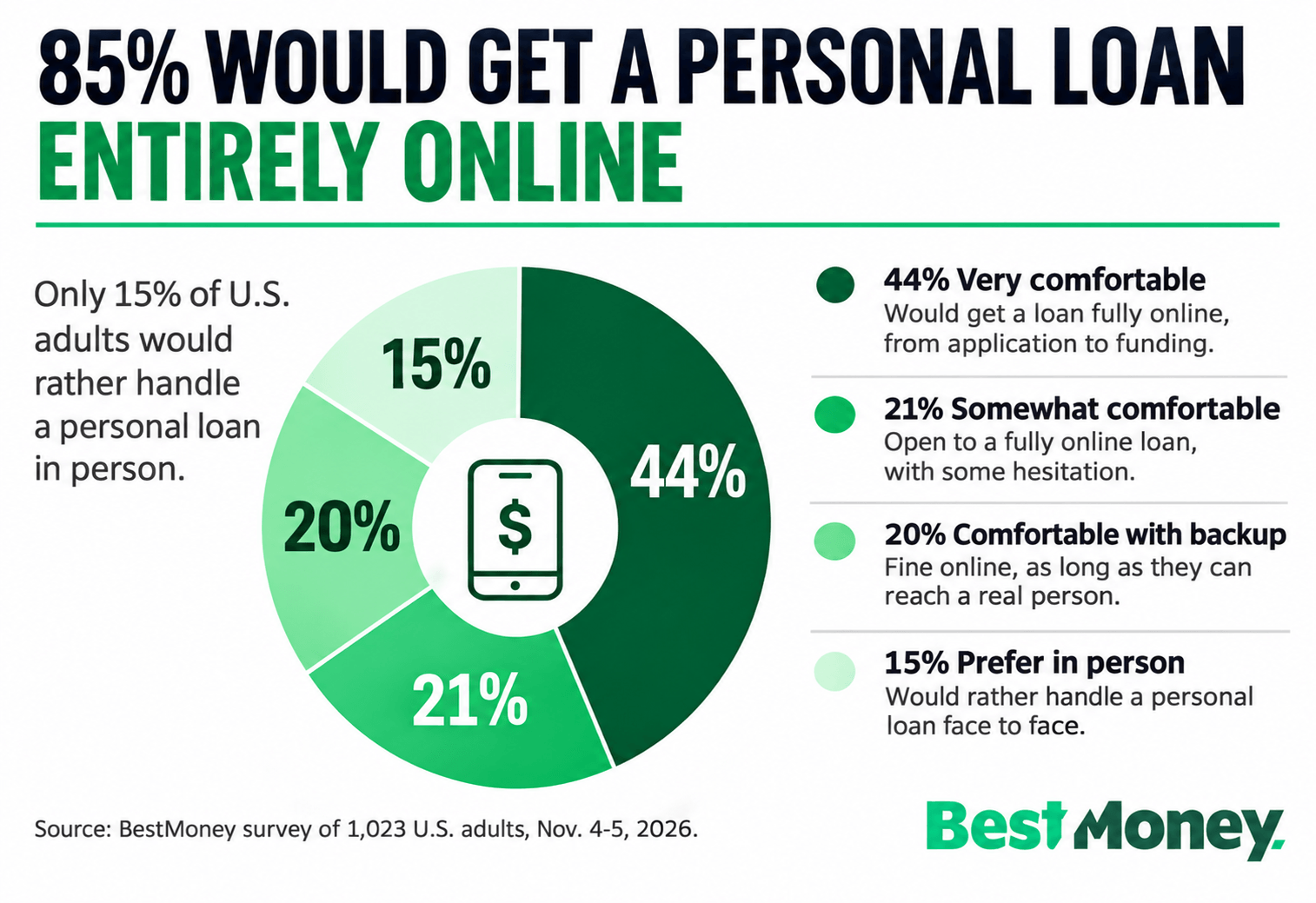
According to our survey, 85% of U.S. adults would be comfortable getting a personal loan entirely online, and two in three are open to AI helping with the application.
Written by
Maya Dollarhide
Maya Dollarhide is a writer specializing in personal finance, with a special focus on student loans and debt consolidation and management. She has written for Yahoo Finance, Investopedia, Student Loan Hero, Bankrate, and other publications.
Getting a personal loan no longer means sitting across a desk from a loan officer. In a new BestMoney survey of 1,023 U.S. adults, just 15% said they’d rather handle a personal loan in person.
This may set a new baseline for anyone shopping for a loan. Rate checks that don’t affect your credit, fast decisions, and the ability tocompare personal loan offers side by side are increasingly common among online lenders, so borrowers who are comfortable applying online may have little reason to settle for less.
Here’s what borrowers told us they expect from online lending, and what it means for how you shop.
Key Insights
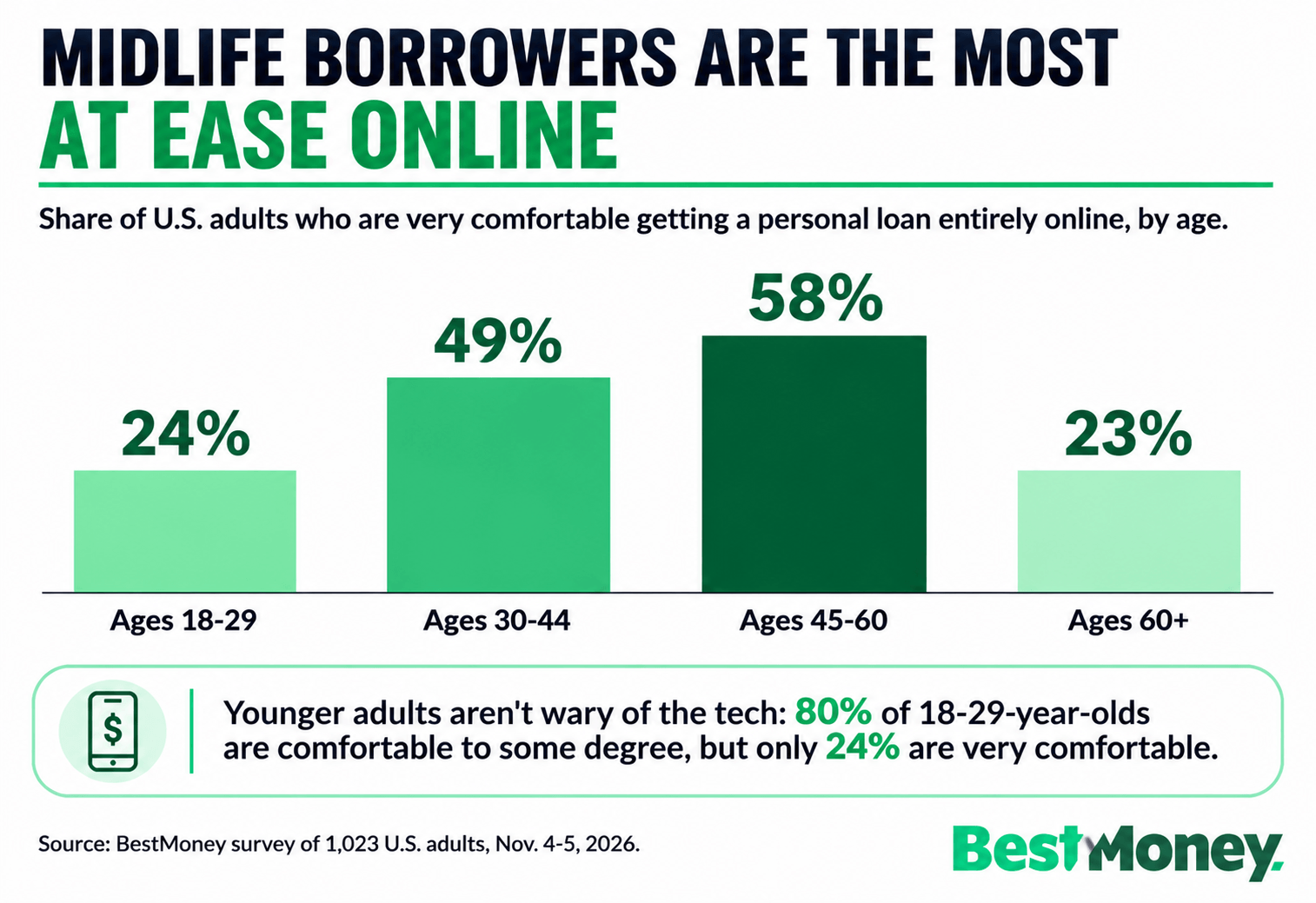
Respondents ages 45 to 60 are the most likely to be “very comfortable” borrowing online (58%), more than double the rate of those ages 18 to 29 (24%).
The youngest and oldest borrowers are about equally cautious, with 24% of ages 18 to 29 and 23% of ages 60 and older “very comfortable.”
Seeing a rate without a credit hit is the top perk of applying online (35%), just ahead of fast approval and funding (33%).
Two-thirds (67%) are open to AI help with an application, but only 22% would apply directly with a lender an AI recommended.
How Comfortable Are Borrowers With Online Personal Loans?
When we asked how comfortable people would be getting a personal loan entirely online, from application to funding, most were on board. For many, though, that comfort depends on having help available.
For one in five respondents, online is fine as long as a real person is reachable if a question or problem comes up. If that matters to you, check for phone, chat, or email support on a lender’s site before you apply, especially if you’re a first-time online borrower.
58% of Borrowers Ages 45 to 60 Are “Very Comfortable” Borrowing Online
You might expect the youngest borrowers to be the most comfortable going fully online. Instead, midlife respondents were the most at ease, and the youngest were about as cautious as those 60 and older (24% and 23% “very comfortable”).
Age group
“Very comfortable” with a fully online loan
Comfortable to any degree
18–29
24%
80%
30–44
49%
93%
45–60
58%
89%
60+
23%
68%
Why Younger Borrowers May Be More Cautious
This suggests younger respondents’ caution isn’t about the technology. Most of them (80%) are comfortable to some degree, but far fewer are very comfortable.
Younger adults may also be just starting to build credit. In 2020, about7 million U.S. adults had no credit record at all, and roughly 1 in 10 more had a file too thin or inactive to generate a score. For someone who has never taken out a loan, a fully online process with no one to walk them through it may feel like a bigger leap.
Why Midlife Borrowers May Be More at Ease
Borrowers in midlife may find a loan offer familiar. Many have likely been through a mortgage, car loan, or refinance before, so it may feel the same whether it arrives at a branch or on a screen. That may also help explain why this group was the most likely to call an AI assistant helpful, which we cover below.
Established Credit Makes Prequalifying Easier
These borrowers tend to have established credit and income, which makes them well suited to prequalification, and they often face life events such as tuition, consolidating higher rate card balances, and helping family. They are also comfortable enough with digital banking that the process is not a barrier.
Logan SheddFounderRail, a business lender inside Fundwell
What Do Borrowers Like Most About Applying Online?
Nobody wants to apply for a loan only to find out the rate is too high, especially after the application has already dinged their credit. So it’s no surprise that the top perk respondents named was seeing their rate first, with fast funding a close second.
Seeing Your Rate Without a Credit Hit (35%)
Online prequalification is built for this. Ituses a soft credit inquiry to show you an estimated rate withoutaffecting your credit score. A hard inquiry, which can lower your score, typically happens only once you formally apply, so you can window-shop for rates without risking your credit.
Not every lender offers prequalification, so check the lender’s site or ask before you hit “submit.”
Getting Approved and Funded Quickly (33%)
Some lenders maydeposit your funds within one business day of approval, so applying online may get you money faster than a traditional application. Always ask upfront how fast a lender funds the loan.
Even lenders that advertise same-day funding may have caveats, such as requiring you to sign your loan agreement before a daily cutoff time.
Doing Everything From a Phone (24%)
Borrowers’ interest in phone-based applications fits a broader trend. According to a 2026 American Bankers Association survey,U.S. consumers are banking via mobile apps more than any other method for the seventh year in a row, with 44% naming apps as their top option. It makes sense that many would want their loans to work the same way.
Borrowers Want to Shop Around. Online Makes It Easier
You probably wouldn’t buy a car from the first dealership you visit, and most respondents feel the same way about loans. We asked how many lenders they’d want to compare if they could see personalized offers without affecting their credit. Only 13% said one good offer is enough, while 87% wanted to compare at least two.
Number of lenders borrowers want to compare
Share of respondents
2–3
55%
4–5
15%
As many as I can see
17%
One good offer is enough for me
13%
Rates, fees, and terms vary from lender to lender, so the first offer may not be the best fit for your budget. Comparing used to mean scheduling multiple appointments and driving from branch to branch. Now you can review prequalified offers in one sitting on your laptop or phone.
The Expert Tip: When you compare personal loan offers, line them up side by side and look at the APR, fees, loan term, and monthly payment, not just the interest rate. Also, try using apersonal loan calculator to figure out how much you can afford to borrow.
How Fast Do Borrowers Expect a Loan Decision?
In an era of one-click purchases and same-day delivery, borrowers expect speed from lenders too. Most of our respondents (85%) said they expect an answer the same day they apply, and only 16% would wait a few days.
How fast borrowers expect a decision
Share of respondents
Within minutes
35%
Within a few hours
34%
By the end of the day
16%
Within a few days
16%
Applying online may take only a few minutes if you have the information you need on hand, like tax returns or pay stubs. A quick decision doesn’t always mean quick money, though.
Payout timing depends on the lender, the information you provide, and whether extra verification is needed, and it can take another day or more for the funds to reach your account. Having yourdocuments ready before you apply can help you avoid delays on both ends.
Are Borrowers Ready to Use AI for Personal Loans?
Many are. Two-thirds of respondents (67%) are open to using an AI assistant or tools to help with a loan application, including 35% who said it would be helpful and 32% who said it’s fine as long as a person is also available. Only 26% said they’d rather deal only with people.
Openness to AI goes hand in hand with comfort online. Among respondents who are “very comfortable” getting a personal loan online, 59% said an AI assistant would be helpful, and borrowers ages 45 to 60 were again the most enthusiastic (45%).
Separately, some lenders may use AI and other complex algorithms in their underwriting. If you’re denied, federal lawentitles you to know the specific reasons, so always ask.
Most Would Treat an AI Lender Recommendation as a Starting Point
If an AI tool recommended a specific lender, 58% of respondents said they’d use it as a starting point or double-check it, and 22% would apply with that lender.
What borrowers would do with an AI lender recommendation
Share of respondents
Use it as a starting point and compare a few others
35%
Double-check it with reviews or a comparison site
23%
Apply with that lender
22%
I wouldn’t rely on an AI recommendation for this
21%
AI is already a first stop for some borrowers. About 15% said they’d turn to an AI tool first to research personal loan options, rising to 19% among those ages 30 to 44.
AI Needs Your Full Financial Picture
Consumers should use AI chatbots as a starting point in their personal loan search, but not treat their suggestions as gospel. AI chatbots are only as good as the information you provide to them. If you leave out important financial information, an AI chatbot’s loan recommendation may not be the best option for you.
Before you apply with a lender an AI tool suggests, prequalify directly with that lender to see your estimated rate, fees, and loan terms, since AI tools can’t see your credit profile or the offers a lender would make you. Then vet the lender using the steps below.
How to Choose a Trustworthy Online Lender
Borrowers’ top worries about online lenders are whether their personal information is secure (34%), whether the lender is legitimate (22%), and hidden fees or unclear terms (21%). Here are four steps to vet a lender andavoid personal loan scams before you apply.
Check the lender’s security: A secure site (HTTPS) is the bare minimum, since scammers use it too. Make sure the web address matches the lender’s name, and read the privacy policy to see whether your information is shared or sold.
Confirm the company: Search online, including Trustpilot and the Better Business Bureau. Look the lender up inNMLS Consumer Access, or ask your state’s banking regulator whether it’s licensed in your state. For an online bank or credit union, check the FDIC’s BankFind or the NCUA’s credit union locator. Search theCFPB’s Consumer Complaint Database for reported problems.
Read your full loan terms: Check your agreement for costs the APR leaves out, like prepayment penalties and late fees. If the origination fee is deducted from your loan amount, you may need to borrow a bit more to end up with the cash you need.
Review customer service options: Some online lenders offer only digital support, like email or AI-assisted chat. If you’d rather talk to a person, confirm there’s phone or live chat support, and check its hours.
The Expert Tip: The one red flag I never ignore is a lender asking me to pay before I receive my funds. Legitimate lenders may charge an origination fee, but it’s spelled out in the loan agreement and typically deducted from the loan amount, so I don’t pay it out of pocket. If a lender asks for money up front, especially by gift card, wire transfer, or a payment app, I’d stop the application and report it atReportFraud.ftc.gov.
What the Survey Means for Your Loan Search
Online personal loans have gone mainstream. The vast majority of respondents (85%) are comfortable getting a loan entirely online, and two-thirds are open to AI helping along the way. That doesn’t mean borrowers have stopped asking questions. One in five (20%) want to be able to reach a person if needed, and their top worries were whether their personal information is secure and whether the lender is legitimate.
Age was the clearest divide. Borrowers ages 45 to 60 were the most at ease, with 58% “very comfortable” with a fully online loan, and they were the most likely to call an AI assistant helpful. Only about a quarter of those ages 18 to 29 (24%) and 60 and older (23%) were “very comfortable.”
Whatever your comfort level, prequalifying lets you check your rate without affecting your credit and compare APRs and fees side by side. Before you formally apply, vet any lender, whether you found it yourself or through an AI tool, to protect yourself from scams.
Your Questions, Answered (FAQs)
Are online personal loans safe?
They can be, when they come from licensed, reputable lenders. Respondents’ top concern about borrowing online was whether their personal information would be secure (34%). To protect yourself, confirm the lender is licensed in your state through NMLS Consumer Access, and avoid any lender that guarantees approval or asks you to pay a fee before you receive your funds.
Can I prequalify for a personal loan without hurting my credit?
In most cases, yes. Prequalification usually involves a soft credit inquiry, which doesn’t affect your credit score. A hard inquiry, which can lower your score, generally happens only when you submit a formal application. It’s also the feature borrowers value most: 35% of our respondents named seeing their rate without a credit hit as the top advantage of applying online.
How long does it take to get approved for a personal loan online?
It depends on the lender. Some can decide within minutes, while others may take a day or more, especially if they need to verify your information. Most respondents (85%) expect a decision the same day they apply. Having your pay stubs, tax returns, and ID ready may help you avoid delays.
Can I use AI tools like ChatGPT to find a personal loan?
You can use them to research your options, but they can’t see your credit profile or the offers a lender would make you. Two-thirds of respondents (67%) are open to AI help with an application, and 58% would use an AI recommendation as a starting point or double-check it. Prequalify directly with lenders to see your actual rates, then vet any lender an AI suggests.
Why Trust BestMoney?
This guide was produced by BestMoney’s Personal Loans editorial team and is based on BestMoney’s original 2026 survey of 1,023 U.S. adults, “A Quick Survey About Personal Loans,” fielded Nov. 4 to 5, 2026. Respondents answered 11 questions about how they would apply for, research, and compare personal loans, including their views on online lending and AI tools. Percentages are based on respondents who answered each question, and some charts show only the top responses, so totals may not equal 100%. The guide also draws on government data and insights from personal loan and consumer lending experts.
Maya Dollarhide is a personal finance journalist who covers personal loans, debt consolidation, student borrowing, and banking. She has written for Yahoo Finance, Parents, and other national publications.
Where We Got Our Information
BestMoney, A Quick Survey About Personal Loans, survey of 1,023 U.S. adults, Nov. 4 to 5, 2026
Maya Dollarhide is a writer specializing in personal finance, with a special focus on student loans and debt consolidation and management. She has written for Yahoo Finance, Investopedia, Student Loan Hero, Bankrate, and other publications.