How to Get the Most Out of Your Credit Card Rewards
How to Get the Most Out of Your Credit Card Rewards
The habits and settings that earn more automatically, plus the one mistake that cancels them
Written by
Meagan Drew
Meagan Drew is a personal finance and loans expert at BestMoney.com. She has written for publications such as Investopedia, Apple News+, and SimpleMoneylyfe.com. With seven years of experience as a financial advisor, Meagan specializes in making complex topics like budgeting and investing accessible and engaging for everyday consumers.
By incorporating a few straightforward habits into your everyday spending, you can make the most of your credit card rewards without complicating your financial life.
In this article, we’ll explore practical strategies to optimize rewards withour best credit cards, helping you earn valuable perks while staying within your budget.
Key Insights
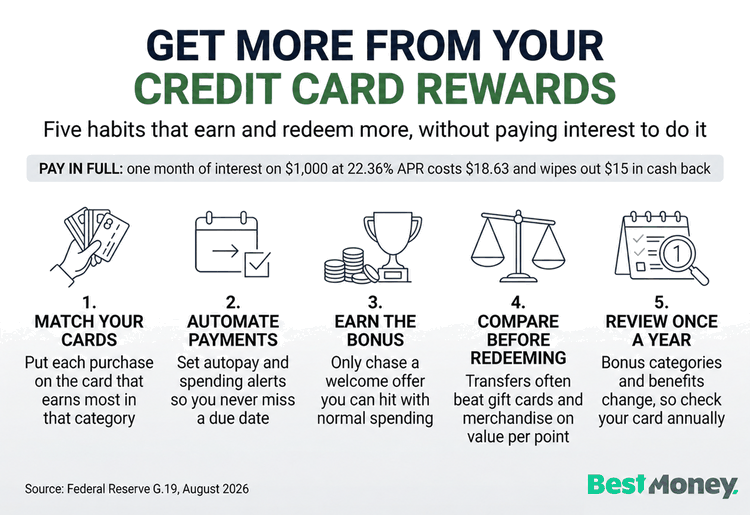
Choose the right card: There are several credit cards with attractive perks, but you should find one that fits your spending habits.
Automate and monitor: Use automatic payments to ensure you're paying bills on time and use alerts to stay on top of spending.
Redeem wisely: Points can be worth more or less depending on where you redeem. Compare your options before you cash in.
Pay in full: At the current average APR, one month of interest can outweigh a year's worth of cash back on the same purchases.
Stay informed: Card terms, bonus categories and benefits change, so review your card at least once a year.
1. Choose the Right Cards
Align Cards With Your Spending Habits
Different cards offer different perks. To take advantage of your credit card's strongest rewards, select cards with the highest reward rates for your primary spending categories. For a detailed comparison of two popular flat-rate options, check outChase Freedom Unlimited vs Wells Fargo Active Cash.
Many cards offer sign-up bonuses for new cardholders who meet minimum spending requirements.Chase Freedom Unlimited, for example, advertises a bonus after you spend a set amount in your first few months. Welcome offers change often and can vary by applicant, so confirm the current terms on the issuer's site before you apply.
These sign-up bonuses are a useful way to kickstart your rewards. However, be wary of cards with a minimum spending requirement outside your everyday spending habits.
Focus on Relevant Perks
Some cards offer perks just for being a cardholder, in addition to rewards for money spent. For example, theBlue Cash Everyday Card earns 3% back at U.S. supermarkets, on U.S. online retail purchases and at U.S. gas stations, each on up to $6,000 per year in purchases, then 1%. It also includes an $84 Disney Streaming Credit worth up to $7 a month back on an eligible Disney+, Hulu or ESPN subscription once you enroll,per American Express. The Blue Cash Preferred, by contrast, earns 6% on select U.S. streaming subscriptions and 3% on transit. Finding these niche categories is a useful way toturn spending into cash back at an accelerated rate.
Other perks from providers could include cell phone insurance or, on travel cards,travel perks like lounge access or free bags. Focus on finding perks you'll use to get the most out of your card.
2. Use Your Cards Strategically
Make it automatic: Set your credit card for recurring bills like streaming services and subscriptions to automatically earn rewards on expenses you'd pay anyway.
Look for utility opportunities: Check if your utility companies accept credit cards without processing fees. These regular payments can accumulate significant rewards over time.
Match your spending: Use specific cards based on their bonus categories—your grocery card at supermarkets, travel card for flights, and dining card at restaurants.
3. Automate Your Rewards
Even generous credit card rewards can't outpace the interest rates you'll pay from carrying high balances monthly or fees from missed or late payments. Your card should work for you and not add to your stress.
The math shows why. Say you spend $1,000 on a 1.5% cash back card and earn $15. The average APR on accounts assessed interest was 22.36% in August 2026, according to theFederal Reserve's G.19 release (Oct. 7, 2026). Carry that balance for a single month at that rate and roughly $18.63 in interest wipes out the reward.
Scenario ($1,000 in purchases, 1.5% cash back)
Rewards earned
Interest paid
Net result
Paid in full
$15.00
$0.00
+$15.00
Carried for one month at 22.36% APR
$15.00
About $18.63
About −$3.63
Simplified example: monthly interest uses 22.36% ÷ 12 (about 1.86%). Actual interest depends on your daily balance, grace period and issuer terms.
Set up automatic payments: To avoid missed or late payments, set up autopay to pay the minimum due amount, the entire balance, or a monthly custom amount.
Enable alerts: Most credit cards offer spending alerts that enable you to stay on budget and monitor spending effortlessly.
Transfer your points: Some credit cards let you automate your points transfers to loyalty programs or redemptions for statement credits. This lets you make the most of your points without adding transfers to your to-do list.
4. Take Advantage of Sign-Up Bonuses
Sign-up bonuses aren't guaranteed, but some cards have them to sway new cardholders to try them. Sign-up bonuses can give you a significant points or miles boost quickly, but they usually come with minimum spending requirements.
The allure of sign-up bonuses can be hard to fight, but only sign up for a card where you can easily qualify for the bonus without overspending. Work out whether the required spend fits what you'd buy anyway over the bonus window. If hitting it means buying things you don't need, the bonus isn't worth chasing.
5. Use Shopping Portals and Partner Programs
Many credit card companies offer online shopping partner programs that you access through their shopping portal. You can earn extra points or miles on purchases by purchasing things you would buy anyway through their portal.
Plus, some cards have bonus points or miles for spending at certain retailers. You can enroll in dining rewards programs or add deals to your card to get additional points on purchases made at participating retailers.
6. Redeem Wisely
Maximize Redemption Value
While redeeming rewards for statement credits or credits at your favorite retailer might be tempting, pay attention to redemption values. For example,travel credit card rewards can often deliver more value when transferred to a hotel or airline partner.
To maximize redemption value, find the transfer or credit that gives you the biggest payoff for your points or miles. For instance, the no-annual-feeCiti Strata Card earns 3 points per $1 on a Self-Select Category you choose,per Citi, which you can then redeem for travel or gift cards.
Avoid Low-Value Redemptions
Merchandise and gift cards often return less value per point than other options. There may be a promotion in certain instances, but overall, these won't give you the most value per point.
Keep Your Points From Expiring
Check your program's expiration and inactivity rules.American Express's Credit Intel guide notes that this depends on the program: some rewards stay active while your account is open and in good standing, while others have expiration timelines or activity rules. Set calendar reminders, or redeem small balances as statement credits when no higher-value option is coming up. Points can also lose value over time, so it's worth understandinghow to protect your points from devaluations.
7. Stay Informed
Regular Account Reviews
Card issuers earn interest on balances you carry, and they often run special promotions to encourage spending.
Periodically check your account, even if you have automated payments and points transfers, to find special offers and promotions, such as bonus points for spending in specific categories or targeted spending goals.
Review Benefits
Just because a card works for you today doesn't mean it will work for you in the future. You should periodically review your card's benefits to ensure that it's still the right fit for you and that you're maximizing all the available features. This simple audit can help you identify anyunused card benefits and decide if the card is still worth its annual fee.
Calculate how much you can earn with Your Card
Enter your average monthly spend to estimate your annual cash back.
Travel Spend
5
%
Dining Spend
3
%
Drugstore Spend
3
%
Other Spend
1.5
%
Travel Spend
See how much cash back you could earn
Enter your monthly spending
Add your estimated monthly spend in each category to instantly see how much you could earn in cash back rewards each year.
The results provided by this rewards calculator are for illustrative purposes only and are estimates based solely on the inputs provided by the user. Actual cash back or rewards earned depend on the specific terms and conditions of the credit card program, spending habits, and are subject to change by the issuer. This estimate does not account for annual fees, interest charges, or potential spending caps on bonus categories.
Key Takeaways for Effortless Rewards Maximization
Integrating simple strategies into your spending habits can make earning rewards effortless. For those just starting, our guide explainingwhat credit card rewards are can help. Always pay your monthly balance in full to avoid interest charges and prevent financial stress. Stay informed about your financial situation, card perks, and rewards updates to ensure you’re using thebest rewards credit cards for your spending habits. Redeem regularly, too, since unused points can expire.
Your Questions, Answered (FAQs)
Do credit card rewards expire?
It depends on the program. Some rewards stay active while your account is open and in good standing, while others expire on a set timeline or after a period of inactivity. Check your card's terms, and set a reminder if your program has a deadline.
How can you get more value when you redeem credit card points?
Compare the value per point across your options before you redeem. Transfers to airline or hotel partners can deliver more value than gift cards or merchandise, though the gap varies by program and by booking.
Does carrying a balance cancel out credit card rewards?
Usually, yes. At the 22.36% average APR on accounts assessed interest cited above, one month of interest on $1,000 runs about $18.63. That's more than the $15 you'd earn at 1.5% cash back on the same spending.
Is it worth having more than one rewards credit card?
It can be, if you track each card's bonus categories and pay every card in full. Pairing a flat-rate card with a category card is one common setup.
Why Trust BestMoney?
This guide was written byMeagan Drew, a personal finance and loans expert at BestMoney who spent seven years as a financial advisor. Her work has appeared in Investopedia, Apple News+ and SimpleMoneyLyfe.
Every rewards rate, fee and card benefit named in this guide links to the issuer's own terms page or to a federal data source, so you can check it yourself.
Where We Got Our Information
BestMoney's editorial team reviewed the current issuer terms pages for every card named in this guide on October 29, 2026. Rewards rates and benefits change without notice, so confirm current terms before you apply.
Disclosure: The credit card offers and information presented on this page are current as of the published date. However, credit card terms, including APRs, fees, and promotional offers, are subject to change without notice. Some offers listed may no longer be available or may have expired. Please refer to the issuer's website for the most up-to-date terms and conditions.Editorial Note: This content is not provided or commissioned by the credit card issuer. Any opinions, analyses, reviews or recommendations expressed in this article are those of the author alone, and may not have been reviewed, approved or otherwise endorsed by the credit card issuer. This site may be compensated through a credit card issuer partnership.
Written byMeagan Drew
Meagan Drew is a personal finance and loans expert at BestMoney.com. She has written for publications such as Investopedia, Apple News+, and SimpleMoneylyfe.com. With seven years of experience as a financial advisor, Meagan specializes in making complex topics like budgeting and investing accessible and engaging for everyday consumers.