How Fed Rate Cuts and Hikes Affect Your Credit Card APR
How Fed Rate Cuts and Hikes Affect Your Credit Card APR
A Fed move shifts a variable card APR by about the same amount, but that's tiny in dollars. Here's what lowers your cost more
Written by
Elke Zalcman
Elke Zalcman is a financial content specialist at Natural Intelligence covering credit cards and online banking. She’s passionate about breaking down personal finance, making complex topics like budgeting and investing accessible and engaging for everyday consumers, and sharing practical guidance on credit card rewards and travel hacking.
Fed rate cuts and hikes usually move your credit card APR by about the same amount. That's because most cards carry a variable rate tied to prime,according to the Federal Reserve Bank of Boston. In dollars, a quarter-point move changes very little on a typical balance.
A Fed cut or hike usually moves a variable credit card APR by about the same amount, often within one or two billing cycles.
BestMoney's estimate: a quarter-point change on a $5,000 balance shifts interest by only about $1 a month.
The Fed raised rates on Sept. 16, 2026. Prime is now 7.00%, so most variable card APRs are edging up.
A 0% intro APR card can save much more than a Fed move, as long as you pay it off before the promo ends.
How Do Fed Rate Decisions Affect Your Credit Card APR?
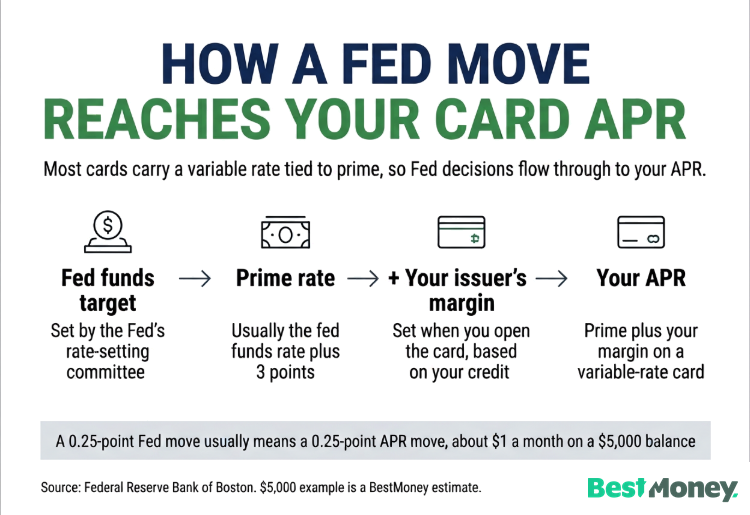
On a variable-rate card, your APR equals the prime rate plus a margin your issuer sets, so Fed decisions flow straight through to your rate. The Boston Fed notes that most credit cards carry this kind of variable rate.
To understand why, you need to knowhow APR works and how it connects to Federal Reserve decisions. Think of prime as the base price and your margin as the markup your issuer locks in when you open the account.
What Is the Prime Rate, and How Is It Tied to the Fed?
The prime rate typically equals the federal funds rate plus 3 percentage points, the Boston Fed explains. The federal funds rate is what banks charge each other for overnight loans, and the Fed's rate-setting committee sets its target.
With the target range now topping out at 4.00%, prime sits at 7.00%, per the Fed's H.15 release. When the Fed moves its target, prime and your variable APR usually move with it.
How Much Does a Quarter-Point Fed Move Change Your Bill?
A quarter-point Fed move changes interest on a $5,000 balance by about $1.04 a month, based on BestMoney's estimate. That's roughly $12.50 a year, so the same balance costs you nearly the same before and after the move.
BestMoney estimated the monthly change for three balance sizes:
Balance
Estimated monthly change from a 0.25-point APR move
$2,000
About $0.42
$5,000
About $1.04
$10,000
About $2.08
These estimates assume your balance stays the same and approximate monthly interest as APR divided by 12. In practice,many issuers calculate interest daily based on your average daily balance, per the CFPB. Paying more than theminimum payment shrinks that balance, and that's what moves your interest cost.
How Fast Does Your APR Change After a Fed Decision?
Your APR usually changes within one or two billing cycles after prime moves, though timing varies by issuer,according to Experian. Issuers also aren't required to pass along a cut right away or by the same amount.
Your issuer generally must give you45 days' notice before raising your rate for new purchases, the CFPB says. It generally can't raise the rate on your existing balance. Exceptions include a promo rate ending or a rise in the index your variable rate tracks, such as prime.
UnderRegulation Z, a variable APR increase tied to an index your issuer doesn't control needs no advance notice. A promo rate can end only if its length and the rate that follows were disclosed up front. That's why a 0% intro APR holds during its promo period, as the FAQ below explains.
Where Do Fed Rates Stand Right Now?
As of October 14, 2026, the fed funds target range is 3.75%–4.00% after the Sept. 16, 2026 hike, and prime is 7.00%. Those figures come from the Fed's Sept. 16 statement and its H.15 release.
BestMoney summarized recent Fed decisions from theFed's meeting calendar, with prime estimated as the target's upper end plus 3 points:
If you carry a balance, you're likely paying about 22%. Banks charged an average22.36% APR on accounts assessed interest in August 2026, and 21.19% across all accounts, per the Fed's preliminary G.19 data. Those figures were collected before the September hike.
The Fed's next rate decisions are scheduled for Oct. 27–28 and Dec. 8–9, 2026, per the same calendar.Kevin Warsh was sworn in as Fed chair on May 22, 2026, CBS News reported.
Why Do Credit Card APRs Stay High Even When the Fed Cuts?
APRs stay high because your issuer's margin is the bigger piece of your rate, and it's usually set when you open the account. Fed rate cuts trim the base price and leave that markup in place.
Cards carry anaverage spread of 14.5 points over the fed funds rate, New York Fed researchers found. That spread is set at account opening and typically doesn't change. Your credit score makes a big difference, as both Fed banks show:
Source
Margin measured over
Lower credit scores
Excellent credit
New York Fed (March 2025)
Fed funds rate
About 21 points (FICO 600)
About 7.22 points (FICO 850)
Boston Fed (March 2026)
Prime rate
About 19–20 points
About 11–12 points
In plain terms, a borrower with a 600 FICO Score pays a spread nearly three times that of someone at 850, per the New York Fed. The gaps run roughly 7 to 14 points across the two studies. So improving your credit before you apply for a new card can trim your rate far more than a quarter-point Fed cut.
Should You Use a Balance Transfer Instead of Waiting on the Fed?
Yes, if you carry a balance, a 0% intro APR balance transfer can save you much more than a quarter-point Fed move. Intro periods and fees vary by card, so compare thebest balance transfer cards on both before you apply.
Example: Say you owe $6,000 on a high-interest card and qualify for a0% intro APR balance transfer card with an 18-month intro offer. You could save about $820, based on BestMoney's estimate. You'd also have a clear runway forpaying off your balance without new charges piling up.
BestMoney compared both paths for that $6,000 balance over 18 months:
Path
Interest
Transfer fee
Estimated cost
Keep it on a 22.36% APR card (about $395 a month)
About $1,118
$0
About $1,118
Move it to an 18-month 0% intro card
$0
$300 (5%)
$300
The estimate uses the G.19 average APR and assumes you pay off the full balance within the promo period.
Pro tip: Don't wait for your card to adjust your APR. A card like the Chase Slate® offers 0% Intro APR intro APR for 21 months on Purchases on purchases and balance transfers, then 18.49% - 28.49% Variable variable APR. The balance transfer fee is $5 or 5%, whichever is greater ( https://click.linksynergy.com/fs-bin/click?id=pV2zaWFdRBY&offerid=1993882.10005706&type=3&subid=0; Chase terms dated Sept. 22, 2026).
Either way, you get a long stretch of predictable, interest-free breathing room regardless of what the Fed does next.
Can a 0% Intro APR Help You Finance a Big Purchase?
Yes. Some cards offer 0% intro APR on purchases as well, not just balance transfers. That promo rate holds for its disclosed term, whatever the Fed does.
Facing a major expense like dental work, home repairs, or travel? A 0% intro APR could help you finance that cost with no added interest. Before you do, make sure you understand exactlywhat 0% APR means and the rules that come with it.
Just make sure you:
Choose a card with a long enough intro period
Pay off the full balance before the promo ends
Avoid making new purchases that could trigger higher interest rates
Does a Fed Move Change Which Rewards Card Makes Sense?
Not if you pay in full every month. APR changes only cost you when you carry a balance, so rewards and perks matter more than the Fed for you.
When you compare rewards cards, look at:
Sign-up bonuses
Cash back on everyday categories like groceries, gas, and dining
Travel-related extras like rental car coverage or no foreign transaction fees, plushidden credit card benefits like purchase protection and extended warranties
Pro tip: Review your top three monthly expenses, thenalign cards with your spending habits by finding one that earns higher rewards in those categories. Small shifts can add up fast.
What Else Can You Do to Lower Your Credit Card APR?
You can ask your issuer for a lower rate, pay down your balance and build your credit so you qualify for lower-margin cards. These are the parts of your APR you control, and here's how to lower credit card interest rates with each:
If you're planning a large purchase, see how a 0% intro APR on purchases can spread the cost.
If you're watching the October and December 2026 Fed meetings, check the rate table after each decision.
Your Questions, Answered (FAQs)
Will my credit card APR go down if the Fed cuts rates?
On most variable-rate cards, yes, usually by about the same amount within one or two billing cycles, according to Experian. Fixed rates and 0% intro rates don't move with the Fed.
Does a Fed rate hike raise the APR on my existing balance?
On a variable-rate card, yes, because the index your rate tracks has risen. Under Regulation Z, your issuer doesn't need to give advance notice for that kind of increase.
Do fixed-rate credit cards change when the Fed moves rates?
Not automatically, since a fixed rate doesn't track prime. Your issuer can still raise it for new purchases, generally with 45 days' notice, per the CFPB.
Does my 0% intro APR change when the Fed raises rates?
No, the promo rate holds for its disclosed term. Afterward, your regular variable APR applies, and that rate follows prime.
When is the next Fed rate decision?
The Fed's next meetings are scheduled for Oct. 27–28 and Dec. 8–9, 2026, per its meeting calendar. Check back after each meeting to see whether prime has moved.
Why Trust BestMoney?
Elke Zalcman is a financial content specialist at Natural Intelligence covering credit cards and online banking. She’s passionate about breaking down personal finance, making complex topics like budgeting and investing accessible and engaging for everyday consumers, and sharing practical guidance on credit card rewards and travel hacking.
How We Researched This
This article relies on public primary and secondary sources, not proprietary BestMoney research. We used Federal Reserve rate statements, its meeting calendar and its H.15 and G.19 releases. We also used Boston Fed (March 2026) and New York Fed (March 2025) research, CFPB guidance, Regulation Z, Experian, CBS News and issuer terms pages.
The worked examples are BestMoney estimates. They assume an unchanged balance and approximate monthly interest as APR divided by 12, and the balance transfer example assumes payoff within the promo period.
Fed decisions nudge your APR, but your margin, your balance and the card you choose matter more. If your credit card situation hasn't changed in a while, the latest Fed move is a prompt to review what you're working with. Ask:
Am I paying interest unnecessarily?
Could I earn more back on my everyday spending?
Do I have a card that reflects where I'm headed financially?
If you're focused on paying down debt, prioritize long 0% intro periods and low fees, and try thesecredit card debt payoff strategies. If you're spending strategically, pick a rewards card with benefits you'll actually use.
The Fed's next move won't magically erase credit card debt or double your rewards. But it's a good moment to move a balance or simplify your finances before rates shift again. You can also use ourTravel Credit Card Guide to get more value.
Disclaimer: AI was used in the creation of this content, along with human validation and proofreading.Disclosures: This content is not provided by the issuers. Any opinions expressed are those of BestMoney alone, and have not been reviewed, approved, or otherwise endorsed by the issuers.The credit card offers and information presented on this page are current as of the published date. However, credit card terms, including APRs, fees, and promotional offers, are subject to change without notice. Some offers listed may no longer be available or may have expired. Please refer to the issuer's website for the most up-to-date terms and conditions.
Written byElke Zalcman
Elke Zalcman is a financial content specialist at Natural Intelligence covering credit cards and online banking. She’s passionate about breaking down personal finance, making complex topics like budgeting and investing accessible and engaging for everyday consumers, and sharing practical guidance on credit card rewards and travel hacking.