Best Summer Vacations 2026: The Travel Index on Where Your Budget Goes Furthest
Best Summer Vacations 2026: The Travel Index on Where Your Budget Goes Furthest
See which destinations fit your travel and budgeting needs.
Written by
Jennifer Calonia
Jennifer Calonia writes for BestMoney.com and has years of experience as a personal finance writer, editor, and founder of Blue Poppy Media LLC. She specializes in transforming complex money topics into accessible, educational content that helps readers confidently navigate their financial decisions.
According to our BestMoney 2026 Travel Index, tourists can increase their purchasing power by up to 45% — without sacrificing safety or world-class infrastructure — simply by letting the data dictate their summer vacation plans.
Every summer, millions of Americans book international vacations based on social media trends, aesthetic photos, and anecdotal advice from friends. But in a global economy shaped by inflation, fluctuating currency valuations, and shifting geopolitical realities, booking a trip based on "vibes" is a financial risk. At BestMoney, we prefer hard numbers.
More U.S. travelers are turning to every tactic to stretch their travel budgets this summer. In fact, Skyscanner’s Smarter Summer Report found that 84% of Americans are willing to alter travel plans to maximize constrained budgets.
For some, that includes making core logistical concessions like changing travel dates or intentionally seeking alternatives to social media-trending destinations that still satisfy their wanderlust for less.
To determine the objectively best international summer travel destinations for U.S. travelers in 2026, we bypassed the travel influencers. We went straight to data from the U.S. Department of State, the World Economic Forum’s Travel & Tourism Development Index, and the World Meteorological Organization to create a scale based on reliable information.
Inside the 2026 Rankings
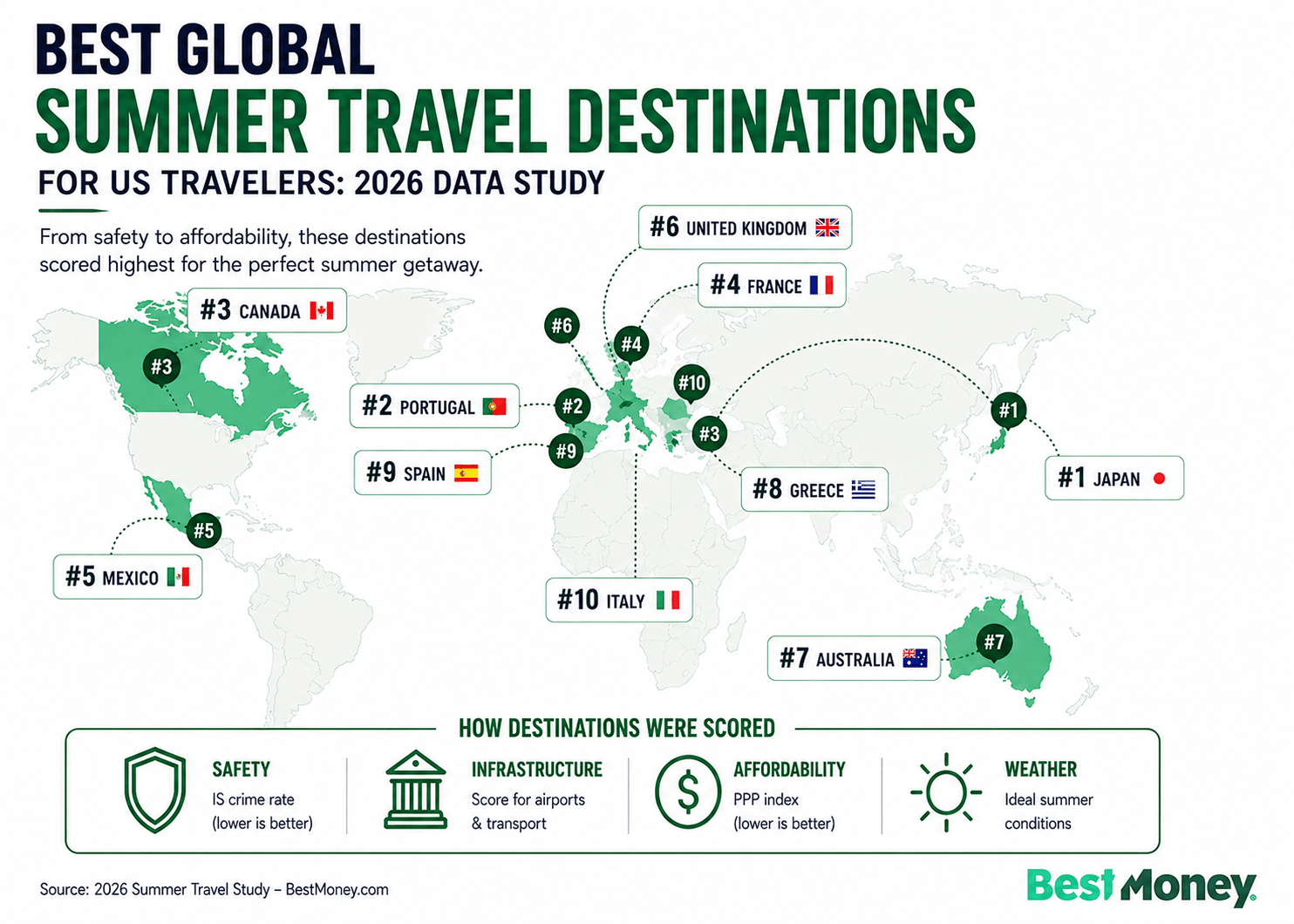
The 2026 Global Rankings: Discover the top 10 international summer destinations ranked by safety, infrastructure, affordability, and weather.
The Best Value for Your Dollar: Learn which countries currently offer the highest purchasing power for U.S. tourists.
Data-Driven Safety: Understand how U.S. State Department Threat Advisories impact your travel risks.
Strategic Financial Planning: Actionable steps on how to use travel credit cards and standalone travel insurance to protect your vacation investment.
The Cost of Choosing the Wrong Destination
Booking an international vacation is a major financial investment, often costing thousands of dollars per person. Choosing the wrong destination can result in exorbitant local costs, dangerous situations, or a miserable experience due to extreme weather.
Understanding the macroeconomic and safety data behind a destination helps you maximize your return on investment (ROI) for the trip. By relying on global indexes rather than travel brochures, you protect your wallet from hidden inflation and your family from uncalculated risks.
Charity De Souza, expert budget traveler who’s explored 60+ countries and managing editor at Beach.com, surfaces another travel planning detail that some travelers — including herself — can easily overlook: local celebrations.
Importance of Local Calendars
I once planned a long weekend in Spain during what I thought was off-season, so I expected lighter crowds and cheaper rates. What I hadn't checked was that an annual local festival was happening that weekend. Hotels had tripled in price, restaurants were slammed, and the ‘quiet getaway’ I'd planned in Seville was neither quiet nor affordable. Lesson learned: local events calendars matter as much as the weather forecast.
When comparing completely different countries, you can't simply look at a single metric. To find the "best" destination, you have to measure diverse data points — like safety advisory levels, temperature, and a global infrastructure rank — on the same scale.
We use a mathematical process called Min-Max Normalization. This takes every piece of data and translates it onto a standard 0 to 100 grading scale. For example, the safest possible rating gets 100 points, while the most dangerous gets 0 points.
We do this for every category, assign a weight based on what matters most to everyday travelers (like affordability), and combine them to create our final BestMoney Score.
How We Researched This
To ensure maximum editorial integrity and factual accuracy, this study relies exclusively on verified, official datasets active for the 2026 travel season. We did not use user-generated reviews or commercial booking data. Our pillars are:
Safety & Security (25%): U.S. Department of State Travel Advisories.
Tourism Infrastructure (25%): The World Economic Forum (WEF) Travel & Tourism Development Index.
Affordability (30%): WEF "Price Competitiveness" metrics (evaluating hotels, fuel, and purchasing power parity).
Ideal Summer Weather (20%): Historical climate baselines from the World Meteorological Organization (WMO).
Alternatives: Top 10 Summer Destinations for 2026
Based on our weighted normalization formula*, here are the top 10 global destinations for U.S. travelers heading into the 2026 summer season.
Rank
Destination
Final BestMoney Score
2026 Safety Level (U.S. State Dept)
Infrastructure Rank (WEF)
Affordability Rating
Ideal Weather Score
#1
Japan
79.8
Level 1 (Safest)
#3 Globally
High
68.0
#2
Portugal
77.6
Level 1 (Safest)
#12 Globally
High (for Europe)
84.0
#3
Canada
77.2
Level 1 (Safest)
#11 Globally
Moderate
92.0
#4
France
72.8
Level 2 (Increased Caution)
#4 Globally
Moderate
100.0
#5
Mexico
69.9
Level 2 (Increased Caution)
#38 Globally
Very High
88.0
#6
United Kingdom
66.7
Level 2 (Increased Caution)
#7 Globally
Low
84.0
#7
Australia
66.7
Level 1 (Safest)
#5 Globally
Low
44.0 (Winter)
#8
Greece
64.6
Level 1 (Safest)
#21 Globally
Moderate
40.0
#9
Spain
64.1
Level 2 (Increased Caution)
#2 Globally
Moderate
44.0
#10
Italy
62.7
Level 2 (Increased Caution)
#9 Globally
Low-Moderate
56.0
*Each destination was scored using Min-Max Normalization, a standard statistical method that converts unlike variables — safety ratings, infrastructure rankings, price indexes, and temperature data — onto a single 0–100 scale, so a State Department advisory and a hotel cost index can be meaningfully compared. Weights were then applied based on traveler priority (affordability at 30%, safety and infrastructure at 25% each, weather at 20%), producing a single composite BestMoney Score.
1. Japan: The Undisputed Data Champion
Japan secures the #1 spot by dominating almost every category. It holds a coveted Level 1 Safety Advisory from the State Department and ranks #3 in the world for tourism infrastructure. Crucially, favorable currency exchange rates currently make it highly affordable for U.S. dollar earners.
When visiting Japan, De Souza advises following the locals’ lead by planning meals around convenience store eats.
“7-Eleven, FamilyMart, and Lawson in Japan are not what you're imagining. The food is genuinely good, the hot dishes are freshly rotated, and a full meal costs around $3 to $4,” says De Souza.
She fondly recalls the assortment of hot and cold dishes that she and her husband filled up on during most days of their visit, then using the meal savings to treat themselves to one or two high-end dinners. “Going through the aisles and picking out the unique snacks to sample is still one of our fondest memories of our trip to Japan.”
2. Portugal: Europe’s Best Kept Financial Secret
While U.S. tourists flock to Italy and Spain (which fell to #10 and #9 due to extreme summer heat and higher localized costs), the data points firmly to Portugal. It boasts one of the highest "Price Competitiveness" scores in Western Europe and maintains a Level 1 safety rating.
“As someone who has lived in Portugal for 7 years, I don’t think you should skip cities like Lisbon and Porto entirely, but if you're looking for a budget-friendly alternative, head to the Alentejo. This sunny interior region is known for its rolling plains, cork forests, and white-washed hilltop villages. It offers travelers an authentic look at Portugal’s everyday life and culture, and best of all, the accommodation is a fraction of the price,” advises De Souza, who noted smaller towns in the Alentejo, like Monsaraz or Marvão, as good options in addition to the obvious hub of Évora.
3. Canada: The Safest, Coolest Escape
For travelers looking to escape the sweltering U.S. summer without crossing an ocean, Canada is a statistical powerhouse. With an average July high of 80°F in Ottawa, a Level 1 safety rating, and top-tier infrastructure, it offers a seamless, high-quality vacation.
“One of the most underrated places I’d recommend for nature lovers on a budget is Cheakamus Lake in Garibaldi Provincial Park, just outside Whistler,” says De Souza, noting the destination’s beginner-friendly trails and turquoise, glacier-fed lake views surrounded by mountains. “It feels like something you should have had to work much harder to reach… It has that rare combination of accessible, affordable, and backcountry experience that makes it feel like a hidden gem.”
Which Destination Fits Your Travel Style?
Data and rankings only matter if you use them. Here's how to read this table based on your actual situation:
If you’re a budget-conscious traveler: Look strictly at the "Affordability Rating" column. Mexico (#5) and Portugal (#2) offer the highest return on your spending. Avoid the UK (#6) and Australia (#7), where high local costs will rapidly drain your travel fund.
If you’re traveling with a family (i.e., safety-first): Filter out any country that doesn’t have a Level 1 State Department rating. Canada (#3) and Japan (#1) provide world-class infrastructure with the lowest possible threat assessments.
If you’re a luxury traveler: You can afford to absorb the higher costs of France (#4) and the United Kingdom (#6) to take advantage of their top 10 WEF global infrastructure rankings, ensuring premium hospitality and cultural access.
If you're an intentional traveler: Japan (#1) and Portugal (#2) are your sweet spot, offering culture without sticker shock — Level 1 safety, top infrastructure, and strong dollar purchasing power.
Next Steps for Your Travel Budget
Booking the flight is only step one. To protect your investment and optimize your spending abroad, you need the right financial strategy in your wallet.
Zero Foreign Transaction Fees: Every time you swipe internationally, standard cards charge a 3% fee. Upgrading to a dedicated travel rewards card eliminates this entirely.
Maximize Rewards: Put your flights and international dining on a card that earns 2x or 3x points to subsidize your next vacation.
» Not sure which card to bring on your next trip? Compare the best travel credit cards for international trips
2. Lock in Standalone Travel Insurance
Notice that major hubs like France, the UK, Spain, and Italy all carry Level 2 Travel Advisories for 2026. Furthermore, U.S. health insurance rarely covers international medical emergencies.
Protect Your Deposits: If you have to cancel a non-refundable trip to Japan, travel insurance ensures you get your money back.
Medical Evacuation: If you are injured hiking in Canada or Greece, standalone policies cover the exorbitant costs of emergency transport.
Do I really need travel insurance if I have a premium credit card?
Credit card travel protections are excellent for secondary coverage (like a delayed bag or a minor rental car ding), but they typically lack the high medical evacuation and comprehensive trip cancellation limits provided by standalone travel insurance policies.
What does a "Level 2" State Department advisory actually mean?
Level 2 means "Exercise Increased Caution." It doesn’t mean a country is highly dangerous, but it indicates heightened risks, often due to the general threat of terrorism in major Western European tourist hubs or localized crime.
Why didn't destinations like the Caribbean or Southeast Asia make the top 10?
While affordable and beautiful, many Caribbean and Southeast Asian destinations are penalized in our summer study due to their weather scores (peak hurricane/monsoon season in July) and lower WEF infrastructure rankings compared to G20 nations.
Why Trust BestMoney on Travel and Credit Cards?
At BestMoney, our editorial methodology, the data sources, weights, and scoring logic. We break down complex financial and macroeconomic data into actionable advice, helping millions of users make smarter decisions with their money.
Author Jennifer Calonia is a personal finance writer and editor with 15+ years of experience covering consumer banking, credit cards, and travel rewards programs. Her work has been featured on national publications, including Newsweek, Forbes, NerdWallet, CNN Money, and more.
Where We Got Our Information
To verify the data points used in this index, you can review our primary official sources:
Jennifer Calonia writes for BestMoney.com and has years of experience as a personal finance writer, editor, and founder of Blue Poppy Media LLC. She specializes in transforming complex money topics into accessible, educational content that helps readers confidently navigate their financial decisions.