How Frictionless “Tap to Pay” Payments Are Changing Spending Habits
How Frictionless “Tap to Pay” Payments Are Changing Spending Habits
Understanding how digital payments affect your brain can help you budget smarter and choose the right online banking tools.
Written by
Jennifer Calonia
Jennifer Calonia writes for BestMoney.com and has years of experience as a personal finance writer, editor, and founder of Blue Poppy Media LLC. She specializes in transforming complex money topics into accessible, educational content that helps readers confidently navigate their financial decisions.
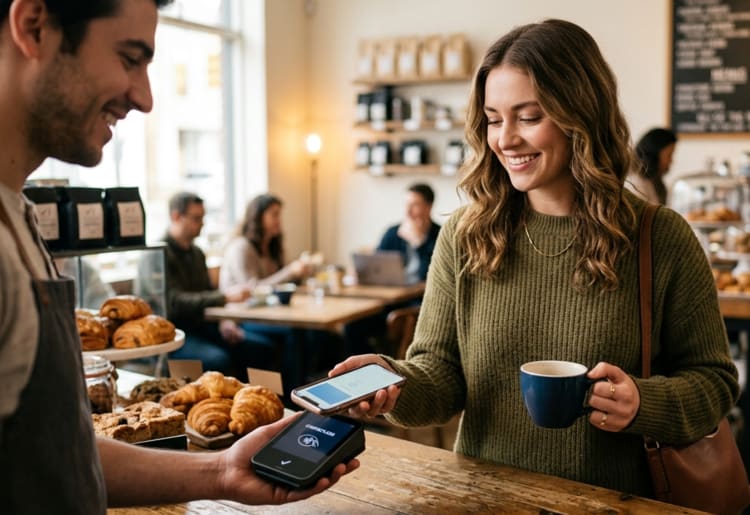
Between ordering your coffee and a quick small talk with the barista, you tap your phone, hear a beep, and walk out. No digging for cash, no checking receipts. It’s so fast you might not even remember the total cost.
If this sounds familiar, you’re not alone. More consumers than ever are making in-person purchases in a similar way.
This shift toward tech-based payments offers a seamless checkout, but the speed of tap-to-pay is changing how we spend. To keep up, consumers now need more from their online banks than just a place to store cash; they need tools that help them track these near-instant transactions in real time.
Key Insights
The "Pain of Paying" is Real: Physical cash triggers brain regions linked to pain; digital taps bypass this, making it easier to overspend.
Convenience Costs More: Studies show shoppers spend nearly 30% more when using one-click or frictionless checkout methods.
Subscriptions Are Phantom Expenses: Americans lose hundreds of dollars annually to "invisible" recurring charges they no longer use.
Awareness is the Best Defense: Simple friction, like deleting saved card info or turning on alerts, restores your power to pause.
The Rise of Frictionless Payments
The pivot in behavior didn’t suddenly appear overnight. It’s the result of rapid innovations in how consumers pay for goods. According to research by Clearly Payments, a Canada-based payments processor, “Contactless payment technology was first introduced in the United States in the early 2000s. However, its widespread adoption did not begin until around 2014.”
The launch of Amazon’s one-click purchase feature in the late-90s, made it so customers could make a purchase right on the product page. In 2014, Apple Pay made the ease of digital wallets and mobile payments impossible to ignore.
During the 2020 pandemic, contactless payment transactions boomed. Both merchants and consumers leaned into touchless payments, including tap to pay and scanning QR codes for payment, as a means of reducing viral spread from contact.
Years after COVID-19, smartphones are still doing the heavy lifting with digital wallets. They can carry multiple debit and credit cards, loyalty program cards, event tickets, boarding passes, and even medical records. And all of it can be unlocked with a face scan or fingerprint.
Why Do Easier Payments Lead to More Spending?
Spending money isn't purely rational. It also triggers a physical response in your brain.
In behavioral psychology, the "pain of paying" describes the psychological discomfort that comes with losing money. Researchers at Carnegie Mellon, Stanford, and MIT found that spending activates the the part of the brain that processes pain. The more abstract the payment method, the less pain you feel, and the more you tend to spend.
Here's how that plays out across payment types:
Cash: The pain is real and immediate. You hand over a $20 bill and get less back. That tangible loss can actually stop impulse purchases before they happen.
Physical credit card: The pain is present but softer. There's no currency exchanged, just a swipe or tap, and you walk away with your card still in hand.
Digital payments: The pain nearly disappears. One-click checkout and saved card details strip away the friction that makes you pause. Cornell University research found that shoppers spent an average of 28.5% more after enrolling in an online retailer's one-click checkout feature.
The easier it is to pay, the harder it is to stop.
Subscriptions and Invisible Spending
Frictionless payments are the perfect fuel for small, recurring purchases, like subscription-based services. In CNET’s second annual subscription survey, it found that the average US adult spends $1,080 on subscriptions annually.
The subscription economy is designed to lock you in as recurring, automated payments quietly process in the background. This spending lurks without so much as a reauthorization request or payment notification.
Unless you’re diligent about tracking them, there’s no natural opportunity to reconsider whether to keep or cancel it. In fact, the same CNET survey found that the average American spent more than $200 for unused subscriptions.
With some subscriptions priced less than a gallon of gas, it’s easy to forget these phantom purchases exist but the cost adds up.
The Psychological Trap of “Invisible Money”
Mental accounting is the idea that people ascribe different values to money based on context. For example, generally you’re careful with your regular paycheck, but might treat a $1,000 tax refund as “fun money” for designer shoes.
Then, the psychological gymnastics of mental accounting is compounded by frictionless payment methods. Streamlined payments, like stored digital credit card payments or tap-to-pay makes impulse buys and emotional spending even less visible.
Signs Your Spending May Be Getting Out of Control
It can be harder to spot how contactless payments impact your own spending habits. These are a few signs to look for:
Your monthly credit card balance surprises you.
You can’t remember what you bought recently.
You have multiple unused subscriptions.
Your small, but frequent, purchases blindside you.
You only check your checking balance after spending, not before.
Although these aren’t inherently red flags, they’re an indication that your spending awareness might be unraveling.
Guardrails to Regain Control
Digital payments can serve a practical purpose, but the goal is to leverage it intentionally.
24-hour rule for impulse purchases: This “sleep on it” strategy reclaims the decision-making part of spending experience that’s lost with digital payments.
Remove saved payment methods: Delete your saved card information from your online retail or e-commerce accounts, or at least log off every time you’re done browsing. Even a couple of minor speedbumps are enough to give you pause and rethink your next purchase.
Use one card for discretionary spending: Combining necessary and discretionary spending into one card makes it hard to know how much you’ve spent on non-essential purchases. Consider using a card with the lowest credit limit to keep your buying access minimal.
Turn on real-time spending alerts: Tap-to-pay spending habits can go unchecked without a paper trail. Setting up real-time transaction alerts pushes you to confront your spending visually. Extra tip: keep your phone ringer on so you hear every purchase, too.
Cancel or audit subscriptions monthly: The average subscriber spends $17 per month for unused subscriptions, according to CNET data. Running a monthly audit of your subscriptions encourages you to clean house of any services you’re not actively using.
Use budgeting apps or manual tracking: These tools help you categorize your spending, assign spending budget limits, and track all of your transactions in real time.
Conclusion
Tap-to-pay isn't the enemy—mindless spending is. The technology is built for speed, so you have to be the one to slow things down. By adding a simple 'pause' before you pay, you turn an invisible habit back into a conscious choice.
Pause to actively listen to the total price at the register or manually enter your payment information at checkout. These brief but powerful moments give your brain the necessary space for decision-making.
Pro Tip: If you find yourself tapping too often, try the 24-hour rule. Add the item to your cart, but wait a full day before tapping "Buy." If you still want it tomorrow, the "pain" has been properly processed!
Frequently Asked Questions
Is tap-to-pay less secure than swiping?
Actually, it’s often more secure. Tap-to-pay uses tokenization, meaning your actual card number is never shared with the merchant.
How can I track my "invisible" spending?
Enable real-time push notifications in our mobile app. Hearing your phone ping with every purchase recreates the "pain of paying."
Why is my digital wallet balance different?
Digital wallets mirror your card account. If you see a discrepancy, it’s likely a pending transaction that hasn't fully cleared yet.
Does tap-to-pay work offline?
Generally, no. Both the merchant's terminal and your device (for mobile wallets) need a connection to authorize the encrypted data.
Written byJennifer Calonia
Jennifer Calonia writes for BestMoney.com and has years of experience as a personal finance writer, editor, and founder of Blue Poppy Media LLC. She specializes in transforming complex money topics into accessible, educational content that helps readers confidently navigate their financial decisions.