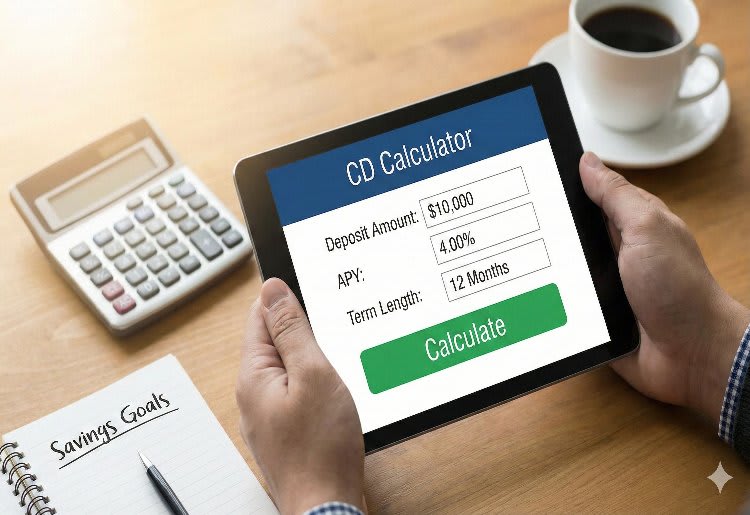
Use the calculator below to experiment with different scenarios: adjust the deposit amount, term length, and APY until the numbers align with your goals. Once you're happy with the results, you'll have a clearer picture of whether a CD is the right choice for your savings.
To get started, make sure you have these three pieces of information ready:
Deposit Amount
Enter how much money you're comfortable locking away for the entire CD term. Remember, you usually can't add more money later, and withdrawing early often triggers a penalty.
APY (Annual Percentage Yield)
This is the rate the bank advertises. APY already includes the effect of compounding, so it shows your true annual return.
CD Term Length
Enter how long you plan to keep the money in the CD, in months. Common terms are 12, 18, 36, or 60 months (1, 1.5, 3, or 5 years).
Once you've filled in these fields, the calculator shows your total interest earned and total balance at maturity: what you'll have if you leave the CD untouched until it matures.
Total Interest Earned
This is the extra money your deposit earns over the CD term. For example, if you invest $10,000 in a 12-month CD at 4% APY, you'll earn approximately $400 in interest.
Total Balance at Maturity
This is your ending value: your initial deposit plus all interest earned. In the example above, you'd have $10,400 after 12 months.
Use these results to compare different CDs. A small change in APY or term length can significantly impact your total earnings, especially on larger deposits or longer terms.
A certificate of deposit is a type of time deposit where you agree to leave a lump sum on deposit for a fixed period, and the bank pays you a specified interest rate in return.
Key traits of CDs:
Because of this, CDs offer guaranteed returns with minimal risk—safer than stocks, but typically offering higher yields than standard savings accounts.
CDs aren't the only way to earn interest on your savings. Here's how they compare with savings accounts:
Here’s the updated table with only CDs vs. Savings Accounts:
| Feature | Certificates of Deposit (CDs) | Savings Accounts |
|---|---|---|
| Interest Rate Type | Fixed rate for a fixed term | Variable rate |
| Typical Rates | Often higher, especially for longer terms | Generally lower than top CDs |
| Access to Funds | Limited; early withdrawals trigger penalties | Easy access |
| Withdrawal Limits | No withdrawals without penalty during term | Some banks limit monthly withdrawals |
| Best For | People who can lock money away for a set period | Emergency funds and everyday saving |
| Rate Movement | Fixed — does not change during term | Can move up or down |
Bottom line: If you know you won't need the money for a specific period, a CD makes sense. If you need flexibility, a high-yield savings account might be better.
The BestMoney editorial team is composed of writers and experts covering a full range of financial services. Our mission is to simplify the process of selecting the right provider for every need, leveraging our extensive industry knowledge to deliver clear, reliable advice.