Survey: Millennials, Not Gen Z, Are Most Likely to Get a Credit Card Because of an Ad
Survey: Millennials, Not Gen Z, Are Most Likely to Get a Credit Card Because of an Ad
Adults 30 to 44, not Gen Z, are the age group most swayed by credit card ads and design.
Written by
Jackie Lam
Jackie Lam is a credit card writer for BestMoney.com and is based in Los Angeles. Her previous writing experience includes work for various publications. Additionally, Jackie is an accredited AFC® financial counselor and educator with a passion for helping artists, freelancers, and gig economy workers manage their finances.
Credit card marketing looks different than it used to. Influencers highlighting a card's perks, a metal design built for a screenshot, ads that make a rewards program feel like something worth sharing. The assumption is usually that Gen Z is the generation most swayed by it.
A new BestMoney survey of 1000 U.S. adults with credit card experience found the opposite. Adults ages 30 to 44, not the youngest cardholders, are the most likely to say an ad or influencer talked them into a card, and the most likely to have picked one mainly because of what it looks like. That same age group is also among the most likely to be actively avoiding new cards altogether, out of fear of debt.
The timing matters. Americans now carry$1.25 trillion in credit card debt, the second-highest balance the Federal Reserve Bank of New York has recorded since it began tracking the number in 1999. Our survey asked how people actually got into credit cards, what they wish they'd known earlier, and who's still making card decisions based on marketing rather than math.
Key Insights
36% of 30-to-44-year-olds got a card mainly from an ad or influencer, more than any other age group.
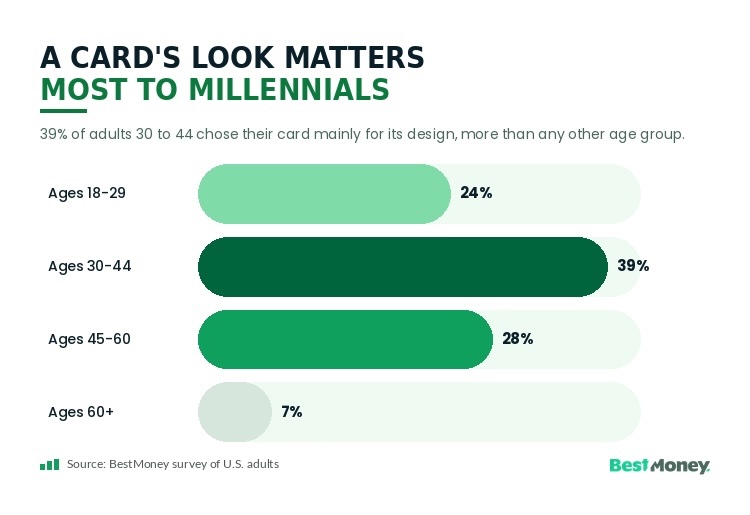
39% of that same age group picked a card mainly for its physical design, versus 7% of people 60 and older.
55% of cardholders have avoided applying for a new card at least once out of fear of debt.
That debt avoidance peaks at 68% among 30-to-60-year-olds, versus 30% among people 60 and up.
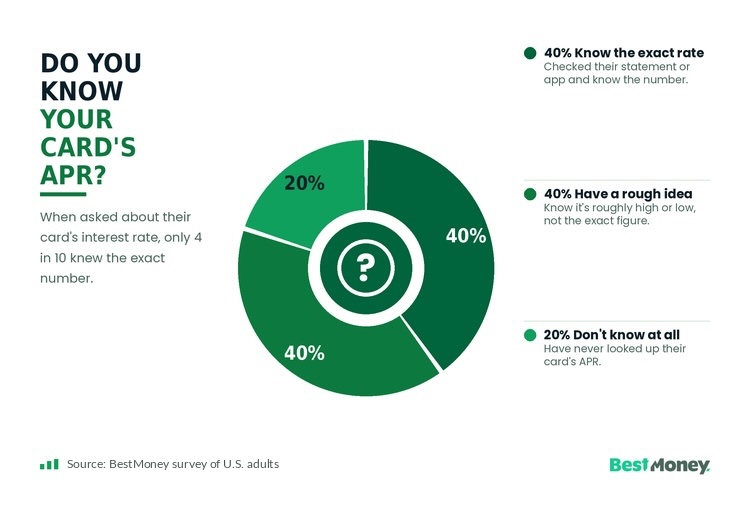
Only 40% of cardholders know their card's exact APR, and 31% carry a balance most months.
Key Findings
Who's Actually Falling for Credit Card Marketing?
When asked whether they'd ever applied for a card mainly because they saw it recommended by an influencer, ad, or on social media, 25% of respondents said yes. Broken out by age, that number tells a different story than the stereotype: 36% of 30-to-44-year-olds said yes, compared with 32% of 45-to-60-year-olds, 29% of 18-to-29-year-olds, and just 4% of people 60 and older.
The same pattern holds for a card's physical design. Nationally, 25% of cardholders said they'd chosen a card mainly because of how it looks (a metal build, a particular color) rather than its rewards or terms. Among 30-to-44-year-olds, that jumps to 39%, more than five times the rate among people 60 and up (7%).
It's the group with the most financial experience and purchasing power, not the newest cardholders, that's most swayed by marketing. That's useful to know if you're in that age bracket: a card that showed up in your feed or looks good in a wallet deserves the same APR-and-rewards comparison you'd give any other financial product. Acard that fits how you actually spend beats one that just looks good in a wallet.
Purchasing Power, Not Age
Adults ages 30 to 44 often have higher incomes, stronger credit, and greater spending needs, making rewards offers more relevant. Marketing susceptibility is less about age and more about timing, lifestyle, and purchasing power.
Dan Ariely, Behavioral Economist, theorizes that it comes down to control.
Looking for Control
I think young people these days are very stressed about using money, and they are looking more grimly at the economy. They are looking more grimly at employment opportunities, and because of that, I think they want more control.
Dan ArielyBehavioral Economist and ProfessorDuke University
Do People Actually Avoid Cards Because They Fear Debt?
More than half of cardholders (55%) said they've avoided applying for a credit card at least once because they were worried about going into debt, including 42% who said it's happened more than once. That hesitation isn't evenly spread by age. It peaks among 30- to 44-year-olds and 45- to 60-year-olds, both at 68%, and drops sharply to 30% among people 60 and older. Adults 18 to 29 land in between at 53%.
That means the two age groups carrying the most financial responsibility, often mortgages, kids, or both, are also the most likely to be sitting out credit card offers entirely out of caution.
Debt Avoidance Is Protective
This credit card avoidance is actually protecting consumers. I have seen so many cases where folks overspent on their credit cards in the name of chasing rewards, only to end up tens of thousands of dollars in debt. As with most things in life, a good rule to follow is 'Know Thyself,' and avoid credit cards if you think you might fall into the credit card debt trap!
However, as long as you pay off your credit card in full every month, then you'd likely be better off getting acredit card for the rewards and building your credit score, says Cerezo. "Other strategies that I've seen work for folks to avoid getting into debt are paying off their credit cards weekly or even daily, and signing up to receive dailycredit card balance alerts so that you stay well aware of how much you've been spending to avoid overspending," she says.
How Many Cardholders Are Carrying a Balance?
In the past 12 months, 56% of respondents carried a balance rather than paying their statement in full, including 31% who said it happens most months. Only 42% said they always pay in full. Balance-carrying is most common among 45-to-60-year-olds (43% carry a balance most months) and least common among people 60 and up (19%).
Asked what commonly drives a carried balance, the top reasons across all respondents were wanting to make a large purchase and pay it off over time (27%) and not having enough funds that month (24%), with an emergency expense a distant third (9%) and a simply missed due date accounting for just 6%. If a balance is already piling up,moving it to a balance transfer card built for paying it down beats one built for points.
Do Cardholders Know Their Own Interest Rate?
Just 40% of respondents said theyknow their card's exact APR. Another 40% said they have a rough idea, and 20% said they don't know it at all. That's true across genders (42% of men and 39% of women know their exact rate), so this isn't a gap tied to who's asking; it's a gap tied to whether anyone ever sat down and looked.
Age is the clearest dividing line in this survey, and it cuts against the usual assumption that younger adults are the least disciplined credit card users. On applying because of marketing, choosing a card for its looks, and avoiding cards out of debt anxiety, 30-to-44-year-olds and 45-to-60-year-olds consistently outpace both 18-to-29-year-olds and people 60 and older.
Segment Insights
How Does Family Financial Oversight Differ by Age?
One place age shows a different kind of shift is parental oversight growing up:
38% of 18-to-29-year-olds and 30-to-44-year-olds said a parent or family member had full visibility into their card statements early on.
8% of people 60 and older said the same.
Whether that reflects looser money conversations decades ago or just a fading memory of them, younger generations report having grown up with far more financial transparency at home than older ones did.
Do Men and Women Handle Credit Cards Differently?
Gender differences were modest by comparison:
Men were somewhat more likely than women to have avoided applying for a card out of debt fear (59% vs. 51%).
Men were also somewhat more likely to carry a balance most months (33% vs. 30%).
APR knowledge was nearly identical between genders (42% of men, 39% of women knew their exact rate).
Neither gap approaches the size of the age divide.
Does Income Predict Credit Card Behavior?
Income shows the pattern you'd expect for the most part. Lower-income respondents were more likely to carry a balance most months, and the $200,000-plus bracket reported the highest rate of always paying in full (71%). That top-income group is a small slice of the sample, so treat it as a directional signal rather than a firm rule. But the broader pattern, more strain at lower incomes, held up across every bracket in between.
Implications
None of this means marketing works better on 30-to-60-year-olds because they're less savvy. If anything, it means they're the ones making the most credit card decisions, opening new cards, carrying balances, upgrading for rewards, so they're the ones marketing is built to reach. The problem isn't age, it's that "the card looked cool" and "the APR is X%" get treated as separate questions when they're really the same one.
4 Ways to Apply This to Your Next Card Decision
Before applying for a card because of an ad, an influencer, or its design: Pull up its actual APR and rewards terms and compare them against at least one alternative.
If you don't know your current card's exact APR: That's a five-minute fix, it's on your statement or in your card's app under account details.
If fear of debt is the reason you haven't applied for a card you actually need (to build credit, for an emergency fund, for better rewards): Separate that fear from the specific card's terms. A card with a low APR and no annual fee is a different risk than a rewards card with a 24% rate.
If you're already carrying a balance most months:Prioritize a card's APR over its rewards rate. A 2% cashback card with an 8-point-higher APR is a net loss the moment you don't pay in full.
What This Survey Really Shows About Credit Card Habits
The credit card habits that get blamed on Gen Z, chasing influencer picks, choosing a card for its looks, don't actually show up most in 18-to-29-year-olds. They show up most in 30-to-60-year-olds, the group also most likely to be sitting out new cards entirely because they're worried about debt.
Only 40% of all cardholders know their exact APR, and 56% carried a balance in the past year. The fix isn't age-specific: know your rate, compare terms before you compare looks, and treat "cool card" and "good deal" as two different questions.
Your Questions, Answered (FAQs)
Are Millennials really more likely than Gen Z to get a credit card because of an ad?
Yes. In our survey, 36% of 30-to-44-year-olds said they applied for a card mainly because of an influencer, ad, or social media recommendation, compared with 29% of 18-to-29-year-olds and just 4% of people 60 and older.
Is it normal to carry a credit card balance?
It's common but not automatic. 56% of cardholders in our survey carried a balance in the past year, and 42% said they always pay in full. Carrying a balance means paying interest on whatever's left, so paying in full when possible avoids that cost entirely.
How do I find out my credit card's exact APR?
Check your most recent statement or your card issuer's app under account or card details. Only 40% of cardholders in our survey knew their exact rate, so if you don't, you're not unusual, but it's worth the few minutes to look it up.
Does picking a card for its design actually cost you money?
Not by itself, but it can if it means skipping a comparison you'd otherwise make. Twenty-five percent of cardholders in our survey chose a card mainly for its physical design rather than its rewards or terms, rising to 39% among 30-to-44-year-olds.
What age do most people get their first credit card?
In our survey, 36% first got a card or card access between ages 18 and 20, and another 27% between 21 and 24, meaning the large majority get their start in their late teens to mid-20s.
Why do so many people avoid applying for a credit card?
Fear of debt was the top reason: 55% of respondents said they've avoided applying for a card at least once because they were worried about going into debt, and that hesitation is highest among 30-to-60-year-olds.
Why Trust BestMoney?
BestMoney's editorial team designs and fields its own consumer surveys, then analyzes the results using the same rigor applied to any financial product research: transparent methodology, verifiable data, and input from credentialed experts where it adds value beyond the numbers. This article is based on a BestMoney survey of 1000 U.S. adults with credit card experience, fielded in July 2026, and every percentage is calculated from the respondents who answered that specific question.
Jackie Lam, an accredited AFC® financial counselor and the 2022 Plutus Award winner for Best Freelancer in Personal Finance Media, wrote this article. Contributing experts includeJoon Um, CPA at Secure Tax & Accounting, Inc.;Dan Ariely, behavioral economist and professor at Duke University and founding member of the Center for Advanced Hindsight; andGabbi Cerezo, fee-only fiduciary financial planner at Sustain Financial.
Methodology
BestMoney asked 1000 U.S. adults in July 2026 about their credit card habits, from how they got their first card to whether they know their current APR. All respondents had either held a personal credit card or been an authorized user on someone else's card. Percentages for each question are calculated out of the respondents who answered that specific question and are rounded to the nearest whole number throughout this article.
Where We Got Our Information
This article is based on a BestMoney survey of U.S. adults conducted in July 2026.
Jackie Lam is a credit card writer for BestMoney.com and is based in Los Angeles. Her previous writing experience includes work for various publications. Additionally, Jackie is an accredited AFC® financial counselor and educator with a passion for helping artists, freelancers, and gig economy workers manage their finances.