A salary increase doesn't guarantee a higher net worth. Research by the Federal Reserve Bank of Philadelphia suggests that lower-income consumers are more likely to report dramatic spending cuts, while higher-income consumers are less likely to reduce their spending.
Getting a raise should, theoretically, make it easier to save money and reach your long-term goals. But in practice, raises don’t always translate into a higher bank account balance.
As income rises, spending tends to rise with it. This is lifestyle creep, and it's why many people earn more but never seem to get ahead. Here's how reverse budgeting can help you keep more of what you earn.
Key Insights
- The Definition: Lifestyle creep is the tendency for non-essential spending to grow automatically alongside your income.
- The Trap: Unconscious upgrades — like premium subscriptions and dining out — can absorb a $10,000 raise in months.
- The Solution: Reverse budgeting (saving first) and the "six-month rule" protect your new income from disappearing.
- The Goal: Use your raise to build wealth rather than just increasing your monthly overhead.
What Is Lifestyle Creep?
Lifestyle creep (also known as lifestyle inflation) occurs when your standard of living improves as your income rises, making former "luxuries" feel like "necessities." It’s the reason why someone earning $100,000 a year can feel just as broke as they did when they earned $50,000.
In 2026, lifestyle creep is often driven by stealth spending — the $15 delivery fees, $20 premium streaming tiers, and the "treat yourself culture" that feels affordable in the moment, but compounds over time.
This mistake stems from emotional decision-making, lack of financial savvy, and avoidance. says Johnson, noting that they’ve spent their entire raise without ever getting ahead or building their net worth. “Emotional decision-making means that people want to reward themselves for advancing in their careers by moving into a bigger house and buying a more expensive car. Many have adopted a YOLO (‘you only live once’) attitude and live for the moment.
Robert R. Johnson, PhD, CFA, CAIAProfessor of FinanceHeider College of Business, Creighton University Why Higher Income Doesn’t Always Build Wealth
Many people assume that a higher salary is a shortcut to wealth. However, without an automatic savings strategy, a raise simply increases the size of your "spending bucket."
The Math: How a $10k Raise Disappears
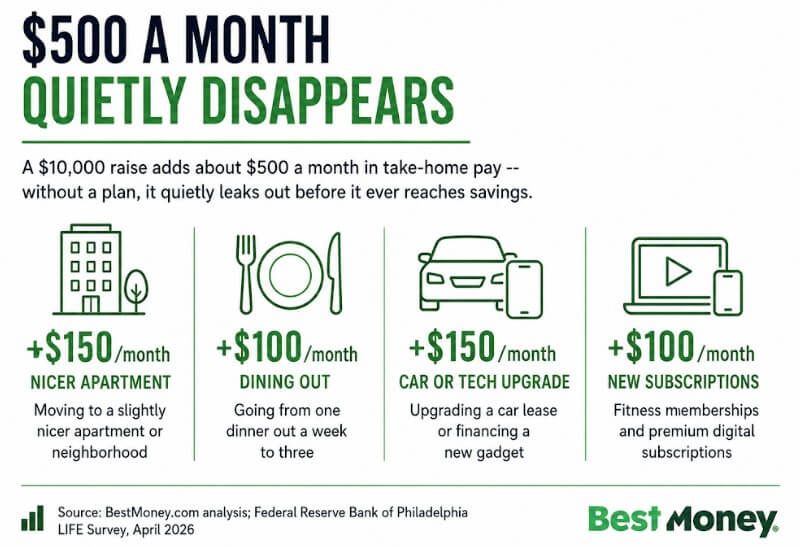
Imagine you receive a $10,000 annual raise. After taxes, your take-home pay increases by roughly $500 per month. Without a plan, that $500 quietly leaks out:
- +$150/month: Moving to a slightly "nicer" apartment or neighborhood.
- +$100/month: Increasing dining out from once a week to three outings a week.
- +$150/month: Upgrading a car lease or financing a new tech gadget.
- +$100/month: New fitness memberships and premium digital subscriptions.
The Result: By the end of the month, your savings account balance remains exactly where it was before the promotion. You have a more expensive lifestyle and zero new wealth.
How Reverse Budgeting Prevents Lifestyle Creep
The best way to avoid lifestyle creep is to make yourse raise "invisible." Instead of waiting to see what’s left over, use reverse budgeting — moving your savings goals to the very top of your priority list.
Reverse Budgeting vs. The 50/30/20 Rule
Traditional 50/30/20 budgeting suggests putting 20% of your total income into savings. Reverse budgeting takes it a step further: it dictates that you save your target amount first and then spend whatever is left with zero guilt.
In behavioral finance, mental accounting bias changes how you regard money and what you choose to do with it, based on where it originated from. For example, if you were gifted $50 for your birthday, research shows consumers are more inclined to impulsively spend that cash, than save it.
Johnson explains how automating savings and retirement contributions helps consumers stick to reverse budgeting habits:
“... The biggest advantage of automatic plans are [the] behavioral underpinnings of the plans,” says Johnson. “If we are enrolled in an automatic savings plan, inertia — and the inherent laziness of people — tend to work in our favor. That is, once enrolled in an automatic savings plan, people tend to stay enrolled.”
The Full Breakdown: How to Budget a Raise
If you want to automate your savings after a raise, follow these steps:
1. Apply the "Raise Filter"
Don't just spend the additional $500 each month. Split it immediately and intentionally:
- $250 (50%): Direct deposit into a High-Yield Savings Account (HYSA).
- $150 (30%): Spend on lifestyle upgrades (to avoid "frugality fatigue").
- $100 (20%): Extra payments toward high-interest debt.
2. The Six-Month Cooling-Off Period
Commit to living on your old salary for exactly six months after a raise.
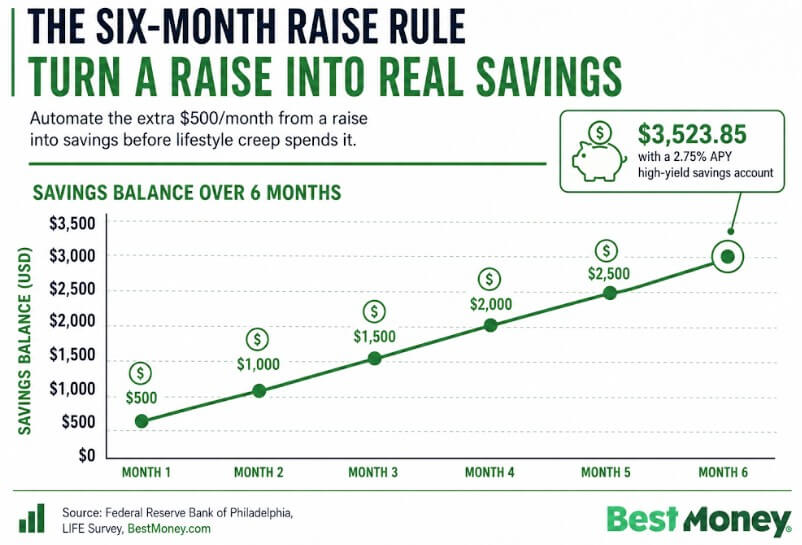
- The Action: Automate 100% of the net increase into savings for half a year.
- The Result: You build a $3,000 buffer (at $500 per month) before you ever commit to a new car payment or apartment lease.
Month | Automatic Transfer to Savings | Running Savings Balance |
1 | $500 | $500 |
2 | $500 | $1,000 |
3 | $500 | $1,500 |
4 | $500 | $2,000 |
5 | $500 | $2,500 |
6 | $500 | $3,000 |
Now, assume that you put these $500 monthly savings contributions into a HYSA at 2.75% APY. Your total savings balance would be $3,523.85, all from deliberately saving your raise first for a few months.
3. Split Your Direct Deposit
Go to your payroll portal and set up a direct deposit split for savings. By sending a flat dollar amount of your raise to a separate bank, you eliminate the decision fatigue of having to transfer it manually every month.
“Convenience spending is insidiously sneaky and eats away at hard-earned money without us being fully aware of it,” says Scot Whiskeyman, CFP, co-owner of Providers & Families Wealth Management.
“No one is completely immune to this — a click or tap and a free or low-cost entry that invites you to ‘cancel any time’ leads to financial erosion, especially if you don't have a system in place to remind yourself to actually cancel, and even more so if you don't closely monitor your spending.”
Which Reverse Budgeting Approach Is Right for You?
- If you're a high earner: Lifestyle creep is your biggest threat. You can out-earn a bad budget, but you can't out-earn an unlimited appetite for upgrades.
- If you're a beginner: Start small. Automating just $50 from a nominal raise is meaningful progress.
- If you have variable income: Use a percentage-based pay yourself first budgeting model. Every time a check clears, move a fixed percentage (e.g., 10%) before paying any bills.
What should You Do Next?
- Calculate your net increase: Use a tax calculator to find your actual "take-home" raise.
- Automate within 24 hours: Set up your payroll split before the first "new" paycheck hits your account.
- Audit your subscriptions: Identify the "stealth spending" that has already crept into your budget this year.
Your Questions, Answered (FAQ)
What is lifestyle creep?
It’s the tendency for discretionary spending to increase as your income rises, often resulting in stagnant savings despite earning more money.
How do I avoid lifestyle creep?
The most effective method is reverse budgeting. It automates your savings the moment you get a raise, effectively living on your "old" salary.
What are common lifestyle creep examples?
Upgrading your car lease, moving to a more expensive apartment you don't need, dining out more frequently, and accumulating "premium" digital subscriptions are all examples of lifestyle creep.
How do I budget a raise?
Use the 50/30/20 rule specifically for the "new" money: 50% to savings, 30% to fun/lifestyle, and 20% to debt or inflation-related costs.
Is it okay to spend any of my raise?
Absolutely. To make your financial plan sustainable, you should enjoy your success. The goal is to ensure the majority of your raise goes toward your future, not immediate and impulsive comfort.
Why Trust BestMoney
At BestMoney, our mission is to simplify the complex world of personal finance. We believe that financial freedom shouldn't be a luxury reserved for those with accounting degrees.
This article was developed through a rigorous multi-step process to ensure accuracy and relevance:
Data-Driven Insights
We analyzed the Labor, Income, Finances, and Expectations (LIFE) Survey by the Federal Reserve Bank of Philadelphia, along with industry research on consumer spending and the psychology of money.
Expert Contributors
Robert R. Johnson, PhD, CFA, CAIA, is a Professor of Finance at Creighton University's Heider College of Business, co-founder and CEO of Economic Index Associates, and co-author of several finance books including Invest With the Fed and Investment Banking for Dummies.
Scot Whiskeyman, CFP® and Certified College Financial Consultant (CCFC), is co-owner of Providers & Families Wealth Management, a firm he founded in 2017 after starting his career with a Fortune 500 insurance company in 2011.
Experienced Journalist
Jennifer Calonia has more than 15 years of experience as a personal finance writer and editor, and is the founder of Blue Poppy Media LLC. She specializes in transforming complex money topics into accessible, educational content that helps readers confidently navigate their financial decisions.
Where we got our information