RV Loan vs. Personal Loan: How to Finance Your Camper or Motorhome
July 21, 2026
July 21, 2026
Despite rising gas prices, 16.9 million American households plan to buy an RV in the next five years, according to RVIA's 2025 Go RVing RV Owner Demographic Profile. But choosing the wrong financing path could cost buyers thousands in unnecessary interest.
The open road has never been more appealing. From luxury highway cruisers to rugged off-grid camper vans, recreational vehicles and motorhomes remain popular across the U.S.
But unlike a standard car purchase, where you simply walk into a dealership and apply for an auto loan, RV buyers face a bigger fork in the road: get a dedicated RV loan, or use a personal loan?
The right choice isn't one-size-fits-all. It depends on the rig's price, how much cash you have on hand, and how you plan to use the vehicle.
Getting your RV financing right is arguably more important than standard auto financing because of the sheer scale of the debt. A high-end Class A motorhome can easily cost as much as a small, single-family house in some places.
RVIA's demographic research points to a shifting buyer profile:
Because of these massive price tags, specialized RV loans can stretch over 10, 15, or even 20 years to keep monthly payments affordable. A 15-year secured loan on a vehicle you plan to live in full-time, for example, might lead to a quick denial from a traditional RV lender. Stretching a personal loan to cover a six-figure motorhome, on the other hand, may not even be possible.
Unlike a house, an RV is a depreciating asset. Like any vehicle, it begins losing its value the moment you drive it off the dealership lot:
From My Experience: If you suddenly need to sell the RV due to a lifestyle change, being underwater means bringing cash to the table just to pay off the lender and transfer the title. Framing your purchase with the right type of financing, an appropriate loan term, and the right down payment strategy is one of the best ways to protect yourself from becoming trapped in a depreciating asset.
"When considering RV loans from traditional lenders, one of the most critical requirements is a steady residence, income stream, and a definite primary address. For people who live full-time in RVs or vans, these criteria may be hard to meet, which makes the loan process more complicated. In such situations, an unsecured personal loan becomes an attractive alternative, as this type of loan doesn't require the RV to be used as collateral."
To make the best decision for your lifestyle, you first need to understand the fundamentals of how these two distinct loan products work.
A dedicated RV loan is a secured loan, much like a traditional auto loan. This means the RV itself acts as the collateral for the debt. If you fail to make your payments, the lender has the legal right to repossess your camper or motorhome, sell it at auction, and use the proceeds to pay off your balance.
Because the lender has this physical security, dedicated RV loans generally offer lower interest rates and allow for much larger loan amounts (often up to $300,000 or more). They also offer much longer terms (typically ranging from 6 to 20 years), which keep monthly payments manageable for six-figure rigs.
However, this security comes with strict rules:
A standard personal loan is an unsecured loan. You are borrowing money based entirely on your creditworthiness, income, and financial history. The lender does not hold the title to your RV, and the RV does not act as collateral. If you default, the lender cannot automatically send a repo truck to take your camper (though they can sue you and ruin your credit score).
Because the lender is taking on more risk by not requiring collateral, unsecured personal loans operate differently:
"A longer-term RV loan can make the RV less expensive to purchase since the payments would be spread out over a longer term, and this would result in reduced monthly payments. However, the downside is that the owner would build equity in the RV more slowly due to the slower reduction in the loan balance. This means that since the value of the RV depreciates, there's a high chance of having an underwater vehicle."
To build an accurate financial comparison, we reviewed the current interest rate environments for both unsecured personal loans and specialized secured RV and auto lenders.
We analyzed demographic and purchasing data published by the RV Industry Association (RVIA) to understand what types of rigs Americans are actually buying. Finally, we calculated complete amortization schedules for popular RV price points to demonstrate the true cost of interest over time.
Dealership finance offices are built to sell based on monthly payment, not total cost. Stretching the loan term is one of the easiest levers to pull. As the automotive education platform CarEdge explains, this is a legitimate financing tool, but longer terms mean slower equity growth on a fast-depreciating asset, which is exactly how buyers end up underwater.
Expert Tip: Consider negotiating your loan term and total cost first, not the monthly payment. If you can put down as much as you can upfront (20% rather than the minimum 10%), it can help you stay ahead of depreciation instead of behind it.
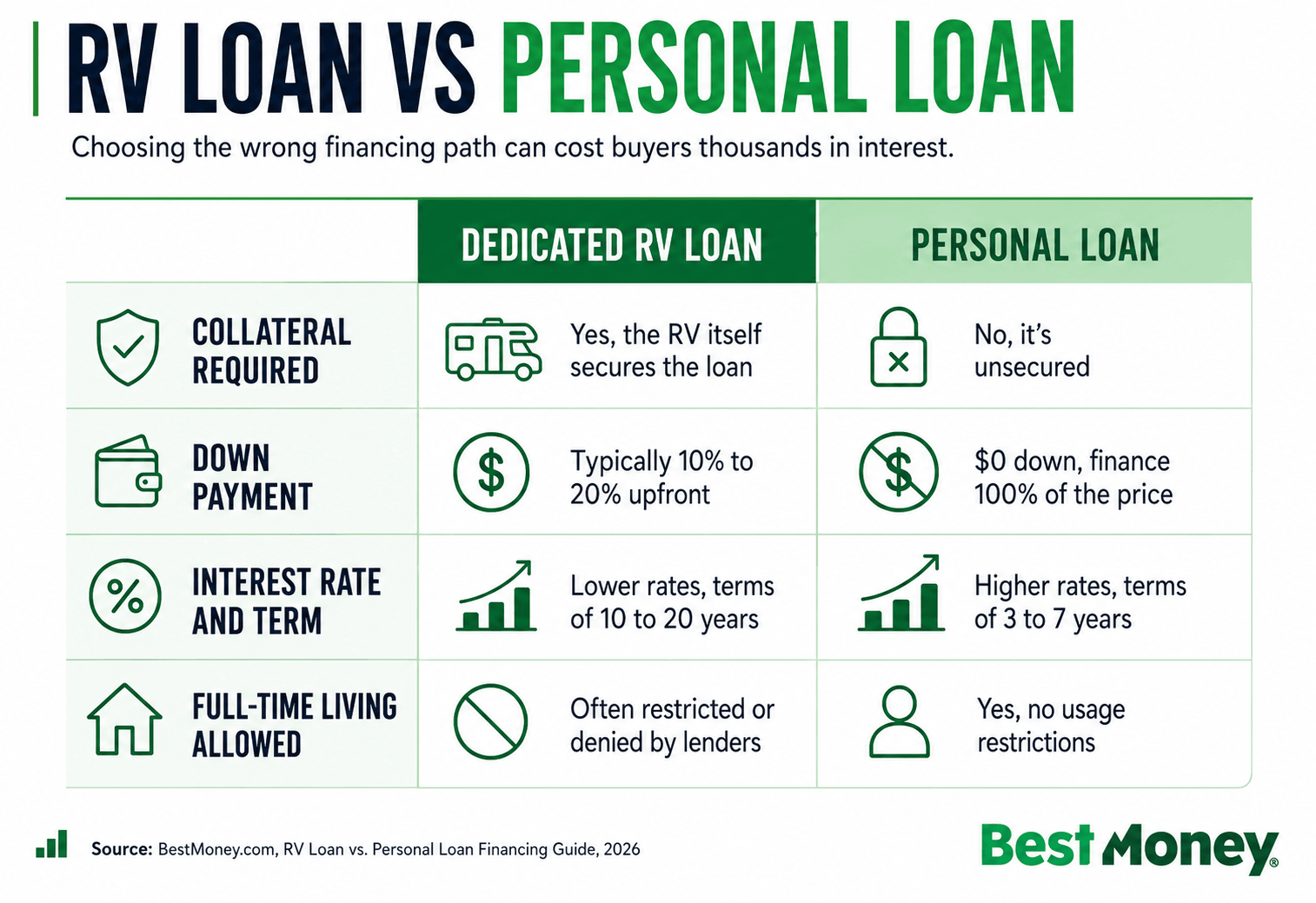
Feature | Dedicated RV Loan | Personal Loan |
|---|---|---|
Collateral Required? | Yes (the RV itself) | No (unsecured) |
Typical Loan Amounts | $10,000 to $300,000+ | $1,000 to $50,000 (rarely up to $100k) |
Typical Repayment Terms | 10 to 20 years (shorter terms available on lower-cost units) | 3 to 7 years |
Interest Rates | Generally lower | Generally higher |
Down Payment Requirement | Yes (typically 10% to 20%) | No (0% down possible) |
Speed of Funding | Days to weeks (requires vehicle appraisal/title work) | As fast as 24 to 48 hours |
Full-Time Living Allowed? | Often restricted or denied | Yes (no usage restrictions) |
Note: Loan term, down payment, and rate ranges reflect a review of current RV and personal loan lenders' policies across the industry as of 2026. Individual terms vary by lender, credit profile, and vehicle type.
"Providing longer terms on RVs is a standard practice across RV lending as it provides affordability to the consumer on something that will be owned and used for a substantial amount of time. Depreciation rates on RVs do vary from autos, but aren't vastly different in terms of percentage."
If you're thinking of hitting the road in an RV, let's look at how the numbers play out if you purchase a used RV or a higher-end, newer option.
Imagine you are buying a modest used travel trailer for $15,000. You are comparing a 5-year personal loan to a 5-year RV loan.
Note: Interest rates used below are estimated averages for borrowers with good credit; your exact rates will vary based on current market conditions and your credit score.
Option 1: 5-Year Personal Loan (Unsecured)
Option 2: 5-Year RV Loan (Secured)
The Verdict: The RV loan saves you about $1,660 in interest over five years and lowers your monthly payment. However, it requires parting with $1,500 in cash upfront and dealing with title liens. For a smaller purchase, the speed and zero-down appeal of a personal loan might outweigh the interest savings for some buyers.
Now, imagine you are purchasing a luxury Class A motorhome for retirement.
Why a Personal Loan Won’t Work
Most personal lenders max out at $50,000. Even if you could secure a $200,000 personal loan, you would be forced to repay it over 7 years. At a 10% APR, your monthly payment would be approximately $3,321, and you'd pay roughly $79,050 in total interest, on top of a monthly payment more than double what the 15-year RV loan option below requires.
The RV Loan Reality
The Verdict: Extending the term to 15 years brings the monthly payment down to a mortgage-like level ($1,483). However, the math shows a significant trade-off: over 15 years, you will pay more than $100,000 in interest alone, substantially increasing the total cost of ownership for an asset that is constantly losing value.
The best financing method depends entirely on your lifestyle, your budget, and your goals. Try using an online RV calculator to get an idea of what you'll pay for your new adventure on wheels, taking into account your age, lifestyle, and finances. To get you started, here's what we recommend for three distinct buyer profiles.
If you're planning to spend your golden years touring the country in a luxury Class A motorhome or a massive Fifth Wheel, a dedicated RV loan may be your best bet. The right term length, though, depends heavily on your age and how many active years of RV travel you realistically expect.
If you're buying a pop-up camper or a standard travel trailer in the $10,000 to $25,000 range for summer vacations, a personal loan is often the smarter, more flexible choice. While the interest rate might be slightly higher, a personal loan allows you to skip the 10% to 20% down payment.
More importantly, you receive the title free and clear immediately. If you decide two years later that the camping lifestyle isn't for you, you can easily sell the trailer on the private market without having to jump through the administrative hoops of paying off a lienholder to transfer the title.
If you're buying an RV or converting a Sprinter van to live in full-time to escape the high cost of traditional real estate, a personal loan is crucial. Many traditional RV and auto lenders have strict underwriting rules that expressly forbid full-time living in the collateral vehicle. If you apply for an RV loan and tell them you're living in it, they'll likely deny you.
A personal loan bypasses these rules entirely. The bank gives you the cash, and you're free to live in your rig 365 days a year without violating your loan agreement. The only downside is that there are limits on how much you can borrow, depending on the lender, your credit profile, and your financial situation.
"One thing that's commonly forgotten from the outside looking in is the regulatory landscape that comes with lending. There's a fine line between providing recreational financing and what some regulatory agencies, states, or municipalities would consider mortgage lending. The regulatory compliance and licensing that comes with that isn't something most lenders are willing to assume from a risk standpoint."
Personal Opinion: In my opinion, the "right" loan isn't just about the size of the RV, it's about whether the loan term realistically matches how long you'll actually use it. A 65-year-old taking out a 20-year loan, for example, is financing years of ownership well past the point most retirees are still driving a large rig. A shorter term, even with a higher monthly payment, could be the better choice here.
A family testing out RV life, or someone curious about van life, is a different story. They may actually be better served by lower payments and a longer term, as long as they can realistically sell or trade in the RV if the lifestyle doesn't stick. The loan term should fit the buyer's actual timeline, not just their budget today.
If you've decided that flexibility, zero down payment, and avoiding dealership financing games are your priorities, exploring unsecured financing is your immediate next step.
Maya Dollarhide is a writer specializing in personal finance, with a special focus on student loans and debt consolidation and management. She has written for Yahoo Finance, Investopedia, Student Loan Hero, Bankrate, and other publications.