Missed Filing Taxes for Years? Here's How to Catch Up Without Penalties
Missed Filing Taxes for Years? Here's How to Catch Up Without Penalties
Filing late returns stops the biggest penalty, even if you can't pay yet. Here's how to catch up one year at a time.
Written by
Orville Marshall
Orville Marshall is a tax expert at BestMoney.com. An Enrolled Agent with over 10 years of experience, he specializes in tax preparation and consulting for individuals and businesses. Orville holds an MBA in Business Administration from Nova Southeastern University and a degree in Accounting & Management Studies from The University of the West Indies, bringing extensive expertise in tax management and technology-driven solutions to his work.
Life gets complicated. You lost a job, went through a divorce, or your business overwhelmed you, and suddenly, years pass without filing.
If you haven't filed taxes in years, you're not alone. TheIRS 2025 Data Book shows it assessed $29.6 billion in tax, penalties and interest on returns not filed on time in fiscal 2025. For you, that means late returns get expensive, and filing sooner limits how much gets added.
Clients often fail to file because they lose key documents or fear owing taxes they cannot pay. Financial institutions requesting tax returns typically trigger taxpayers to finally file.
This guide explains how to determine what you owe, file back returns, use IRS relief, and when to seek help bycomparing tax relief companies.
Key Insights
Filing stops the 5%-a-month failure-to-file penalty, which is 10 times the 0.5% failure-to-pay rate.
The IRS normally enforces only the last six years of unfiled returns, under its Policy Statement 5-133.
Refunds and credits like the EITC are lost if you don't file within three years of the due date.
New in 2026: The IRS is replacing First Time Abate with an Automatic Exemption from Penalty for clean filing histories.
Most IRS payment plans and offers require every missing return to be filed first.
What Happens If You Don't File Your Taxes?
If you don't file, the IRS uses the income data it already has, sends reminder notices and can prepare a return for you. The IRS receives income information from employers and financial institutions through W-2 and1099 forms.
TheIRS Substitute for Return (SFR) is prepared with minimal information and might not credit deductions and exemptions you're entitled to. That usually means a higher tax liability than an actual return would show. The SFR uses onlySingle or Married Filing Separately status.
Think of an SFR as the IRS filling out your return using only the receipts it found in your mailbox. None of your deductions make it in. If the IRS files an SFR, filing your own return is still in your interest, and the IRS generally adjusts your account.
When both penalties apply, the IRS charges 4.5% for failure to file plus 0.5% for failure to pay each month for the first five months. IRS penalties grow fast because charges stack on top of each other.
The failure-to-file penalty is a percentage of thetax due. So if you were owed a refund for a year, there's generally no late-filing penalty.
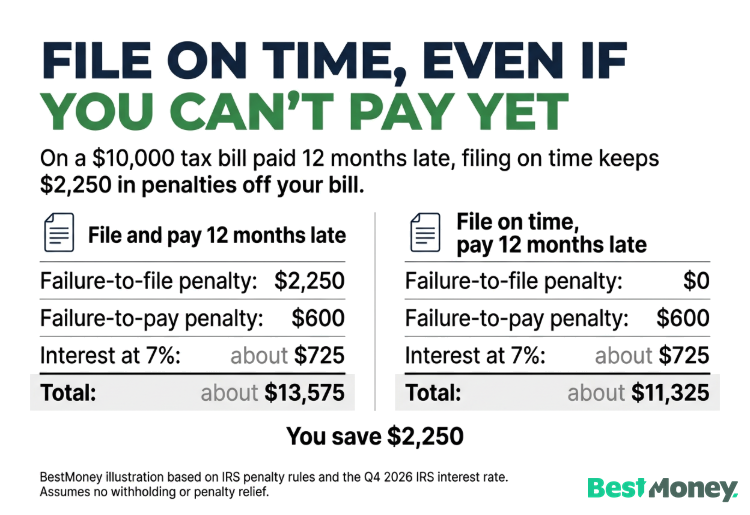
BestMoney's illustration based on IRS penalty rules; rates as of October 2026: Say you owe $10,000 and file and pay 12 months late. Here's how that compares with filing on time but paying 12 months late.
Cost
File and pay 12 months late
File on time, pay 12 months late
Tax owed
$10,000
$10,000
Failure-to-file penalty
$2,250 (4.5% for five months)
$0
Failure-to-pay penalty
$600
$600
Interest at 7%
About $725
About $725
Total
About $13,575
About $11,325
In this example, filing on time, even without paying, keeps $2,250 off your bill. It assumes no withholding and no penalty relief, and interest on penalties would add a little more.
Many clients seek professional help after receiving the CP504 (intent to levy) notice.
Pro tip: Filing your return even when you can't pay stops the 5% failure-to-file penalty from growing. You'll still owe the 0.5% failure-to-pay penalty and interest, but that's far less costly than facing both penalties combined.
Why Should You File Back Taxes Now?
Filing now stops penalty growth and protects money and benefits you could otherwise lose. The IRS guide tofiling past-due tax returns lists these reasons to act:
Before filing back taxes, you'll need to reconstruct your income, deductions, and credits.
IRS wage and income transcripts: Create an account at IRS.gov and request transcripts showing W-2 wages, 1099 income, and withholding amounts.
Contact former employers and financial institutions: Request W-2 copies, 1099 forms, and interest statements. Review old bank statements to reconstruct expenses.
Check tax software accounts: Companies often store old return data.
Start with the oldest year. Tax software rolls over information from previous years.
Make a list of income sources and expenses before preparing returns. Bank statements, sales and expense records, and prior tax returns are key documents.
How Do You Get an IRS Wage and Income Transcript?
You can view and download it in your IRS Individual Online Account, according to the IRSGet Transcript page. By mail, Form 4506-T lets you request every transcript type, including wage and income.
Return and account transcripts ordered by mail arrive in 5 to 10 calendar days. You can also call 800-908-9946.
Think of the transcript as the IRS's copy of your tax paperwork. It shows the W-2, 1099 and withholding data the IRS already has. If you filed jointly, order your spouse's transcript too.
How Far Back Does the IRS Make You File?
In most cases, the IRS asks for the most recent six years of returns. That's an enforcement policy,IRS Policy Statement 5-133, not a law, and going further back needs managerial approval.
There's no statute of limitations on unfiled returns. Technically, the IRS can go back decades, becausefederal law lets it assess tax at any time when no return was filed.
The IRS may require returns beyond six years if you had significant unreported income, operated businesses with payroll obligations, or if theysuspect tax fraud.
Think of the collection clock like a parking meter that doesn't start running until your tax is assessed. Filing your return is what gets it going.
How Do You File Back Taxes Step by Step?
File each missing year on that year's forms, starting with the oldest. You can't use current-year forms for prior years because tax laws change annually.
Step 1: Which Tax Forms Do You Need?
You'll need that year's Form 1040 plus relevant schedules (Schedule C for self-employment, Schedule SE forself-employment tax, Schedule E for rental income). Get prior-year forms from "Prior Year Forms and Instructions" on IRS.gov.
Step 2: How Do You Complete Each Return Accurately?
Apply that year's specific tax laws and brackets. Claim all deductions and credits you qualify for, because the IRS won't add these. Don't miss the Earned Income Tax Credit, Child Tax Credit, or education credits if you're entitled to them.
Step 3: Should You E-File or Mail Each Return?
You can e-file recent years, but older years must be mailed. The IRSaccepts e-filed returns for the current year and two prior years, which in 2026 means 2025, 2024 and 2023. You'll need tax software or a preparer.
For mailed returns, use certified mail with a return receipt requested to prove filing and delivery. If you got an IRS notice, mail the return to the address on the notice.
Include payment if possible. This reduces penalties and interest from the day the IRS receives it. The IRS says it takesabout 6 weeks to process an accurately completed past-due return.
Step 4: In What Order Should You File?
File from oldest to newest. Oldest first means each year's carryovers flow forward. Just know thattax refunds for years more than three years past due can't be claimed or applied.
You may see these options marketed as the IRS "Fresh Start" program. It isn't a separate program you apply for today. The IRS's currenttax debt help page lists payment plans, offers in compromise and penalty relief instead.
IRS relief options at a glance (as of October 2026)
Option
Who it fits
Key terms
Cost
Short-term payment plan
You owe less than $100,000 and can pay soon
Up to 180 days
$0 setup fee
Long-term or Simple Payment Plan
You owe $50,000 or less and have filed all returns
Up to 10 years; no financial statement for Simple Payment Plans
$29–$178 setup fee ($43 for low income, direct-debit fee waived)
Offer in Compromise
You can't pay in full through a plan or asset equity
Automatically approved if not decided within two years
$205 fee plus first payment, waived for low income
Penalty relief
You have a clean filing history or reasonable cause
AEP or First Time Abate, or reasonable-cause relief
No fee
Currently Not Collectible
You face severe financial hardship
Collection paused; interest and penalties continue
No fee
How Do IRS Payment Plans Work?
AnIRS payment plan lets you pay over time, and the setup fee depends on how you apply and pay. You can get a long-term plan if you owe $50,000 or less in combined tax, penalties and interest and have filed all required returns. Short-term plans of up to 180 days have no setup fee if you owe less than $100,000.
Simple Payment Plans need no financial statement and give most taxpayers up to 10 years to pay. Keep in mind that a longer term means more interest and penalties.
IRS long-term payment plan setup fees (as of October 2026)
How you pay
Apply online
Apply by phone, mail or in person
Direct debit
$29
$107
Other payment method
$69
$178
Low income
Direct debit: fee waived; other methods: $43
Direct debit: fee waived; other methods: $43
Direct debit comes with a lower setup fee. For ways to send money to the IRS, seehow to pay your taxes.
Can an Offer in Compromise Settle Your Tax Debt for Less?
Yes, if you qualify. AnOffer in Compromise lets you settle your tax debt for less than owed if paying the full amount would create genuine economic hardship. The IRS evaluates your income, monthly expenses, and asset equity to calculate what they believe they could realistically collect.
To qualify for an OIC: All required tax returns must be filed first. You must stay current with future filings and payments.
OIC application:$205 fee and initial payment (both waived for low-income taxpayers). A lump-sum offer requires 20% of the offer amount upfront.
OIC timeline: There's no fixed timeline, but an offer is automatically approved if the IRS doesn't decide within two years. Penalties and interest keep accruing.
Expect a tough review. In fiscal 2025, the IRSaccepted 5,464 of the 38,797 offers it received, or about 1 in 7. The IRS generally won't accept an offer if you could pay in full through a payment plan or the equity in your assets.
Can the IRS Remove Your Late-Filing Penalties?
Possibly, through administrative relief or reasonable cause. The IRS isreplacing First Time Abate with an Automatic Exemption from Penalty (AEP), announced July 8, 2026, in IR-2026-83. AEP applies starting with tax year 2025 returns for taxpayers who filed and paid on time for the three prior years.
For prior years, you can still requestFirst-Time Penalty Abatement by phone or with Form 843. Because it requires three clean prior years, it generally helps only with the earliest missed year if you skipped several in a row.
Reasonable Cause penalty abatement requires documenting circumstances beyond your control. Examples include serious illness, natural disasters, death of an immediate family member, or inability to obtain necessary records. Lack of funds by itself isn't reasonable cause, according to the IRS.
Ask About First-Time Abatement
If you have penalties from prior years, talk to a CPA who understands IRS relief programs. The First-Time Abatement might be available and it could save you real money.
It's a temporary pause on IRS collection for people in severe financial hardship. If paying basic living expenses leaves nothing for tax payments, the IRS may place your account inCurrently Not Collectible (CNC) status.
This temporarily stops active collection, though your debt continues accumulating interest. The 10-year collection statute generally keeps running unless paused.
The IRS may still apply your refunds to the debt and file a lien. It may also ask you to file past-due returns before granting CNC.
When Should You Get Professional Help With Back Taxes?
Get professional help when your case involves several years, business income or IRS enforcement. While it's possible to file back returns on your own, certain situations often call for professional help. Consider hiring an enrolled agent,CPA, or tax attorney when you:
Have multiple unfiled years
Are self-employed or own a business
Received IRS contact about enforcement
Owe over $25,000
Are considering an Offer in Compromise
What's the Difference Between an EA, a CPA and a Tax Attorney?
The main differences are who licenses them and how broad their services are.
Enrolled Agents: Federally licensed for tax matters.
Tax Attorneys: Legal training plus attorney-client privilege, often used for complex or criminal-risk cases.
How Can You Spot a Predatory Tax Relief Company?
Watch for big promises, upfront fees and pressure tactics. The tax resolution industry includes predatory companies that exploit people's fear with aggressive advertising and false promises.Watch out for these tax scams:
Promise specific settlement amounts before reviewing your finances
Ask for large upfront fees before explaining your options
Use pressure tactics like "limited time offers" or "act now before this program ends"
Advertise "pennies on the dollar" settlements without qualification
Employ unlicensed case managers instead of credentialed professionals
Avoid credential verification or refuse to provide license numbers
The FTC'sAug. 13, 2026, consumer alert adds its own warnings. Only the IRS or your state can decide what you qualify for. Don't pay a whole fee upfront, and know that no company can guarantee a particular result.
If you decide you need a firm, use the next steps at the end of this guide to compare vetted options.
What Does a Tax Relief Scam Look Like in Real Life?
It can look like a large deposit for a fraction of the work, as in this case from Orville Marshall's EA practice.
I worked with a client who responded to an advertisement promising quick relief. The company required a large deposit up front, then prepared only the current year's return without interviewing the client or addressing previous unfiled years.
When we met on another matter, I reviewed the draft return they sent for approval, but it was incorrect. I took over the engagement, got return transcripts from the IRS, filed all missing years properly, and negotiated a manageable payment plan. What the scam company failed to do, we resolved systematically.
How Do You Check a Tax Pro's Credentials?
Check each credential with the organization that issues it before hiring:
How Do You Stay Compliant After Catching Up on Taxes?
Stay compliant by paying taxes as you earn, so a new balance doesn't build up.
Pay quarterly estimated taxes: If you're self-employed or have income not subject to withholding, payestimated taxes by each quarterly due date the IRS sets.
Open a dedicated tax savings account: Move a fixed share of each payment there so funds are ready for quarterly taxes.
Automate your compliance: E-file for proof of receipt, book tax prep weeks before the deadline, and track income and expenses monthly in accounting software.
Pro tip: Keep all tax documents ready by late January. Wait for late-issued documents like investment statements, then file immediately. If you can't pay, file anyway to avoid the 5% failure-to-file penalty and explore payment options.
What's the Bottom Line on Catching Up on Unfiled Taxes?
Start with the oldest return first. Don't overwhelm yourself thinking about all the years ahead. The key is taking action now.
Filing voluntarily, before the IRS forces the issue, gives you access to more relief options. If you owe taxes you can't pay, file anyway. The 5% monthly failure-to-file penalty is 10 times the monthly rate of the failure-to-pay penalty.
For complex situations, compare tax relief companies using the next steps below, orsettle with the IRS yourself if your case is straightforward.
Who Is This Guide For?
This guide is for anyone with unfiled federal returns, whatever the reason.
W-2 employees with withholding: You may be owed refunds, but only for years inside the three-year claim window.
Self-employed and gig workers: With no withholding, you may owe, so file soon to stop the failure-to-file penalty.
People who got a CP59, CP2566 or CP3219N: File your own return so your deductions and credits count.
People who owe and can't pay in full: File first, then apply for a payment plan or other relief.
Anyone who hasn't filed taxes in five or 10 years: Focus on the last six years first and consider a tax pro.
State returns follow state rules. For state balances, see our guide tostate tax debt relief.
Your Questions, Answered (FAQs)
How many years of unfiled tax returns do I need to file?
Six years, in most cases, under IRSPolicy Statement 5-133. The IRS can go further back for fraud or significant unreported income.
What if I can't afford to pay the taxes I owe?
File anyway, since filing stops the 5% monthly failure-to-file penalty. Then consider an IRS payment plan (up to 10 years for balances of $50,000 or less), an Offer in Compromise or Currently Not Collectible status.
Can you go to jail for not filing taxes?
Rarely for simply being behind, but willful failure to file is afederal misdemeanor. It's punishable by up to one year in prison, a $25,000 fine, or both.
Can I still get a refund for an old tax year?
Only if you file within three years of the original due date. Older refunds are forfeited, as explained in the section on why you should file back taxes now.
Can I file back taxes online?
Yes, for the current year and two prior years, through tax software or a preparer. Older years must be mailed, as covered in Step 3 above.
Why Trust BestMoney?
This guide comes fromOrville Marshall, a BestMoney tax expert and Enrolled Agent with more than 10 years of experience. He specializes in tax preparation and consulting for individuals and businesses.
Orville holds an MBA in Business Administration from Nova Southeastern University. He also has a degree in Accounting & Management Studies from The University of the West Indies. The client examples in this guide come from his practice.
How We Researched This
We built this guide from official secondary sources plus our author's experience as an EA. We didn't use a BestMoney survey, because we don't have one on this topic.
Data sources: IRS pages on penalties, notices, payment plans, offers, penalty relief, e-file and past-due returns, plus the IRS 2025 Data Book.
Other official sources: Taxpayer Advocate Service guidance, the FTC's August 2026 consumer alert and the U.S. Code via Cornell Law School.
Expert review: Orville Marshall, EA, shared perspective on client behavior, record reconstruction, scam tactics and resolution strategies. Joey Joseph, CPA, added insight.
Calculations: The $10,000 example is BestMoney's illustration based on IRS penalty rules and the Q4 2026 interest rate.
Limitations: We reviewed this in October 2026, and it reflects IRS guidance as of then. Fees, rates and individual situations vary.
Orville Marshall is a tax expert at BestMoney.com. An Enrolled Agent with over 10 years of experience, he specializes in tax preparation and consulting for individuals and businesses. Orville holds an MBA in Business Administration from Nova Southeastern University and a degree in Accounting & Management Studies from The University of the West Indies, bringing extensive expertise in tax management and technology-driven solutions to his work.