Shorten your timeline, cut interest, and decide whether early payoff or a lower-rate refinance fits your budget.
Written by
Leanora Benjamin
Leanora Benjamin is a mortgage loan officer and finance expert at BestMoney.com. Licensed under NMLS #2283860, she specializes in home financing and mortgage lending, helping clients navigate the loan process. Leanora currently serves as a Mortgage Loan Officer at Achieve and works as a North Carolina Notary Signing Agent.
Personal loan balances are still sizable for many households—Experian's personal loan research put the average U.S. balance near $19,333 in 2025 (September data; published March 30, 2026).
Yes—you can usually pay off a personal loan faster by putting extra money on principal. Stack extra monthly payments, biweekly schedules, round-ups, or windfalls. Refinance only when a lower rate or shorter term clearly helps. Before a large lump sum, confirm any prepayment penalty. When you shop replacement loans,compare personal loan options on early-payoff terms, APRs, and fees.
Personal loan rates were still expensive for many borrowers in mid-2026, which makes principal reduction more valuable over a multi-year term. The Federal Reserve’sG.19 Consumer Credit release shows a commercial-bank finance rate of 11.86% on 24-month personal loans as of May 2026 (also tracked as FRED series TERMCBPER24NS). Some lenders publish mid-single-digit starting APRs for strong profiles; those are starting points, not averages.
“You should only take out the loan amount that you need. Most of the personal loan lenders do charge higher interest rates than a standard home loan lender, so it's important to keep the amount you borrow low,” says Jillian Hishaw, a bankruptcy attorney at Hishaw Law LLC, quoted in BestMoney’s Personal Loans Explained guide.
What Are the Key Insights on Paying Off a Personal Loan Faster?
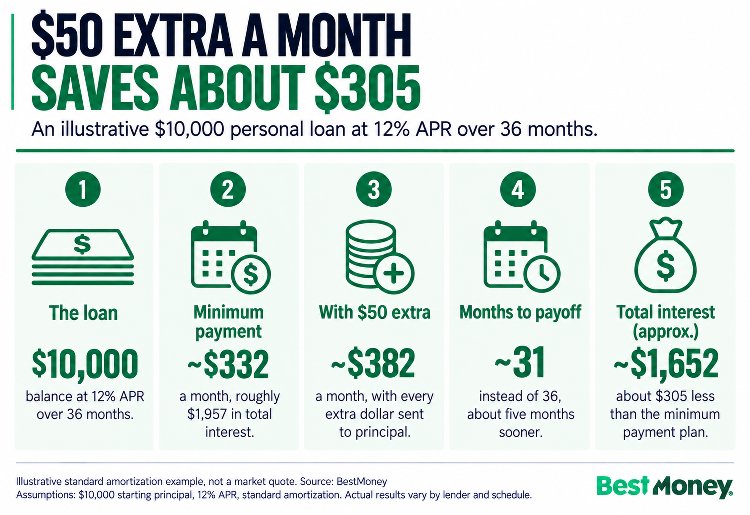
Extra monthly principal payments may cut interest and shorten repayment. (See illustrative table below.)
Biweekly payments can create a 13th payment each year toward principal.
Tell your lender to apply extras to principal—not prepaid future installments.
Check your contract for prepayment penalties before a large lump-sum payoff.
Refinance only when the new rate or shorter term beats fees and remaining interest.
Why Does Paying Off a Personal Loan Faster Save Money?
Think of principal like weight in a backpack: every extra dollar you remove makes the next stretch of the hike cost less energy. On many amortizing personal loans, early payments cover more interest than principal. Extra payments made early can have a bigger impact because they reduce the balance that generates future interest.
Illustrative amortization example (not a live market quote; standard amortization math—see How We Researched This):
Payment plan
Monthly payment
Months to payoff
Total interest (approx.)
Interest savings vs. minimum
Minimum only ($10,000 at 12% APR, 36 months)
~$332
36
~$1,957
—
Minimum + $50 extra to principal
~$382
~31
~$1,652
~$305
Assumptions: $10,000 starting principal, 12% APR, standard amortization. Actual results vary by lender and schedule.
Below are eight strategies that show how to pay off a personal loan faster and capture interest savings.
How Can You Pay More Than the Minimum Each Month?
Pay more than the required monthly amount and apply the extra directly to principal.
Treat the minimum as a floor, not a target. Even a modest automated bump can shorten a three- to five-year loan.
Start modestly: Add a fixed extra (for example $50) above your minimum and automate it.
Automate the extra: Schedule the higher amount so consistency does not depend on willpower.
Confirm principal application: Ask your servicer to reduce principal immediately—not hold extras as advance payments.
Illustrative only: On a $10,000 balance at 12.25% APR, about $50 extra per month can trim interest and months; re-run the math with your statement.
How Do Biweekly Loan Payments Speed Up Payoff?
Pay half your monthly amount every two weeks. With 52 weeks in a year, that is 26 half-payments—equal to 13 full payments instead of 12—if the lender posts each half-payment when received.
This works best if you are paid biweekly. You align payments with paychecks and may add roughly one extra full payment per year.
How it works: A $400 monthly bill becomes $200 every two weeks ($5,200/year vs. $4,800).
Verify lender acceptance: Confirm half-payments post immediately, not after a full month piles up.
Alternative: If biweekly is unsupported, keep monthly payments and add one extra full payment yearly.
Schedule
Payment size
Payments per year
Total paid per year
Extra toward principal
Monthly
$400
12
$4,800
—
Biweekly (half-payments)
$200 every 2 weeks
26 half-payments
$5,200
~1 full payment ($400)
Illustrative schedule only. Savings depend on APR, remaining term, and posting rules.
How Should You Apply Windfalls to Your Loan Principal?
Decide your split before a refund or bonus hits—for example, 60% to principal, 20% to savings, 20% for discretionary spending—so the balance drops without draining every comfort.
One detailed example (illustrative): Suppose $3,000 intax refund cash arrives while you still owe principal on a 10% APR personal loan. Without the extra payment, that $3,000 of principal would keep generating interest. Applied to principal, the same $3,000 stops accruing interest at your loan’s rate going forward—an avoided-interest effect equal to the rate on the amount retired. Confirm the servicer posts the lump sum to principal.
Windfall type
Example move
What to confirm
Tax refund
Send a set share straight to principal
Principal application + any payoff quote fees
Work bonus / overtime
Commit a pre-set percentage to the loan
Same-day or next-cycle posting rules
Side-gig income
Route surplus months to principal
No prepayment penalty on larger extras
Lump sums earlier in the term generally retire more future interest than the same dollars near the end.
How Does Rounding Up Your Monthly Payments Help?
Rounding to the nearest $50 or $100 creates a steady principal bump without complex math.
One detailed example (illustrative): If your bill is $287, pay $300. That $13 extra each month is $156 per year toward principal—if the lender applies it correctly. Some borrowers find a round number easier to automate than an odd minimum.
Approach
Payment
Extra per month
Extra per year
Stated minimum
$287
—
—
Rounded up
$300
$13
$156
When Should You Use the Debt Avalanche or Snowball Method?
If you carry multiple debts, pick a repayment order you will keep. Single-loan readers can skip this section. A practical method is the one you will stick with consistently. For broader multi-debt context, see BestMoney’s guide onhow to pay off debt.
What Is the Debt Avalanche?
Pay minimums on every balance. Send all extra dollars to the highest APR first. This approach is designed to minimize total interest when you follow it through.
What Is the Debt Snowball?
Pay minimums on every balance. Send extras to the smallest balance first. Quick closures can build momentum even when the interest math is not optimal.
When one debt is gone, roll its full former payment onto the next target.
Debt
Balance
APR
Avalanche order
Snowball order
Credit card
$2,500
22%
1st (highest APR)
1st (smallest balance)
Personal loan
$8,000
14%
2nd
2nd
Illustrative only. Here both methods hit the card first for different reasons. Swap in your balances and APRs.
Where Can You Find Extra Money in Your Budget?
Some households can free cash by pausing underused spending for a defined stretch—often 6–12 months—while they attack principal.
One before/after example (illustrative): Imagine $45 in unused streaming and apps, $80 trimmed from restaurant nights, and $40 from fewer convenience coffees. That is about $165 per month that can move to principal on top of your minimum—if you automate the transfer the day after payday.
Budget lever
Example monthly free-up
Where it goes
Cut 2–3 unused subscriptions
Often tens of dollars
Extra principal
Fewer restaurant meals
Varies by habit
Extra principal
Fewer convenience purchases
Varies by habit
Extra principal
Average balances remain meaningful: Experian’s personal loan research (linked above) reported about $19,333 in 2025. Your statement is the only number that matters for your plan.
When Does Refinancing to a Lower Rate or Shorter Term Make Sense?
If your credit improved or offers look cheaper, you may refinance into a lower APR or a shorter term.
Refinancing should lower your rate, shorten payoff time, or both. A lower payment alone can be a trap: stretching the term is like cutting a subscription bill by adding more months—you may pay less each month and more overall.
Compare total cost: Weigh new APR, fees, and months left against your current remaining interest—case by case, not a fixed “points” rule.
Check costs: Review origination fees on the new loan and any prepayment fee on the old one.
Shorter terms: Higher monthly payments can force faster principal reduction when the budget allows.
When you shop refinance offers, compare APRs, fees, and payoff timelines side by side. Review related guidance onpros and cons of personal loans before you replace one installment loan with another.
How Do You Avoid Fees and Check for Prepayment Penalties?
Many personal loans allow early payoff with no prepayment penalty, but some still charge a flat fee or a share of the remaining balance. Read your loan agreement and Truth in Lending disclosures before sending a large extra payment.
Late fees and returned-payment fees can erase progress. One call can clarify autopay discounts and how extras post.
Prepayment penalties: If present, fees vary by contract—review your agreement before large extras.
Autopay: Helps avoid late fees; some lenders offer a small rate discount for enrollment.
Request a written payoff quote with a good-through date.
Confirm any prepayment penalty line item.
Confirm funds reduce principal (not future installments only).
Compare any penalty to interest you would otherwise pay.
Should You Pay Off a Personal Loan Early?
Paying early often makes sense when interest savings and simpler cash flow beat locking cash into the loan.
Reasons to pay early
Reasons to go slower
Cut total interest and finish sooner
Emergency savings are still thin
Free monthly cash flow for goals
Higher-APR debt elsewhere should come first
Reduce stress and simplify your budget
A prepayment penalty exceeds remaining interest savings
If a full payoff is not realistic yet, chip away with the strategies above. Shop a shorter-term or lower-APR refinance only when your credit and offers support it.
How Can You Estimate What You’ll Save?
Estimate savings with a few amortization inputs—not a software product.
Input
Illustrative value
Why it matters
Remaining balance
$10,000
Interest is charged on principal outstanding
APR
12%
Higher APR raises the value of each extra dollar
Remaining term
36 months
Sets the baseline payment and interest total
Extra monthly
$50
Shortens months and total interest when applied to principal
Schedule
Monthly vs. biweekly
Biweekly can add about one full payment per year
Using the same illustrative $10,000 / 12% / 36-month case, about $50 extra per month can drop total interest by roughly $444 and finish near month 29. Larger balances use the same levers—extra principal, biweekly cadence, windfalls, and a cheaper refinance—but not the same dollar savings. Re-run the math with your statement and a lender payoff quote.
Who Is This Guide For?
You hold one unsecured personal loan and want a faster payoff plan.
You juggle multiple debts and need avalanche vs. snowball clarity.
You may refinance after a credit or rate improvement.
You need to know whether a prepayment penalty changes the math.
Not a deep dive into student-loan or mortgage-only prepayment rules.
Can I pay off a personal loan early without a penalty?
Often yes—many personal loans allow early payoff with no prepayment penalty—but some still charge a fee. Verify your contract and Truth in Lending disclosures before sending a lump sum.
Will paying off my personal loan early hurt my credit score?
Paying off a loan early might cause a smalltemporary credit score dip from reduced credit mix. The long-term benefit of less debt often outweighs a short-lived change.
Do extra payments automatically reduce principal?
Not always. Some servicers apply extras as prepaid installments unless you instruct them to reduce principal immediately—confirm in writing.
Should I build savings before aggressive loan payoff?
Build a basic emergency fund of about $1,000–$2,000 before aggressive payoff. Then split extras between savings growth and principal until you reach roughly 3–6 months of expenses.
Can I negotiate a lower interest rate without refinancing?
Some lenders offer autopay or loyalty discounts. Ask about rate reduction programs if you have a strong on-time history.
Why Trust BestMoney?
This article was written by Leanora Benjamin, a mortgage loan officer and finance expert at BestMoney.com (NMLS #2283860). She specializes in home financing and mortgage lending, serves as a Mortgage Loan Officer at Achieve, and works as a North Carolina Notary Signing Agent.
Payoff strategies and illustrative amortization examples in this guide were reviewed for clarity by Leanora Benjamin. Rate context uses Federal Reserve G.19 data; balance context uses Experian’s personal loan research. BestMoney is a comparison and referral marketplace, not a lender, and this page is general education rather than personalized financial advice.
How We Researched This
Expert review: Strategies and examples reviewed by Leanora Benjamin (NMLS #2283860).
Calculations: Illustrative payoff figures use standard amortization on labeled balances and APRs.
Rates: Federal Reserve G.19 (May 2026 commercial-bank 24-month personal loan finance rate).
Balances: Experian personal loan research (September 2025 data; published March 30, 2026).
Limits: Fees, prepayment rules, and refinance eligibility vary by lender and borrower.
Where We Got Our Information
Federal Reserve G.19 Consumer Credit — 11.86% as of May 2026 (24-month bank personal loan finance rate; also FRED TERMCBPER24NS).
Experian personal loan research — average balance about $19,333 (September 2025 data; published March 30, 2026).
Jillian Hishaw, Hishaw Law LLC — guest expert quote via BestMoney’s Personal Loans Explained guide.
BestMoney personal loan education pages linked in this article.
Standard amortization methodology for illustrative payoff examples.
What Should You Do Next?
Paying off a personal loan faster works best when you stack habits you can keep: biweekly or one extra annual payment, modest round-ups, and windfall principal hits.
Confirm the rules. Ask about prepayment penalties and how extras apply to principal.
Automate one strategy. Add a fixed extra, round up, or use a biweekly-equivalent plan.
Revisit rate and term. If interest is the bottleneck, shop offers side by side on APR, fees, and payoff timelines—and readpaying off a consolidation loan early if your balance started as multi-debt cleanup.
Recheck fees. Use autopay if it prevents late fees; keep a basic emergency cushion.
Even small extras on an illustrative $10,000 loan can remove months and interest when applied to principal. Start with two or three strategies that fit your cash flow, then automate them.
Conclusion: Your Faster Payoff Roadmap
To pay off a personal loan faster, retire principal early, confirm how extras and payoffs post, and only refinance when total cost improves. Watch prepayment fees, protect a small emergency cushion, and automate the one or two tactics you will actually keep. Revisit your statement math whenever your balance, rate, or cash flow changes.
Written byLeanora Benjamin
Leanora Benjamin is a mortgage loan officer and finance expert at BestMoney.com. Licensed under NMLS #2283860, she specializes in home financing and mortgage lending, helping clients navigate the loan process. Leanora currently serves as a Mortgage Loan Officer at Achieve and works as a North Carolina Notary Signing Agent.