Middle-Aged Americans Trust AI Financial Advice More Than Any Other Generation
Middle-Aged Americans Trust AI Financial Advice More Than Any Other Generation
Our survey also found that people in this group are the most likely to chase credit card sign-up bonuses.
Written by
Holly Johnson
Holly Johnson is a money and insurance expert who has covered personal finance, credit cards and insurance for over a decade. She is passionate about explaining the ins and outs of financial products to consumers, and is the co-author of "Zero Down Your Debt: Reclaim Your Income and Build a Life You’ll Love." She lives in Indiana with her husband and children.
According to our research, Americans tend to shop for more than one financial product at a time. In the past year, half looked into a new credit card, nearly as many opened or compared a savings account, and more than a third researched a loan, insurance policy, or investment account.
Interestingly, more than half are doing that research with an AI chatbot’s help: Fifty-nine percent of the U.S. adults BestMoney surveyed said they’ve used a tool like ChatGPT, Claude, Gemini, or Google’s AI Mode to help pick a financial product.
Another surprising detail is the age group that is increasingly using AI for their research. Our survey found that Americans ages 45 to 60 trust and use AI for financial decisions more than any other age group. This is especially true when it comes to picking a new credit card.
Key Insights
Well over half (59%) of respondents have used AI to research a financial product, and almost as many (53%) of them acted on exactly what it suggested.
Americans ages 45 to 60 are the most AI-trusting age group. Sixty-nine percent have used AI to research, and well over half (56%) would again.
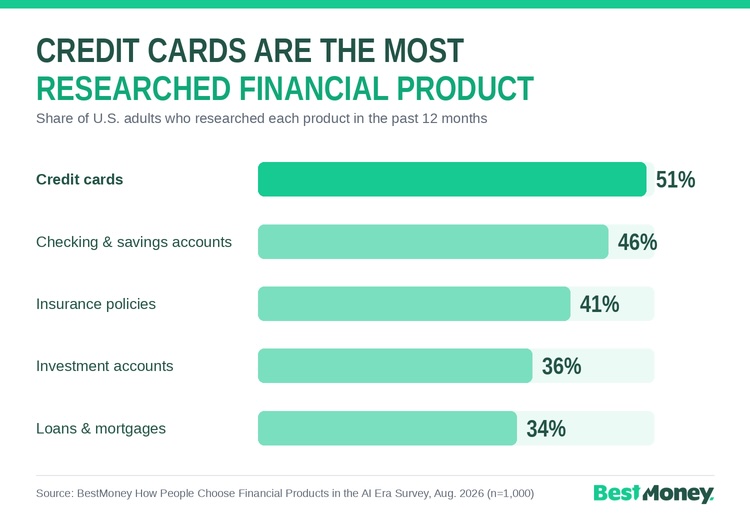
Credit cards are the most-researched financial product overall, with more than half of respondents (51%) looking into one in the past year.
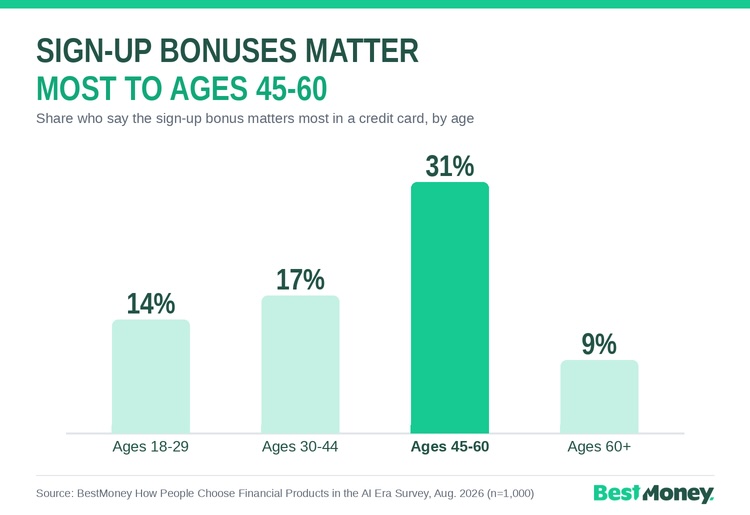
Almost one third (31%) of 45-to-60-year-olds say a credit card’s sign-up bonus matters most, more than double the rate of shoppers 60+.
Provider websites are the most trusted source overall (38% call them “very trustworthy”), ahead of AI chatbots and Google.
Almost two-thirds (63%) of shoppers ages 60 and older prioritize a low rate or no fee over credit card rewards, the most of any age group.
Seventy percent would rely on AI more than they do now if it were proven highly accurate, up from the fifty-nine percent who already use it.
Key Findings
How Are Americans Researching Financial Products Today?
Credit cards are the single most-researched financial product in our survey. More than half (51%) of respondents said they’d looked into a credit card for themselves or their household in the past 12 months, ahead of checking and savings accounts (46%), insurance policies (41%), investment accounts (36%), and loans or mortgages (34%).
When it comes to where people look, no single channel dominates: Twenty percent rely most on a provider’s own website, and another 20% rely on traditional search engines, 18% on friends, family, or an advisor, and 14% on an AI chatbot.
AI chatbots are already a bigger source than social media (5%) or online forums (7%), though still well behind a provider’s own website and search engines. Most people don’t stop at one source, either: More than four-fifths of respondents (81%) check at least two platforms before making a final choice.
How Many People Are Turning to AI, and Does It Work?
Respondents to our survey were also inclined to use AI for financial product research. Specifically, fifty-nine percent said they’ve used a tool like ChatGPT, Claude, Gemini, or Google’s AI Mode to help research or choose a financial product.
Among that group, eighty-six percent rated the quality of what the AI suggested as “excellent” or “good,” and more than half (53%) said they went on to apply for or open the exact product the AI suggested. Another third of respondents (34%) said the AI shaped their shortlist even if they ultimately chose differently.
Add those two groups together and around eighty-seven percent of AI-assisted shoppers said the tool had a real influence on what they ultimately did. Interest also isn’t tapering off: almost two-thirds (61%) of all respondents say they’re likely to use an AI chatbot for this kind of research in the future, and if AI tools were proven highly accurate, more than two-thirds (70%) say they’d rely on one more than they do today.
Do People Verify Recommendations Before Acting?
Often, yes. When we asked what people did the last time they saw a financial product recommended anywhere, whether on TV, social media, a forum, or through AI, most said they didn’t act immediately. Almost thirty percent (29%) said they searched elsewhere to verify or compare it first, which is more than double the nine percent who clicked through and applied right away. Another seventeen percent took no further action at all, and eighteen percent went directly to the provider’s own site, which lines up with providers being the most trusted source overall.
Which Source Do People Trust Most?
Despite the rush to AI, it isn’t the most trusted source. When we asked how trustworthy each source felt for honest, unbiased financial product recommendations, a provider’s own website ranked highest, with more than a third (38%) calling it “very trustworthy.” Google search (29%) and financial comparison websites (30%) came next, followed by online community forums (27%).
AI chatbots trailed at just under a quarter of respondents (24%), just ahead of social media creators and influencers (20%). That said, trust in AI isn’t simply low — it’s split. More than half (52%) of respondents called AI chatbots at least somewhat trustworthy, close to comparison sites (58%) and forums (64%).
But AI chatbots also drew the highest outright distrust of any source: Just under twenty percent (19%) called them “not very” or “not at all” trustworthy, which is more than three times the share who said the same about Google search or a provider’s own website (6% each). People who don’t trust AI for this really don’t trust it.
What Matters Most When Choosing a Credit Card?
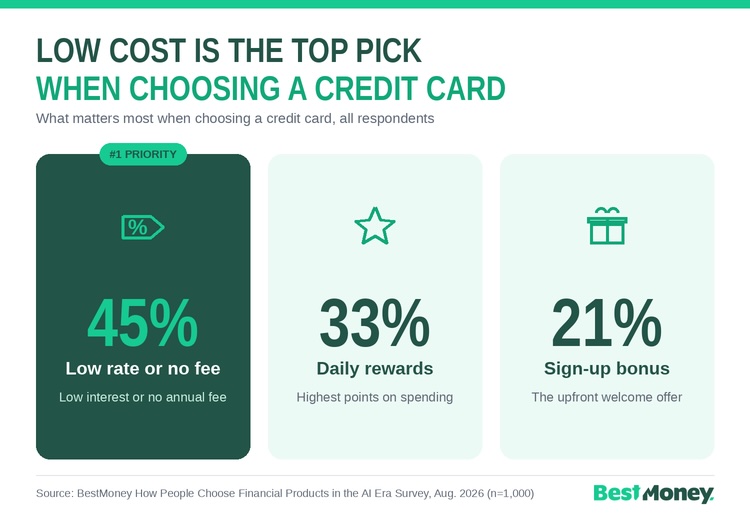
Since credit cards are the product Americans research most, our survey dug deeper into how people actually choose one. When we asked what matters most, almost half (45%) picked a low interest rate or no annual fee, ahead of ongoing rewards (33% picked daily points with the highest return) and a sign-up bonus (21%).
Combined, more than half of respondents (53%) said some form of reward, either the points or the upfront bonus, mattered more than the card’s baseline cost. That trade-off carries real weight: Americans owe a record $1.26 trillion in credit card debt, according to the Federal Reserve Bank of New York, and every one of those balances carries an interest rate that makes a card’s ongoing terms matter as much as its perks.
Which Age Group Chases Sign-Up Bonuses the Most?
This is where the age pattern from the rest of the survey shows up again, and most sharply. Nearly a third of respondents ages 45 to 60 (31%) said the sign-up bonus is what matters most to them in a credit card. That’s more than double the rate of shoppers ages 60 and older (9%), and well ahead of both younger brackets: 18-to-29-year-olds (14%) and 30-to-44-year-olds (17%).
Who Cares Most About Fees Instead of Perks?
Shoppers ages 60 and older tell a different story. Almost two-thirds (63%) of this group said a low interest rate or no annual fee matters most, compared with just over one third (41% to 42%) across every younger bracket. Meanwhile, combined, daily points and sign-up bonuses matter most to fewer than a third of respondents 60 and older, the lowest share of any age group.
Expert Commentary
People are already using AI to help pick financial products more than they say they trust it, and more than half act on exactly what it recommends. According to the experts we spoke to, there are numerous reasons consumers rely on AI for financial advice.
Financial advisor Jacob Bayer of Jacob Bayer Wealth Management says it’s all about access. A 50-year-old with $400,000 in a 401(k) is typically below the asset minimum most advisory firms require, so the choice isn’t between AI and a planner — it’s between AI and nothing.
The tool answers at 11 p.m., never makes the user feel behind, and never charges $3k for a plan. That is a true gap in the market and filling that gap is what drives people to use this tool.
AI can eliminate excuses for avoiding financial planning, and it reduces anxiety, shame, and complexity from getting an opinion. But an algorithm can’t teach people discipline.
Consumers’ overall reliance on it shows up sharply in credit cards, the product people research most, and in one specific age group.
This could be because picking a credit card is less complicated than, say, creating a full investment plan. Assistant Professor Leo Chen with the University of South Florida also says that people in middle age are busy in general, thus they may be inclined to use tools that make things easier.
Middle age is the life stage where people have the least spare time to book a meeting due to work and life involvements.
Leo Chen PhD in business administration and financeUniversity of South Florida
Beyond that, Chen points out that AI can feel “neutral” because there is no commission riding on the answer if someone chose a common AI product such as ChatGPT to get their questions answered.
Segment Insights
Age is where this survey’s findings diverge the most, both in how people research financial products broadly and in how they choose a credit card specifically.
Shoppers ages 45 to 60 stand out from every other bracket. This group is the most likely to have used AI to research a financial product (69%, versus 60% of 30-to-44-year-olds, 63% of 18-to-29-year-olds, and just 28% of those 60 and older).
They’re also the most likely to say they’d rely on AI “much more” if it were proven highly accurate (54%, more than double every other age group) and the most likely to say they’re “very likely” to use an AI chatbot for this kind of research in the future (56%, versus 19% of 18-to-29-year-olds and 14% of those 60 and older). That same enthusiasm carries straight into credit cards: almost one third (31%) of this group prioritizes the sign-up bonus, more than any other age bracket.
That same group is also the least likely to shop around to compare. When we asked how many platforms people typically check before choosing a financial product, just under twenty percent (18%) of 45-to-60-year-olds said they don’t compare at all, and that they go with the first option they find. That’s the highest share of any age bracket; every other group landed between 2% and 6%.
Shoppers ages 60 and older sit at the opposite end on nearly every measure. They’re the least likely to have used AI for this kind of research, the least likely to say they’d lean on it more in the future, and, as the credit card findings above show, by far the most likely to prioritize a low rate over any rewards feature.
Younger respondents fall in between. Consumers ages 18 to 29 are almost as likely as 45-to-60-year-olds to value a sign-up bonus over other rewards, but they’re also more inclined to double-check any recommendation before acting on it. Learning how to build credit helps younger cardholders weigh a bonus against a card’s long-term terms before applying.
Implications
What Should You Do Next?
Whatever financial product you’re comparing, the survey suggests two things are worth knowing about yourself: how much you lean on AI recommendations, and how many places you actually check before deciding.
Credit cards make the trade-off easiest to see. If you’re between 45 and 60, the survey suggests you’re the most likely to be swayed by a flashy sign-up offer, and the least likely to have checked more than one place before deciding. That combination is worth pausing on, especially if an AI tool is the one making the suggestion.
A few concrete steps:
Comparison shop. Compare a card’s welcome bonus against its ongoing rate and annual fee, and not just against other bonuses. A big sign-up offer can still cost more over a year or two than a card with no bonus at all.
Do more research. If an AI tool recommends a specific product, whether it’s a credit card, a loan, or an insurance policy, treat it as a starting point, not a final answer. Verify the current terms directly on the provider’s site before applying, especially since our survey found provider websites are actually the more trusted source.
Run the numbers. If you’re 60 or older and already prioritizing low fees and rates, make sure you’re not leaving real value on the table. See what a rewards card would actually be worth for your spending, even if a bonus isn’t the deciding factor.
None of this means AI recommendations or sign-up bonuses are a bad deal. Both can be genuinely useful. The survey just suggests that the group most inclined to trust a recommendation and the least inclined to shop around may overlap.
Conclusion
AI has become a real part of how Americans choose financial products, with well over half (59%) having used it and more than half of those acting on exactly what it recommended. But trust hasn’t caught up to usage: providers’ own websites, not AI chatbots, remain the most trusted source.
Age is the biggest divide running through all of it. Shoppers ages 45 to 60 are the most AI-trusting group by far, and that shows up clearly in credit cards, the product Americans research most. This age group is the most drawn to a sign-up bonus and the least likely to compare more than one option first.
Shoppers ages 60 and older sit at the other extreme, prioritizing a low rate or no annual fee (63%) over any perk, more than any other age group.
Neither approach is wrong. A sign-up bonus can be worth real money, and a low rate matters even more once you’re carrying a balance. The takeaway from BestMoney’s survey isn’t which group has it right — it’s that knowing your own tendency, whether that’s leaning on AI, chasing a bonus, or defaulting to the first option you find, is the first step to making sure you’re getting the best product for your needs.
Your Questions, Answered (FAQs)
What financial product do Americans research most?
Credit cards. More than half (51%) of respondents said they’d looked into a credit card for themselves or their household in the past 12 months, ahead of checking and savings accounts (46%), insurance (41%), investments (36%), and loans (34%).
Do people trust AI chatbots more than other sources for financial advice?
No, not yet. Less than a quarter (24%) of respondents called AI chatbots “very trustworthy,” behind a provider’s own website (38%), Google search (29%), and comparison sites (30%). That’s despite well over half (59%) of respondents already having used AI to help research a financial product.
What matters most to Americans when choosing a credit card?
A low interest rate or no annual fee matters most to some consumers, with just under half (45%) of respondents picking cost over any rewards feature. Combined, sign-up bonuses and ongoing points mattered most to more than half (53%) of respondents, so rewards still edge out cost when grouped together.
Do younger or older credit card shoppers care more about sign-up bonuses?
Shoppers ages 45 to 60 do, more than any other age group. Almost one third (31%) of this group said the sign-up bonus matters most, compared with 17% of 30-to-44-year-olds, 14% of 18-to-29-year-olds, and just 9% of those ages 60 and older.
What do people 60 and older prioritize instead of rewards?
Older Americans prioritize a low rate or no annual fee. Almost two-thirds (63%) of respondents ages 60 and older said this matters most in a credit card, the highest share of any age group and well above the 41% to 42% seen in every younger bracket.
How many people use AI to help choose a credit card or other financial product?
Just under sixty percent (59%) of respondents said they’ve used an AI tool like ChatGPT, Claude, Gemini, or Google’s AI Mode to help research or choose a financial product. Usage is highest among 45-to-60-year-olds (69%) and lowest among those ages 60 and older (28%).
Should you trust an AI chatbot’s credit card recommendation?
Treat it as a starting point rather than a final answer. More than half (53%) of AI-assisted shoppers in our survey said they applied for or opened the exact product the AI suggested, so it’s worth verifying the card’s current terms directly with the issuer before doing the same.BestMoney is a good place to check a recommendation against other options.
Why Trust BestMoney?
This guide was produced by BestMoney’s Credit Cards editorial team and is based on BestMoney’s original 2026 How People Choose Financial Products in the AI Era Survey of 1,000 U.S. adults. Our editorial recommendations are informed by original survey data, research, the latest .gov financial reports, and credit card expert insights.
Holly Johnson is an award-winning credit card expert who covers travel rewards, rewards credit cards, loans, banking, and personal finance for outlets including LendingTree, U.S. News and World Report Travel, and Travel Pulse. She owns Club Thrifty and co-authored “Zero Down Your Debt: Reclaim Your Income and Build a Life You’ll Love.”
Methodology
BestMoney surveyed 1000 U.S. adults in August 2026 about how they research and choose financial products, including credit cards, loans, savings and checking accounts, insurance, and investment accounts. Respondents who indicated they’d researched at least one financial product in the past year were asked a set of follow-up questions, including which factor matters most when choosing a credit card, how they research products, and their views on AI tools; the remaining questions were asked of all respondents. Credit cards receive particular focus in this piece because they were the single most-researched product in the survey (51% of respondents).
Holly Johnson is a money and insurance expert who has covered personal finance, credit cards and insurance for over a decade. She is passionate about explaining the ins and outs of financial products to consumers, and is the co-author of "Zero Down Your Debt: Reclaim Your Income and Build a Life You’ll Love." She lives in Indiana with her husband and children.