- Home/
- Student Loans/
- The ROI of Higher Ed: Why Over 53% of Grads Say Their Student Loans Were Worth the Cost
The ROI of Higher Ed: Why Over 53% of Grads Say Their Student Loans Were Worth the Cost
August 6, 2026
August 6, 2026
In a recent BestMoney survey of 1,000 college graduates, 53.19% said their degree was "worth the cost" of the student loans they took on to get it.
That confidence aligns with the underlying economics of degree-versus non-degree holders: workers with a bachelor's degree earn a median of $2.8 million over their careers, 75% more than those with only a high school diploma, according to Georgetown University's Center on Education and the Workforce.
Here's what recent grads actually think about the cost of college, the choices they'd revisit, and what separates a degree that pays off from one that doesn't.
The fact that over 50% of graduates surveyed checked "worth it" suggests they're evaluating debt based on positive outcomes, for the school experience and beyond, rather than sticker price alone. Borrowers who take out loans strategically may have a less financially stressful outcome than those who don't.
A student loan doesn't build wealth on its own, it's the degree and how well the loan behind it is managed that determines whether the investment pays off. Today's graduates are highly protective of their return on investment (ROI), and they're rewriting the rules on how education should be financed.
While the majority of students we surveyed were satisfied with their educational investment, they were also realistic about their budgets. The survey revealed a major shift toward strategic borrowing. 74.88% of respondents agreed that taking on massive student debt is a greater financial risk in today's economy than entering the workforce without a degree.
However, this doesn't contradict their belief that college is worth it. It may show that today's students are treating college like a major financial investment, one with a tipping point they're careful not to cross.
"Looking ahead, the goal is to graduate with a plan. Understanding what repayment will look like, continuing to save when possible, and making spending decisions that align with future goals can make the transition into the workforce much smoother. These habits, built over the years, will set them up for financial success."
College graduates earn about $30,000 more per year than peers without a degree, according to the Federal Reserve Bank of New York. A wage gap that size means the degree itself is rarely the financial risk. The risk lies in how it's financed, which is why more grads are shifting their attention from school prestige to loan terms before signing.
That $30,000 figure is worth keeping in mind when you start borrowing for your degree, because if your loan payments start cutting into that potential edge, you risk crossing the line from strategic borrowing into risky borrowing.
While no one has a crystal ball about future employment, it's still worth weighing college costs against your degree's earning power.
If your dream school costs more than you can afford, scholarships and work-study can help close the gap, on campus if you qualify through financial aid, or off campus if you don't.
The Takeaway: A degree is highly valuable, but school prestige isn't worth straining your future budget. To calculate your risk, weigh your projected entry-level salary, informed by that wage premium, against the exact total of the loans you need to take out. An online entry-level salary calculator can help you research and plan.
Based on our survey, when graduates look back on their college years, their regrets rarely center on the decision to get an education itself. Instead, they focus on the choices made along the way, from which school to attend to how the resulting loans were structured for repayment.
Rick Castellano, vice president at Sallie Mae, said in a press statement that families need more transparency about the real cost of college. That need for transparency shows up in the numbers. Nearly 9 in 10 families in Sallie Mae's 2025 survey said college is a worthwhile investment, but making that investment pay off starts with understanding the real cost, not just the sticker price.
It can be hard to know the right steps to take when you're deciding about your future. Looking back, our survey found:
According to the College Board's Trends in College Pricing report for 2025-26, average annual tuition at an in-state public university was $11,950, compared with $45,000 at a private nonprofit college. Over four years, that's a $132,200 difference in sticker price before interest.
Not always. The same report estimates the average net price, after grants and aid, at just $2,300 a year for in-state students at public four-year colleges. Financial aid, scholarships, and work-study (or off-campus jobs) can considerably narrow the gap between a "reach" school and an in-state option, which is worth exploring before ruling a school out on sticker price alone.
Interest rates play a large role in repayment figures. Nearly 37% of grads in our survey pointed to another mistake: not understanding how interest would inflate their total repayment over time. This tracks with a broader gap in financial literacy.
The 2025 TIAA Institute-GFLEC Personal Finance Index found that comprehending risk is the lowest-scoring area for U.S. adults, with only 36% of related questions answered correctly. That gap holds across every generation, not just recent grads.
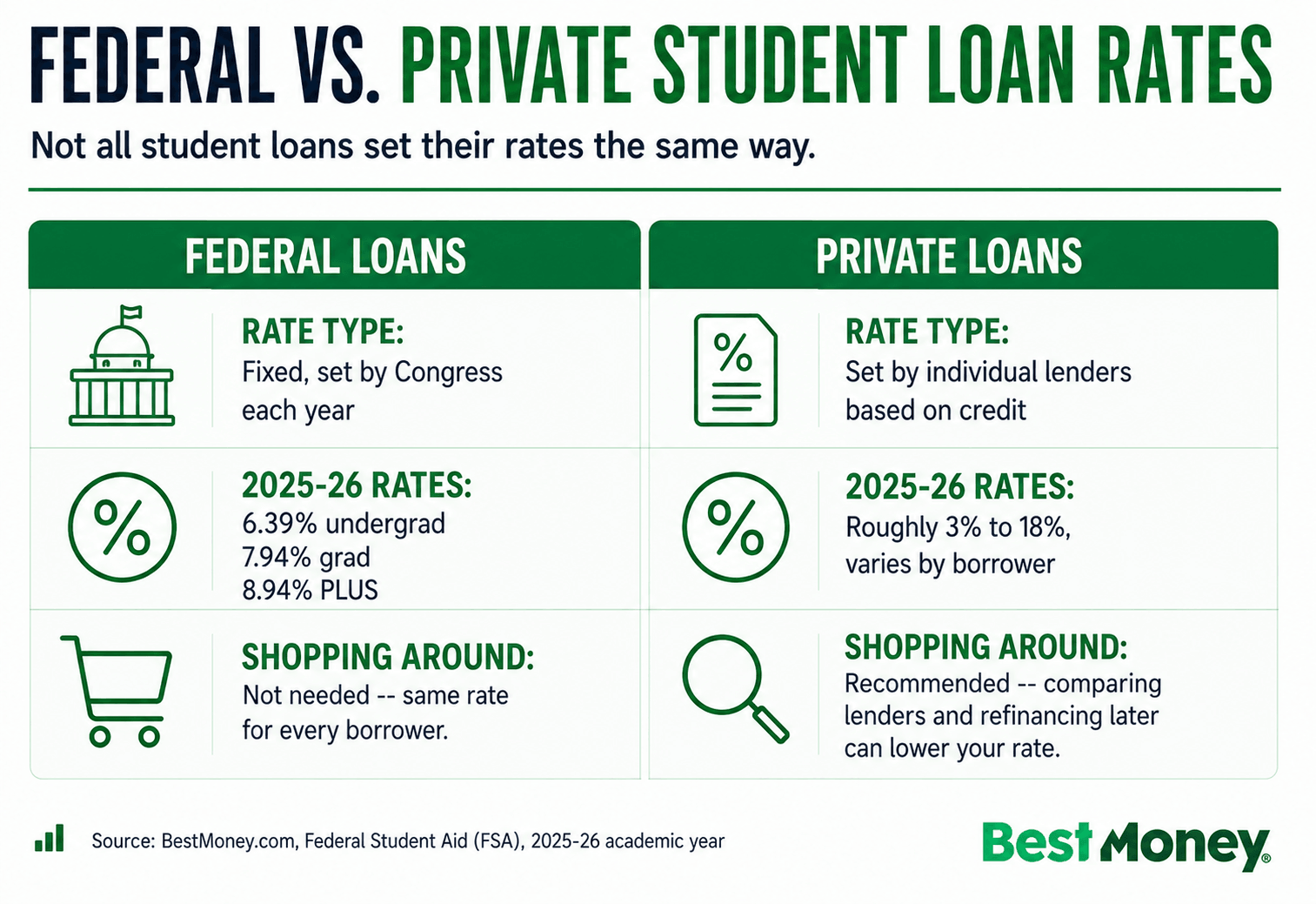
It's also worth noting that not all student loans work the same way here.
Having taken out both federal and private loans, I found that federal loans offered far more consumer protection. Income-driven repayment and deferment options gave me real breathing room during low-earning years, something private lenders didn't offer. And while borrowing large sums for education can be scary, your ROI doesn't stop at graduation: the connections and work I did in school opened doors for years, even decades, into my career.
The Takeaway: The real pain point of student debt is rarely the principal, it's the interest rate. Federal rates are fixed and non-negotiable, so there's no shopping to do. Private rates vary by lender, so compare offers before borrowing, and if you've already graduated with private loans, refinancing for a lower rate is a smart way to cut your lifetime cost.
When student debt is borrowed strategically and paired with favorable interest rates, it doesn't have to put life on hold. That said, unoptimized debt can still cause real delays.
According to NAR's 2025 Profile of Home Buyers and Sellers, the median age of first-time homebuyers has climbed to a record high of 40. High rents and student loan debt are cited as key factors making it harder to save for a down payment. Our own survey found a similar issue: 192 respondents said their debt heavily influenced their homeownership timeline.
But the downside isn't the whole story:
The Takeaway: Paying off debt and building wealth are not mutually exclusive. Securing favorable loan terms, and refinancing when it makes sense, can ease your monthly payments. That frees up cash to invest in your future today.
Our survey found that 53% of graduates felt their student loans were worth the investment in their futures.
But a few factors mattered along the way: attending an affordable school, not borrowing more than future earnings could cover, and being selective about both major and loan type (federal vs. private). Understanding how student loans actually work, from interest rates to payback timelines, is also key to determining the ROI over time.
The findings in this article are based on a proprietary BestMoney survey, "College Graduates on Student Loans, Career Success, and College Value."
The survey polled 1,000 respondents online. Since we wanted the data to reflect real borrowing experiences, the findings in this article focus on the 58% of respondents who actually took out student loans for college.
Respondents reported their initial loan amounts, current income, and whether they work in a field related to their degree. We also asked about their financial readiness after graduation, how they viewed the ROI of their degree, and how their debt affected major milestones like homeownership, saving, and investing.
To add broader context, we supplemented these survey findings with national data from the Georgetown University Center on Education and the Workforce, the Federal Reserve Bank of New York, the National Association of Realtors (NAR), the College Board, and the TIAA Institute.
Statistic | Source |
|---|---|
A bachelor's degree holder earns a median of $2.8 million over their career, 75% more than those with only a high school diploma. | |
College graduates earn a "college wage premium" of about $30,000 more per year than peers who did not attend college. | |
Median age of first-time homebuyers has climbed to a record high of 40, with high rents and student loan debt cited as key factors. | |
The average annual tuition is $11,950 at an in-state public university, compared to $45,000 at a private college. | |
Comprehending risk is the lowest-scoring area of financial literacy for U.S. adults, with only 36% of related questions answered correctly, a gap that holds across every generation, not just recent grads. |
Maya Dollarhide is a Journalist for bestmoney.com, specializing in personal finance and consumer lending. She earned her MS in Journalism from Columbia University and has written for TIME, Yahoo Finance, Investopedia, Bankrate, Forbes, CNN, and AARP. Her work focuses on creating SEO-driven content, developing K-12 financial literacy curriculum, and producing B2B content for financial services clients.