


What Documents Do You Need to Apply for a Personal Loan?
Sep 10, 2026
How to Avoid Personal Loan Scams
Sep 20, 2026
Secured Personal Loans: What They Are and How They Work
Sep 10, 2026
Lender type: Marketplace
Loan types: Unsecured personal loans for debt consolidation
Loan amounts: $5,000 to $50,000
Loan terms: 2 to 5 years (varies by partner lender)
APR range: APR: 8.95% - 17.48% (inclusive of an origination fee up to 10%)
Best for: Good-to-excellent credit borrowers (640+) focused on consolidating high-interest debt
Our Happy Money personal review awards the company a total score of 6.6, which sits in our above-average rating. It performed best in Reputation (8), supported by a positive 17-year track record and strong third-party review scores. Its weakest area is User Experience (5), due to the lack of a mobile app and limited loan customization options.
Below, we detail Happy Money’s loan structure, process, and how it compares to competitors.
Happy Money has been a fixture in the personal lending market for over 17 years, having launched in 2009 under its original name, Payoff. The Torrance, California-based fintech has continued its focus on debt consolidation by partnering with credit unions and community-focused lenders.
Happy Money performs well on third-party review platforms. It has been accredited by the Better Business Bureau (BBB) since 2022, holding an A+ rating. It has a BBB customer review score of 3.3 out of 5 based on 89 reviews, which is higher than our computed industry average of 2.19. Happy Money also performs strongly on Trustpilot, with an excellent 4.7 out of 5 from over 750 reviews.
However, the Consumer Financial Protection Bureau (CFPB) has recorded over 140 complaints about Happy Money since 2020. Given the company’s large loan volume, these totals are relatively low. That said, BBB and CFPB feedback tends to be more critical than Trustpilot reviews.
Getting a Happy Money personal loan can be challenging. The company requires a credit score of 640 or higher. It doesn’t disclose a hard minimum income requirement for borrowers, but most approved borrowers have stable salaries, debt-to-income (DTI) ratios below 50%, and no current delinquencies on their credit reports.
This sub-category is where Happy Money falls a little short. Its Payoff Loan is limited to debt consolidation, unlike most personal loans, which allow broader uses. Co-borrowers and co-signers aren’t permitted, and there’s no secured option to lower your rate. Loan amounts and terms also vary by partner lender, with prequalification offers depending on the credit union funding the loan.
The upside to Happy Money’s variability is that partner lenders have to compete on rates and terms to match your credit profile for your single loan use. The drawback is that you can’t predict the loan amount or repayment schedule until you see a more personalized offer.
The table below shows how term length could affect monthly payments and total cost for a $15,000 debt consolidation loan at a representative annual percentage rate (APR) of 13.99%.
Term | Monthly Payment | Total Cost | |
Loan A | 3 years | $513 | $18,455 |
Loan B | 5 years | $349 | $20,928 |
A shorter term means higher monthly payments, but less interest paid overall. It’s worth weighing both numbers when you review your offers.
Expert take: “Happy Money stands out due to its specific focus on credit card consolidation, making it especially suitable for mid-credit borrowers managing multiple revolving balances.” — Nina Abazyan, banking professional and personal lending specialist
APR range: APR: 8.95% - 17.48%
Origination fees: 0.5% to 10% (higher in some cases)
Prepayment penalty: No
Late fees: No
Other notable charges? No application, annual, returned check, or check processing fees
Happy Money’s personal loan rates start at a highly competitive 7.95% and cap at 35.99%. This pricing structure is heavily dictated by lending standards, with the lowest advertised APRs typically reserved for borrowers with excellent credit and strong financial profiles. While the platform accepts applicants with credit scores as low as the mid-600s, those borrowers will likely be offered higher rates.
Happy Money keeps its fee structure relatively simple, generally only charging an origination fee.
Its policy of not charging late fees adds a strong competitive edge, considering most personal loan lenders charge between $15 and $40 for a missed payment.
The upfront origination fee can reach 10% of your loan amount, so for a $20,000 loan, you will only see $18,000 deposited into your account.
Another ding against Happy Money’s cost score is that it doesn't offer the discount rates you may find at some competitors. There’s no autopay discount, no rate-match, and no direct-to-creditors rate reduction, though it does offer direct-to-creditor payment as a convenience feature.
Expert take: “The lenders that shine the most in terms of debt consolidation are those that directly send the money to your creditors instead of sending it to you. That difference may not seem like much but … I have seen clients get consolidation money, and then fail to pay off their cards, and then take out a new loan on top of the old balances. Lenders such as Payoff and Happy Money design the single feature of direct payment into their structure, and legally, that single feature remodels the risk profile.” — Marcus Denning, financial attorney
Pricing and service information are easily found on Happy Money’s website. The rates and terms page clearly discloses the APR range, origination fee ceiling, and loan framework, ensuring key details aren't buried in the fine-print.
The “Check my Rate” process is efficient and took us less than five minutes during testing. After we entered personal contact information and financial details for a $10,000 loan request, Happy Money performed a soft credit check. The system confirmed that this did not affect our credit score.
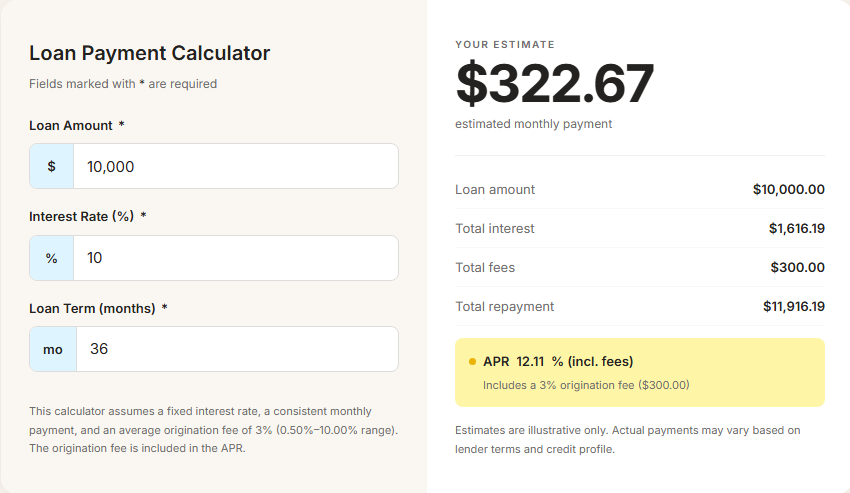
The results displayed a set of loan offers with varying terms, APRs, and origination fees, providing useful transparency at the prequalification stage.
However, while the application process is fully online, Happy Money’s "digital simplicity" has some limits. Funding takes approximately three business days, lagging behind competitors that offer same-day service.
The platform also lacks a mobile app. Without this, users miss out on industry-standard features such as self-management and push notifications, and are forced to manage their loans through the website.
Happy Money offers three support channels: phone (1-800-878-0901), email (support@happymoney.com), and live web chat. Live agent support (phone and chat) is available Monday to Friday from 6 a.m. to 2:30 p.m. PT (9 a.m. to 5:30 p.m. ET). These hours are standard but not competitive — some businesses in this industry offer 24/7 live support.
We reached a representative within two minutes when calling mid-morning Eastern time, and the agent quickly answered our questions about rates, terms, and eligibility without redirecting us.
Live chat filters questions through a chatbot that may route you first to educational materials on the Happy Money website.
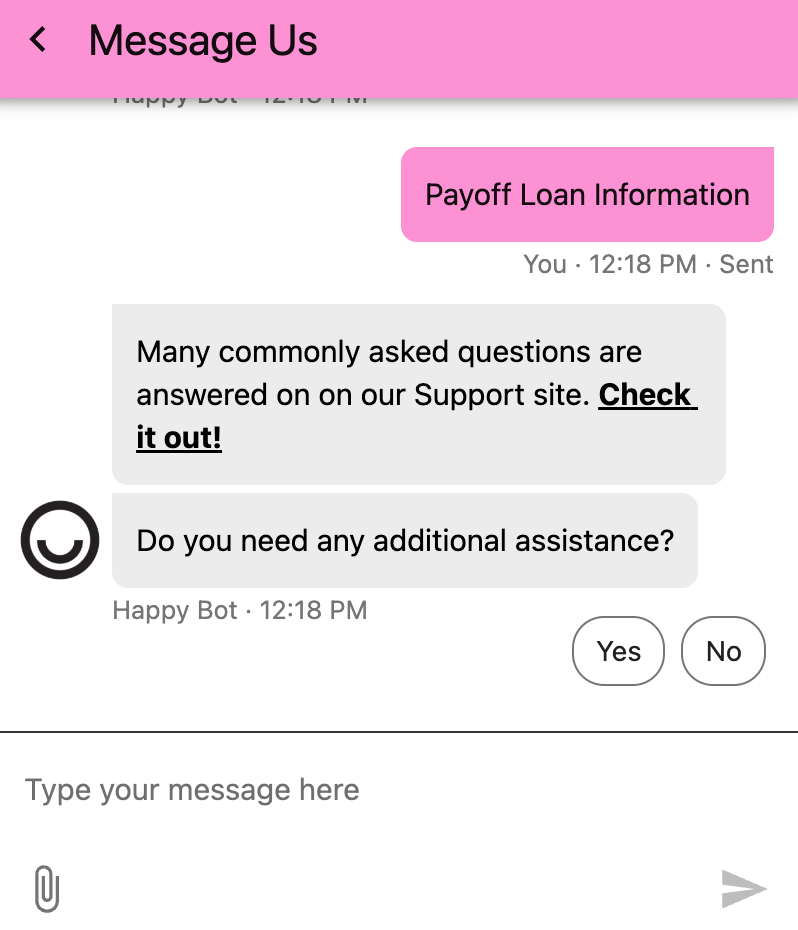
Ultimately, an agent responded in under a minute with a clear explanation of the origination fee structure, while email replies arrived within one to two hours. These response times were faster than the 24-hour window some competitors advertise during standard support hours.
Happy Money is a primary point of contact for members, even though the loans originate from partnering lenders. Some BBB reviewers noted confusion about who to contact for support, but our testing found that the team could handle application and servicing questions quickly.
Customer sentiment varies by platform. On Trustpilot, Happy Money personal loan reviews consistently praise the speed and clarity of the application process. Borrowers often highlight the transparency of the terms and the helpfulness of the customer support team.
One reviewer noted the attractive rate offers: “This is my second loan over the last eight years or so. The process was once again fantastic, and the terms were competitive with the banks. My loan was funded in less than a week, and the consolidated accounts were paid shortly thereafter.”
Happy Money’s BBB reviews are more critical. Reviewers complain about being pre-approved but later denied, high origination fees, and delays in updating paid-off loans on credit reports.
Happy Money replies to nearly every Trustpilot and BBB review, whether it's positive or negative, and provides follow-up outreach.
BestMoney reviewed close to 40 personal loan providers against five categories, covering 35 criteria:
Reputation: Accreditations, third-party ratings and reviews, years in business
Accessibility and flexibility: Loan types, amounts, terms, minimum requirements, state availability, and co-borrower rules.
Cost: APR range, fees, available discounts, and prepayment penalties.
User experience: Consultation flow, funding speed, online application process, mobile app/website quality, etc.
Customer support: Hours, availability, testimonials, ease of payment, testing results across channels.
Happy Money is best for borrowers with good-to-excellent credit who specifically want to consolidate debt and value working with credit union-backed lenders. It stands out for transparent pricing and a low-fee servicing model that can significantly reduce the cost of paying off credit cards. It also offers the convenience of direct-to-creditor payments.
It’s less suitable if you need funds for other purposes or want features like a mobile app or rate discounts. That said, you can still use Happy Money’s free prequalification tool to see your real loan cost in minutes, then compare offers with other lenders side-by-side.
Is Happy Money a good loan company?
Happy Money is a legitimate, well-reviewed lending company with over 17 years in the business. It’s a good choice for borrowers with good-to-excellent credit scores looking to consolidate high-interest credit card balances into a single personal loan.
Does Happy Money send money directly to your creditors?
Yes. Happy Money offers the option to send loan funds directly to your creditors, simplifying the debt consolidation process.
21515 Hawthorne Blvd, Suite 200
Torrance, CA 90503
 FAQs
FAQsJack Woerner is a Certified Financial Coach and Certified Financial Education Instructor (CFEI) with ten years' experience teaching and writing about personal finance. He has designed personal finance curricula, coached clients one-on-one through budgeting, tax, debt relief solutions, and many other areas of financial struggle.