Before giving up your VA benefit, consider the cost. VA mortgage rates have historically averaged about 0.25% to 0.40% lower than conventional 30-year fixed rates, according to FRED data. Combined with no monthly PMI, that can mean substantial long-term savings.
Most military buyers wrestle with the same trade-off. Do the savings from a VA mortgage make up for a harder bidding process? Too often, veterans leave tens of thousands of dollars on the table simply because a listing agent is afraid of a VA appraisal that rarely causes any real problem.
This guide separates myth from reality and uses hard data to help you make the best financial choice for your family.
Key Insights
- VA loans often provide lower interest rates and eliminate monthly PMI, creating meaningful long-term savings.
- Although the VA funding fee raises the loan balance, it can still cost less than years of conventional PMI payments.
- VA offers are often viewed as less competitive because of outdated concerns about appraisals and required repairs.
- A knowledgeable agent and VA-experienced lender can address seller concerns, prevent delays and strengthen the offer.
- VA loans are typically most valuable for buyers putting down less than 20%, especially those exempt from the funding fee.
Why Does Your VA Loan Strategy Matter?
Your choice between a VA loan and a conventional loan affects three things:
- Upfront costs: How much cash you need at closing.
- Monthly payment: What you pay each month for the life of the loan.
- Long-term equity: How much wealth you build through the property over time.
Choosing wrong, out of fear or bad advice from an inexperienced agent, can cost you thousands over the life of the mortgage. Understanding how each loan works protects you from being penalized for using a benefit you earned.
It also puts you in a stronger negotiating position and helps you lock in better terms. From there, you can build long-term wealth through real estate without paying for insurance premiums or interest you don't need to.
How Do VA Loans Work?
Before diving into the math, it helps to understand the basics of how each loan type works.
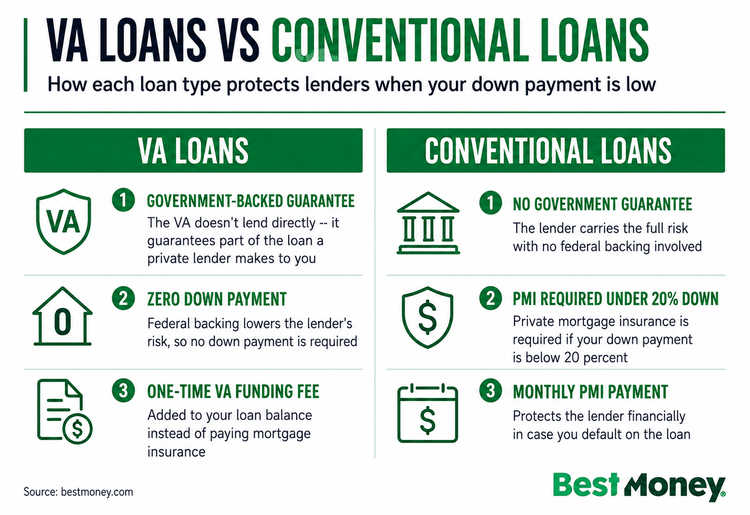
- VA loans: The Department of Veterans Affairs doesn't issue your home loan directly. Instead, it guarantees a portion of the loan made by a private lender, like a bank or mortgage company. This federal backing lowers the lender's risk, which is why VA loans can offer zero down payment. In exchange, you pay a one-time VA funding fee that gets added to your loan balance.
- Conventional loans: These rely on private mortgage insurance (PMI) instead of a government guarantee. If you put down less than 20%, lenders require you to pay PMI monthly to protect themselves in case you default.
The financial showdown between these two loan types usually comes down to comparing the upfront VA funding fee against years of conventional PMI payments.
How We Researched VA vs. Conventional Mortgages
To provide an objective answer to whether you should use your benefit, we went straight to the data. We analyzed Federal Reserve Economic Data (FRED) rate trends to compare average 30-year fixed rates. We reviewed origination fee patterns utilizing the latest Home Mortgage Disclosure Act (HMDA) datasets. We also compared Urban Institute PMI and Mortgage Insurance Premium (MIP) averages against the VA’s published funding fee charts. Finally, we tapped into the insights of specialized VA loan underwriters to build a complete, transparent financial picture.
The Full Breakdown: Comparing the Costs and the Competition
To determine whether using your benefit puts you ahead financially, we need to consider the loan's lifetime cost, the realities of the housing market, and the importance of who processes your paperwork.
The Math: VA Loan Funding Fee vs. PMI and Rates
One of the biggest concerns for borrowers is the VA funding fee. For a first-time use with less than 5% down, the fee is currently 2.15% of the total loan amount. While that sounds steep, it’s a one-time charge that can be rolled into the loan.
Conventional PMI, on the other hand, is paid monthly. Depending on your credit score and down payment, PMI typically costs between about 0.5% and 1.5% of the loan amount annually, and you must pay it until you reach 20% equity.
When you combine the absence of PMI with historically lower VA mortgage rates, the savings can be substantial. For most buyers, the math strongly favors the VA loan.
Cost Comparison Scenario: $400,000 Home Purchase
Feature | VA Loan | Conventional Loan (with 3% Down Payment) |
Down Payment | $0 | $12,000 |
Base Loan Amount | $400,000 | $388,000 |
VA Funding Fee (First Use) | $8,600 (Rolled into loan) | N/A |
Total Financed Amount | $408,600 | $388,000 |
Assumed Interest Rate | 6.50% | 6.85% |
Monthly Principal & Interest | ~$2,582 | ~$2,544 |
Monthly PMI (Est. 0.75%) | N/A | ~$242 |
Total Monthly Payment (Excl. Taxes/Ins.) | $2,582 | $2,786 |
Out-of-Pocket at Closing | $0 (plus standard closing costs) | $12,000 (plus standard closing costs) |
Note: Interest rates and PMI costs fluctuate. This table is for educational comparison purposes. Your specific rates will vary based on your credit profile.
Even with the higher initial financed amount due to the funding fee, the VA loan saves this hypothetical buyer over $200 a month. That adds up to roughly $12,000 in savings over just the first five years, all while keeping $12,000 in their pocket at closing.
“One of my recent clients was a veteran purchasing a $385,000 home who was originally quoted for a conventional loan with 5% down. Because he qualified for a VA loan instead, he bought with zero down and no private mortgage insurance, saving roughly $19,000 upfront and about $190 per month in PMI he would have otherwise paid. Between the eliminated PMI and a rate that came in about a quarter point lower, he's on track to save more than $25,000 over the first seven years of the loan alone.”
Are VA Loans Competitive? The "Uncompetitive Offer" Reality
If the math is so good, what are the disadvantages of VA loans? One drawback is perception. Many sellers and their listing agents operate on outdated assumptions, fearing the VA's Minimum Property Requirements (MPRs) and the VA appraisal process.
What Does a VA Appraisal Actually Check For?
A VA appraisal isn't a home inspection. It's a property condition review focused on safety, structural soundness, and basic sanitation. Most MPR flags that scare sellers off a VA offer are minor items like peeling paint, a broken window, or exposed wiring, issues that can typically be fixed over a weekend for a few hundred dollars.
“The VA horror stories agents pass around usually trace back to one misunderstanding, confusing an MPR flag with a deal-breaker, when in reality the vast majority of VA appraisals in Hawaii close without a single required repair.”
How Do You Make a VA Offer Competitive?
So, are VA loans competitive? Absolutely, provided you build the right team. Listing agents often worry that a VA appraiser will flag minor issues that force the seller to make repairs before closing. In a hot market where a seller has multiple offers, they may choose a conventional buyer to avoid this perceived hassle.
You overcome seller objections and the "uncompetitive offer" myth by working with a real estate agent who knows how to educate the listing agent.
“The number one way to get a VA home loan offer accepted begins and ends with communication. Before writing the offer, the buyer's real estate agent should personally call the listing agent to learn the seller's priorities: preferred closing date, possession needs, or anything else that would make the transaction smoother. A well-written offer isn't just about price, it's about solving the seller's problems.”
A strong buyer's agent will also explain your financial strength. VA loans actually have one of the lowest default rates in the mortgage industry, which puts sellers at ease.
The Importance of Lender Experience and HMDA Data
Not all lenders process VA loans with the same efficiency. HMDA data shows that a concentrated group of specialized lenders handles a significant portion of all VA originations, and that experience matters for your offer's competitiveness.
A lender with a dedicated VA underwriting team can close your loan in 30 days or less. They also know how to navigate the Tidewater Initiative, the process used when a VA appraisal comes in lower than the purchase price. If you use a lender that only processes a handful of VA loans each year, your closing could be delayed, which reinforces the seller's initial fears.
You can find experienced VA lenders by checking the VA's monthly report on lender loan volume.
Which Loan Makes Sense for Your Down Payment?
The right choice depends on your specific financial situation.
- If you're putting down 0% to under 20%: The VA loan is likely your stronger option. Lower base interest rates plus no monthly PMI can save you significant money, both at closing and in your monthly budget.
- If you're putting down 20% or more: A conventional loan might make more sense. At 20% down, you avoid PMI, and you'd also skip the VA funding fee. Still, compare interest rates closely to see which loan actually offers the better rate.
- If you have a service-connected disability: You may be exempt from the VA funding fee entirely. If you receive VA disability compensation, that fee gets waived, making the VA loan a near-automatic choice: zero down, no PMI, no funding fee, and a better rate.
What Should You Do Next?
- Understand the entire process: Now that you know the math, learn exactly how to navigate the VA loan process from getting your COE to closing day. Read BestMoney’s Guide to VA Home Loans to deepen your knowledge.
- Compare Top Lenders: Don't settle for the first quote you receive. Compare current rates and find lenders with high VA volume by using BestMoney's mortgage rate comparison tools.
Why Trust BestMoney on This?
At BestMoney, our editorial standards prioritize transparency, accuracy, and data-backed financial analysis. This article was crafted by a mortgage industry expert with deep experience in real estate finance and underwriting, and rigorously reviewed by our editorial team. Our goal is to empower veterans and active-duty military with objective guidance so they can maximize their benefits without falling prey to real estate myths or costly lending traps.
Please note: We do not provide individualized financial advice. Interest rates, fees, and funding fee exemptions vary based on your specific credit profile and military service history. Only the Department of Veterans Affairs can officially determine your eligibility and issue a Certificate of Eligibility (COE).
Where We Got Our Information