Your 0% Intro APR Is Ending? Here's Your Action Plan to Save on Interest
Your 0% Intro APR Is Ending? Here's Your Action Plan to Save on Interest
What happens after your 0% intro APR ends, and how to keep a leftover balance from costing you.
Written by
Laura Gariepy
Laura has been a freelance writer since 2018. Her work primarily focuses on managing your money, navigating your career, and running a successful business. Her words have been featured in U.S. News & World Report, Fortune Recommends, The New York Post, USA Today, and many other publications.
0% intro APR ending soon? Here’s what happens when the promo ends and how to avoid costly interest: confirm your end date, set a payoff target, and choose the best next step, from faster payments to a balance transfer or rate reduction.
As of May 2026, the average APR on credit card balances charged interest was about 22%, according to theFederal Reserve's G.19 consumer credit release. A balance left over when your promo ends can get expensive fast.
0% intro APR ending soon? Here's what happens when the promo ends and how to avoid costly interest: confirm your end date, set a payoff target, and choose the best next step, from faster payments to a balance transfer or rate reduction.
You used a 0% introductory annual percentage rate (APR) offer to finance a big purchase or move expensive credit card debt with a balance transfer. Now your 0% APR offer is ending soon, and you're wondering what happens after it ends and you still haven't finished paying off all of your balance.
When the promo ends, the standard APR applies to any remaining balance, often around 22%.
Confirm your exact end date and next APR on your statement, in the app, or by calling the issuer.
Set a payoff target (balance ÷ months left) and put it on autopay.
Still carrying a balance? Pay it down faster, transfer it, or ask about a lower rate or hardship plan.
Deferred interest is different: you may owe interest on the original amount.
How Does A 0% Introductory APR Period Work?
Before we get into creating your strategic plan, it's helpful to review how a 0% introductory APR period works. Here are the basics:
A promotional rate may apply to purchases, balance transfers, or both for a set time (often 12 to 24 months).
Missing a payment can end the promo early and may trigger a penalty APR.
When the 0% APR has expired, the standard APR applies to whatever balance remains.
Note: Deferred-interest promotions are different. If the deadline passes with a balance, you may owe interest on the original amount, not just what's left.
A longer runway, if you need one: If your current intro window is closing, a fresh card with a longer runway may buy you time. Chase Slate® offers an industry-leading 21 months introductory APR ( 18.24% - 28.24% Variable APR thereafter) period on balance transfers and purchases, giving you plenty of time to pay down balances — with no annual fee. [See Chase Slate® →](See Rates and Fees)
What Happens After Your 0% APR Ends?
Once the promotional rate ends, interest usually starts accruing again on the remaining balance. Credit cards often calculate interest using a daily periodic rate (APR ÷ 365) and apply it across the billing cycle, so costs can add up quickly.
That reverting standard APR averaged about 22% in May 2026, according to the Federal Reserve's G.19 release, so a residual balance gets expensive quickly.
What May Change On Your Next Statement?
What changes
What you might see
What to do next
APR line item
Promo APR switches to standard APR (or penalty APR if you missed a payment)
Confirm the post-promo APR and avoid late payments
Minimum payment
Minimum payment increases because interest is back
Adjust your autopay so you don't fall into minimum-only payments
Interest charges
A new interest line appears even while paying down the balance
Pay down faster or choose a lower-cost option if you won't reach $0
Promo end date unclear
You can't find the end date in your account
Call the issuer and ask for the promo end date + what APR applies next
What Is Residual Or Trailing Interest?
Even if you pay the balance right after the promo ends, you may see a small interest charge on a later statement. This can happen when interest accrues between the statement close date and when your payment posts. If you pay it off, check the next statement to confirm the balance truly hit $0.
What Should You Do Before Your Intro Period Ends?
How Do You Calculate The Payoff Payment?
Promo periods can be nearly two years – easy to forget – you must have a plan as you track your repayment progress. Ideally, you should create a budget in advance that will allow you to put money aside to have it available to pay the balance in full when the zero percent comes to an end.
How Do You Put It On Autopay?
Set autopay to your target payoff payment so you don't accidentally fall back to the minimum payment or miss a due date. If you can't autopay the full amount due, autopay the minimum and schedule a second payment for the "extra" amount.
Use the 0% interest period to pay off your loan faster, and avoid letting your spending increase just because you have extra cash. The promo period should be a tool used to grant you some breathing room from the burden of high interest and large payments. This is wasted if you do not use this time in a way that is productive and allows you to budget so that you can have the balance paid off or close to it before or when the promo period ends.
Add "runway checkpoints" so you don't drift from your plan. A simple way to stay on track is to set payoff milestones during the introductory period. For example:
25% paid down by month 25% of the promo
50% paid down by the halfway point
75% paid down with a few months left
Bottom line: If you miss a checkpoint, you still have time to adjust before the interest cliff hits.
Avoid the minimum payment trap
Minimum payments keep the account current, but they're rarely enough to get you to $0 before the promo ends. Set simple milestones (25%, 50%, 75% paid down) and adjust early if you're behind.
How Do You Handle Variable Income?
Have a budget that has enough room to pay off the balance even if your income fluctuates heavily. If this is something that you cannot budget for, then you may want to think twice about doing this, or be prepared to shift the remaining balance to another 0% if you can.
The key is to treat this debt like a non-negotiable monthly expense. Start by dividing the total balance by the number of months in the introductory period to determine the required monthly payment. Even if your income varies, prioritize setting aside these funds first, ideally in a separate account, to ensure you always have the money available. Automating payments and building a small cash buffer can protect you in lean months and keep you on track
What Does A Practical Autopilot Setup Look Like?
Open a separate "payment holding" account.
Each payday, move a fixed amount or percentage into that account first.
Run autopay from that account to cover at least your target payoff payment.
Keep a small buffer (even one extra payment) to reduce the risk of missed payments.
What Are Your Options If You Still Have A Balance?
If your 0% intro APR ending date is near and you won't reach $0 even if you tried, most options fall into three buckets: pay it down faster, move it to a lower-cost option, or negotiate better terms.
How Do You Choose Your Path In 60 Seconds?
If your situation is...
Best next move
Why it fits
You can pay it off in 1–3 months
Focus on payoff speed (cut spending, add income, automate payments)
You may avoid paying much interest by finishing quickly
You need 6–18 months
Compare a balance transfer, a fixed-payment option like a personal loan, or a low-interest card
These options may lower interest and create a more predictable payoff
Cash flow is tight right now
Ask about hardship options before a late payment happens
Staying current matters, and hardship programs may reduce APR or payments
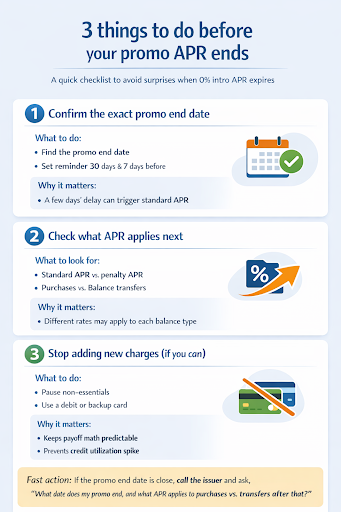
What's On The Start-Here Checklist?
Confirm the exact promo end date.
Check what APR applies next (standard vs penalty) and whether purchases and balance transfers have different APRs.
Stop adding new charges if you can, so the payoff math stays predictable and credit utilization doesn't creep up.
If you'll carry a balance after intro APR ends, call your issuer and ask if there's a lower APR or a reduced promotional rate available.
Why this matters: When a 0% APR expired promo switches to a standard APR, the interest rate can be high, and carrying even a modest balance can get expensive quickly. A lower APR doesn't erase the debt, but it may reduce the cost of paying it off over time.
What to ask for?
An APR reduction (temporary or ongoing)
A retention offer or re-pricing review
A new promotional rate (often a reduced APR rather than a true 0% offer)
Ways to free up cash:
Cut discretionary spending for a short window
Sell unused items
Negotiate recurring bills
Add temporary income if it's realistic
Make it measurable: Track weekly:
Remaining balance
Weeks until the promo ends
Weekly payment target (balance ÷ weeks remaining)
When Should You Ask For Hardship Help?
If repayment is getting tricky, ask your issuer about hardship programs. These can reduce APR, reduce payments, or set a temporary plan that helps you stay current. Ask what changes (usage restrictions, duration, reporting) before you agree.
Should You Consider A Balance Transfer?
If you can't pay it off in full, abalance transfer after 0% APR to another 0% offer (if you qualify) or a lower-rate card may reduce interest costs. Balance transfers often come with a fee, so the math matters.
Transfer fees commonly range from about 3% to 5% of the balance you move, according to card issuers' disclosures.
How Do You Do The Break-Even Math?
Estimate the transfer fee (transfer amount × fee %)
Estimate the interest you'd pay if you keep the balance for the same payoff timeline
If the fee is clearly lower than likely interest, the transfer may be worth exploring
Quick example: Transfer $5,000 with a 3% fee: fee is $150. If leaving $5,000 at a high APR would cost more than $150 in interest while you pay it down, the transfer may pencil out.
Cards like Chase Slate® are built for exactly this move: 21 months at 0% APR on the transferred balance, no annual fee, and a balance transfer fee of either $5 or 5% of the amount of each transfer, whichever is greater — terms that work in your favor when you run the break-even math above. (See Rates and Fees)
Pitfalls to avoid:
New purchases can complicate payoff and may trigger interest.
Payment allocation rules can be surprising. Check the cardholder agreement.
Transfers aren't instant, so start early if the promo is ending.
A new account can shift credit utilization and affect your credit score in the short term.
How Should You Manage The Card Going Forward?
It can be smart to keep the card after the promo period ends and you've paid it off, unless there's a high annual fee you don't get value from. Issuers can sometimes downgrade or change the product. Closing a card can affect your credit profile by changing available credit and utilization.
If a high annual fee is the main sticking point, ask your issuer about a product change or downgrade to a no-fee version of the card. That can keep the account, and its credit history, open without paying for perks you don't use.
A quick credit score reality check:
Payment history: Late payments usually do the most damage.
Credit utilization: High utilization can hurt even if you pay on time.
Average age of credit: Closing older accounts can change your credit profile, but fees and your overall plan matter.
Bottom line: Don't keep an expensive card open "for credit reasons" if it doesn't make sense. Consider downgrading instead.
What Should You Do Differently Next Time?
It's not the end of the world if you didn't pay the balance off before the introductory period ended. Use it as a quick post-mortem so the next 0% offer works as a tool, not a reset button.
How Do You Analyze Your Spending?
Figure out what actually kept the balance from hitting $0.
How Do You Assess Your Habits?
Pick the main reason:
Payment drift: You paid what felt doable, not the payoff number (balance ÷ months left).
Spending drift: You kept charging, so the balance didn't fall fast enough.
Timing drift: You lost track of the promo end date.
Income drift: A few lean months forced minimum payments.
Fix it with one rule:
Timing: calendar reminder + halfway checkpoint
Payment: autopay the payoff amount (not the minimum)
Spending: pause discretionary charges until $0
Income: separate "payment" account + small buffer
Why Does Human Psychology Matter?
Temporal discounting is real. "Out of sight, out of mind" is why 0% offers can backfire: people move the balance and assume they'll handle it later.
Turn psychology into a system. If "later" is your risk, build friction into spending and make payoff automatic:
Freeze discretionary spending on the card until the balance is at $0
Use autopay plus a calendar reminder for the promo end date
How Do You Create A Plan?
Before moving debt to a 0% APR plan, you should create a budget that will allow you to have the debt paid off in time. Should you receive an increase in income or an unexpected bonus, those extra funds should go towards paying this off more quickly to ensure it is paid. This tool is an excellent one if used correctly, and can simply exacerbate the problem if it is not.
Depending on your credit profile and timeline, it can also be worth comparing:
A personal loan (fixed payment and payoff date)
Debt consolidation (if it lowers total cost and you can stick to the plan)
A temporary hardship arrangement (if cash flow is the core problem)
The best fit depends on the total balance, your payoff timeline, and whether your budget can handle a consistent monthly payment.
What Should You Do Next?
Turn this plan into your next move with a few concrete steps:
Compare low-interest and 0% APR cards to see whether a new intro offer fits your payoff timeline.
If a transfer makes sense, line up a balance transfer card before your promo ends so the switch is ready.
Call your issuer to confirm your exact end date and ask about a lower rate or a hardship plan.
Your Questions, Answered (FAQs)
Is 0% APR a trap?
A zero-percent interest offer may feel like a trap if you can't pay off your entire balance before the introductory period ends. However, if you're able to create and stick to a repayment strategy that results in a zero-dollar balance before the standard APR kicks in, the zero-percent offer helps you shed debt while saving money in interest charges.
Is 0% APR expired the same as deferred interest ending?
No. With a standard 0% intro APR, interest typically starts going forward on the remaining balance after the promo ends. With deferred interest, you may owe interest on the original amount if the balance isn't paid in full by the deadline. Always confirm which type of offer you have in the cardholder agreement.
How do I know when my 0% APR ends?
When you apply for a card with a 0% interest offer, note the date the introductory APR period ends on your calendar. You can also likely find the end date on yourbilling statement, in your mobile app, or in your online account. If you have questions about your introductory APR period, contact your card issuer.
Can a late payment end my 0% promo early?
Yes. Some issuers can revoke the promotional rate after a late or missed payment, and may apply a penalty APR to your balance. Check your cardholder agreement for the exact terms. Setting up autopay helps make sure a single slip doesn't cost you the 0% rate.
Should I keep or close the card after the promo ends?
In most cases, keeping the card helps your credit by preserving available credit, which lowers utilization, and by keeping the length of your credit history intact. The main exception is a high annual fee you don't get value from. If that's the case, ask about a product change or downgrade to a no-fee version before you decide to close.
Why Trust BestMoney?
This guide was written by Laura Gariepy, a freelance personal-finance writer whose work has been featured in major national outlets. She focuses on turning credit, debt, and budgeting decisions into plain-language guidance readers can act on.
Before publishing, our editorial team reviews each guide for accuracy and clarity, and updates it as rates and rules change. We help consumers compare credit card options and evaluate providers across multiple factors so you have what you need to make an informed decision.
Our Research
This article relies on secondary sources rather than original BestMoney research. We used the Federal Reserve's G.19 consumer credit release for average credit card APR figures, and card issuers' published disclosures for typical balance transfer fees, penalty APR terms, and promotional rules. The payoff strategies reflect our editorial team's review of how these offers work in practice.
Where We Got Our Information
Federal Reserve, Consumer Credit (G.19), linked above: average credit card APR data.
Card issuers' published cardholder agreements and disclosures: balance transfer fees, penalty APR, and promotional terms.
Disclosures: This content is not provided by the issuers. Any opinions expressed are those of BestMoney.com alone, and have not been reviewed, approved or otherwise endorsed by the issuers.The credit card offers and information presented on this page are current as of the published date. However, credit card terms, including APRs, fees, and promotional offers, are subject to change without notice. Some offers listed may no longer be available or may have expired. Please refer to the issuer's website for the most up-to-date terms and conditions. All Chase credit card products are subject to credit approval. Not all applicants will qualify. Credit limits and terms are determined based on individual creditworthiness. BestMoney may receive compensation from JPMC.
Written byLaura Gariepy
Laura has been a freelance writer since 2018. Her work primarily focuses on managing your money, navigating your career, and running a successful business. Her words have been featured in U.S. News & World Report, Fortune Recommends, The New York Post, USA Today, and many other publications.