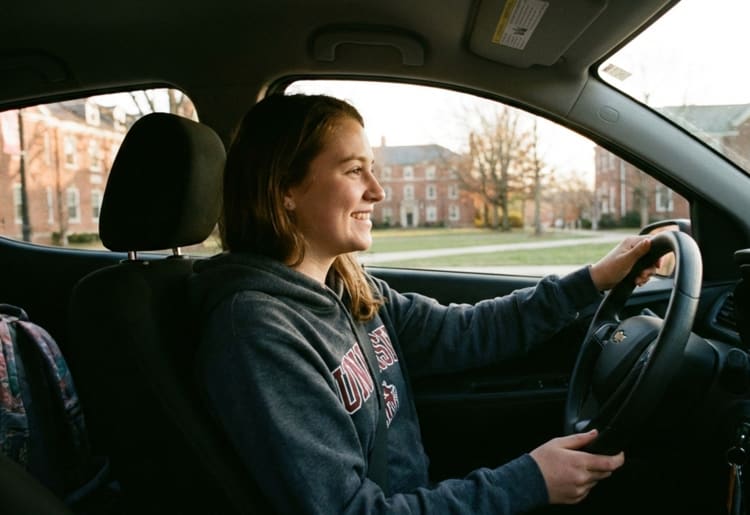
The biggest misconception encountered as an independent insurance adjuster is that “my kid is away at college, so they’re basically not a risk anymore.” In reality, insurers still rate young drivers as higher‑risk; what changes pricing most is whether the car’s actually garaged at school and how often it’s driven.
This guide explains 11 key strategies for managing college car insurance, from deciding whether to send the car to campus to maximizing discounts and knowing when to compare car insurance companies for better rates.
Key Insights
- Garaging location determines your rates, coverage requirements, and discount eligibility, not where the student claims residency.
- Out-of-state students must verify if the school state requires in-state registration or insurance after 30-90 days, even for full-time students.
- Accurate disclosure prevents carriers from re-rating policies, demanding back premiums, or scrutinizing claims after a major loss.
How College Affects a Student's Car Insurance Situation
Your car insurance policy is based on where vehicles are primarily kept (garaged), not where the student claims residency. When a student takes a car to campus, the garaging location changes from the family home to the college address, creating three key impacts:
- Premium rates vary by college location’s risk profile: Cities with high theft rates, accident frequency, or severe weather usually cost more than suburban family homes.
- Coverage requirements change if you cross state lines: Different states have different minimum liability limits and insurance regulations.
- State insurance laws are tied to garaging location: The state where the car is garaged determines which rules apply.
Location can swing young‑driver costs dramatically. For an 18‑year‑old on their own policy, annual full‑coverage averages range from about 1,743 dollars in Hawaii to 11,155 dollars in Louisiana, according to Bankrate’s national pricing analysis.
Other high‑cost states include Florida (about 10,039 dollars), Rhode Island (9,675 dollars), Delaware (9,374 dollars), and New York (9,246 dollars), while lower‑cost states include Idaho (4,580 dollars), Iowa (4,847 dollars), Indiana (4,940 dollars), and Vermont (5,148 dollars).
With a Car at School vs. Without a Car at School
Student takes car to campus:
- Car must be added to a policy covering the campus location
- Premiums reflect campus area risks
- Student needs coverage for daily use
- Must update garaging address with insurer
Student leaves car at home:
- Eligible for "student away at school" discounts (typically 10-35% off)
- Car remains listed on parents' policy at family home
- Student may still drive during breaks
- Lower premiums due to reduced driving exposure
Out-of-State College Considerations
Students attending college in a different state face additional complexity.
- State insurance requirements vary significantly: Some states require in‑state insurance for registered vehicles, while others allow students to maintain home‑state coverage.
- License and registration rules differ: Many states use thresholds (often 30–90 days) that trigger new registration or insurance requirements.
- Premium costs swing dramatically by location: Large differences between high‑cost and lower‑cost states for 18‑year‑olds on their own policies.
Before move‑in, confirm three things:
- Whether the school's state requires in‑state registration or insurance after a time threshold, often 30–90 days of residence.
- Whether registering the car there changes required minimum liability limits.
- Whether your carrier needs an endorsement or policy rewrite for long‑term out‑of‑state garaging.
Pro tip: Check your school‑state DMV and nonresident student rules to avoid surprises.
11 Car Insurance Tips for College Students and Parents
1. Decide Whether the Student Takes the Car to Campus or Leaves It Home
This decision drives both your premiums and your discount eligibility.
If your student takes the car to campus:
- The car must be listed on a policy that reflects the campus as the primary garaging location.
- Premiums are calculated using the campus area’s risk factors, like theft, crash frequency, and parking challenges.
- The student needs full coverage suited to daily use near campus.
- You must update the garaging address with your insurer (see Tip 4).
If your student leaves the car at home:
- The car stays on the family policy at the home address.
- Driving exposure drops, which usually lowers premiums.
- The student can still drive during breaks under the existing policy.
- This setup often unlocks a “student away at school” discount if the student lives far from home and has no car at school (see Tip 2).
The distant‑student discount exists because risk falls when the student doesn't have regular access to a vehicle while away, so fewer miles driven typically mean fewer losses. Most carriers require full‑time enrollment, significant distance from home, and no car kept at school to qualify.
2. Ask About "Student Away at School" Discounts
If your student attends school 100+ miles from home without a car, most insurers offer substantial discounts.
- Typical savings range from 10-35% off the student's portion of the premium: This can save $300-900 annually, depending on your current rates.
- Requirements include full-time enrollment and distance: Students must attend school typically 100+ miles from home with no regular vehicle access.
- Documentation may be required: Insurers often need proof of enrollment and campus housing to verify eligibility.
- Discounts apply during school terms, not summer breaks: When students return home for summer, the discount typically ends.
If you don't notify your insurer, you might miss legitimate discounts. Worse, you could end up with the wrong garaging address on file. That can trigger delays, extra paperwork, or disputes at claim time because the carrier priced the risk based on inaccurate information.
3. Keep the Student on Parents' Policy vs Separate Policy
Staying on parents’ policy (usually the best option):
- Multi‑car and multi‑driver discounts typically apply.
- The student benefits from the family’s claims‑free history.
- Administration is simpler with one combined policy.
- It usually costs about 1,500–3,000 dollars annually to add a student, depending on the state, insurer, and vehicle.
Separate policy for the student:
- Often required if the student owns the vehicle in their own name.
- May be necessary when the student lives independently year‑round.
- Higher cost due to young‑driver risk without family‑policy discounts.
- Sometimes required for out‑of‑state students, depending on state and insurer rules.
Pro tip: Keep students on family policies whenever possible. The cost of a separate policy for a young driver often exceeds adding them to an existing family policy by a wide margin
4. Update the Garaging Address Correctly
Accuracy on garaging is critical. Misstating where a vehicle is kept can lead to re‑rating, back premiums, or claim disputes.
If the car stays on campus most of the year:
- Update the garaging address to the campus location (dorm, apartment, or nearby parking area).
- Premiums will adjust based on the new ZIP code and local risk profile.
- Coverage will follow the state requirements where the car is actually kept.
If the car stays at home:
- Keep the home address listed as the garaging location.
- Ask about eligibility for the “student away at school” discount if the student is living far from home without a car.
- The student can still drive during school breaks under the same policy.
Pro tip: Provide your insurer with the exact campus address, not just the city or school name. Even differences of a few blocks can matter in dense or high‑risk areas.
"Families get the best results when they treat college as a mid-term 'policy update event.' Confirm garaging, confirm discounts, and avoid surprises at claim time. The boring admin steps often prevent the biggest headaches later," says Lynne McChristian, Director of the Office of Risk Management & Insurance Research and former Insurance Information Institute spokesperson.
5. Understand Rules for Out-of-State Colleges and Licensing
The most common out‑of‑state mistake is assuming “college address doesn’t matter” for registration and insurance. Some states treat students as nonresidents for registration, while others use how long the car is kept there as the trigger for new requirements.
Vehicle registration:
- Some states require local registration after the car is garaged there for a set period, often 30–90 days.
- Others allow students to keep home‑state registration while attending school as nonresidents.
- Rules vary by state and the student’s residency status.
Driver’s license:
- Most students keep their home‑state licenses during college.
- Some states require a new license if the student becomes a legal resident.
- Update the address with the home‑state DMV even if keeping the home‑state license.
Insurance requirements:
- Some states require in‑state insurance for any vehicle registered there.
- Your policy must reflect the vehicle’s primary garaging location, even if registration and license remain in the home state.
- Registering in the school state can trigger higher minimum liability limits than in your home state.
State‑specific patterns:
- California, New York, and Texas often allow students to keep home‑state registration, but insurers still require the correct campus garaging ZIP code.
- Florida frequently requires in‑state insurance if the vehicle is registered there, including for students.
- Pennsylvania, Ohio, and Michigan commonly allow home‑state policies for students but still expect disclosure of long‑term out‑of‑state garaging; Michigan, for example, has separate 30‑day and 90‑day thresholds for no‑fault coverage and registration.
Pro tip: Rules vary by state and insurer. Always confirm with both the carrier and the school‑state DMV. A student can legally keep a home‑state license while still needing insurance adjustments based on where the car is actually kept.
6. Choose a Vehicle That's Safe and Cheap to Insure
Vehicle choice dramatically impacts car insurance costs for students.
- Mid‑size sedans with strong safety ratings, modern crash‑avoidance features, and low theft rates tend to be cheaper to insure.
- Sports cars, luxury vehicles, and popular theft targets cost significantly more, due to higher repair costs and more severe claims.
- Model‑based data show that high‑performance sports cars can cost thousands of dollars more per year to insure than mainstream sedans like a Honda Accord.
Students driving sports cars could pay several thousand dollars annually for coverage, while a safe, practical sedan for the same driver might cost substantially less. Safety features may also qualify for additional car insurance discounts while protecting inexperienced drivers.
7. Use Good Student Discounts and Know Requirements
Good student discounts reward academic achievement with lower premiums.
- Typical savings range from about 5–25 percent off the student’s premium, depending on the insurer.
- Requirements usually include a 3.0 GPA or higher and full‑time enrollment.
- Insurers require documentation such as report cards, transcripts, or dean’s list certificates, often each term or annually.
Pro tip: Families should calendar reminders to submit updated proof; letting documentation lapse can cause discounts to drop off quietly at renewal
8. Consider Parking Risks and Comprehensive Coverage
Campus parking situations strongly influence whether comprehensive coverage makes financial sense.
- High‑risk parking (street parking in high‑crime areas, open lots with theft or vandalism history, or regions with hail and flooding) supports keeping comprehensive coverage.
- Low‑risk parking (secure garages, gated campus lots with security, or low‑crime suburban campuses) may not justify comprehensive coverage on older, lower‑value cars.
Comprehensive coverage typically costs a few hundred dollars per year but pays for theft, vandalism, and many weather‑related losses not covered by liability‑only policies. Balancing that cost against the vehicle’s value and local risk is essential.
9. Set Rules Around Roommates and Friends Borrowing the Car
Other students borrowing your vehicle creates liability, because insurance follows the vehicle more than the driver in many scenarios.
What happens if a friend crashes your student’s car:
- Your insurance generally pays first as the primary coverage on the vehicle.
- Your premiums may increase if a claim is paid under your policy.
- If damages exceed your policy limits, your household could face personal liability exposure.
Pro tip: Set clear rules about who may drive the car and when. Consider adding roommates or friends as occasional drivers if they borrow the vehicle regularly.
10. Handle Summers and Breaks Correctly
Coverage needs shift during academic breaks, and keeping your insurer updated prevents gaps and missed savings.
- Summer break may require a garaging update if the student and car return to the family home; discounts linked to being away at school could pause during this period.
- Winter and spring breaks usually don't require address changes if the car normally lives at school, but coverage must remain continuous.
- Internships and co‑ops in different cities can require temporary garaging updates so coverage matches where the car is actually kept.
Pro tip: Don't cancel coverage during summer to save money. Coverage lapses can trigger future rate increases and create legal issues if the car is driven.
11. Know When the Student Should Get Their Own Policy
Keep students on family policies as long as it is legally and practically possible. The benefits of multi‑car discounts and established insurance history usually outweigh early independence.
- Transition when the student becomes financially independent and no longer lives primarily at the family home.
- Permanent relocation to another state for work typically requires a new policy in that state.
- Vehicle ownership in the student’s name often requires a separate policy listing them as the primary insured.
Most transitions to fully independent policies happen in the mid‑20s, when insurers begin to treat drivers as lower risk and rates often decrease.
Coverage Decisions That Create Risk Exposure
“Young‑driver risk is real and shows up in loss experience. The practical response is to keep coverage strong (especially liability limits) while using every legitimate discount available. For college families, the winning combination is accurate garaging plus smart discounts plus limits that protect the household,” says Sean Kevelighan, CEO of the Insurance Information Institute.
Risk‑creating decisions include:
- Letting discounts lapse by not resubmitting GPA or enrollment verification.
- Failing to update coverage for internships or co‑ops in new locations.
- Mislisting the primary driver to save money, can trigger re‑rating or claim scrutiny.
- Skipping uninsured/underinsured motorist coverage in areas with many uninsured drivers.
- Dropping comprehensive coverage near campuses with high theft, vandalism, or severe weather risk.
- Forgetting to coordinate umbrella policy limits so the student is covered in serious liability claims.
How Parents and Students Can Compare Policies Together
Shopping for student coverage works best as a joint project between parents and students.
Policy Comparison Checklist
What to Compare | What Parents Should Check | What Students Should Understand |
|---|
Liability limits | Minimum 100/300/100, preferably 250/500/250 or higher; umbrella policy if significant assets | Higher limits protect against lawsuits; lower limits create major financial risk |
Deductibles | Balance monthly savings with emergency fund; $500 vs $1,000 saves $200-300 annually | Amount paid out-of-pocket before insurance pays; need emergency funds to cover |
Available discounts | Good student (GPA requirement), away at school, defensive driving, multi-car and multi-policy, safety features | Good grades directly reduce costs; worth effort to keep GPA above 3.0 |
Premium cost | Total annual cost including all fees; adding to family policy vs separate policy; monthly vs annual payment options | Auto-pay prevents missed payments |
Coverage territory | Policy covers college location if out-of-state; garaging address correct; states covered for road trips | Important for traveling home |
Walkthrough of Comparing Quotes Online
Step 1: Gather Necessary Information
- Student's driving record
- Vehicle VIN and current odometer reading
- College address (if taking car to campus)
- Current policy details for comparison
Step 2: Get Quotes from 3-5 Insurers
- Include both adding student to family policy and separate policy quotes
- Request quotes for both scenarios (car at school vs at home)
- Verify all applicable discounts are included
Step 3: Compare Total Costs and Coverage
- Base premium, all fees, and discount applications
- Coverage levels and deductibles
- Claims process and customer service ratings
- Roadside assistance and mobile app functionality
Pro tip: Don't shop on price alone. Compare liability limits, claims handling, and whether the student still qualifies for key discounts. A slightly higher premium can be worth it if the insurer has strong claims service and you're not underinsured for a serious injury crash.
Methodology
- Expert review: Joey Haddad, independent insurance adjuster with over a decade of experience, reviewed all content for accuracy. Additional insights from Lynne McChristian (Director, Office of Risk Management & Insurance Research) and Sean Kevelighan (CEO, Insurance Information Institute).
- Sources: Premium ranges, discount estimates, and state‑specific examples reflect recent analyses and insurer guidance from Bankrate, Travelers, NJM, and other major carriers, along with state DMV and insurance department publications. Figures are national or state‑level averages and will vary by insurer, location, vehicle, driving record, and coverage selections
- Transparency: This article is intended for educational purposes only and does not constitute legal, tax, or insurance advice. Policy terms, eligibility rules, and state regulations change over time, so families should confirm details with a licensed agent or broker in their state and review official DMV and insurance‑department resources before making coverage decisions.
Making Smart College Car Insurance Decisions
The single most important decision is whether the car is truly staying home or truly living at school, because that choice drives garaging, discounts, and compliance. Once that’s clear, families can layer in discounts and strong liability limits to save money without creating coverage gaps.
Take time to discuss options with your student, review available discounts, update your insurer about college plans, and compare quotes regularly. Establishing good insurance habits during the college years helps protect both the student and the household for the long term.
Frequently Asked Questions
1. Should my college student stay on my car insurance or get their own policy?
In most cases, keeping students on a family policy is cheaper because you benefit from multi‑car discounts and the household’s claims‑free history. Adding a student typically costs around 1,500–3,000 dollars per year, while a separate young‑driver policy can run significantly higher, especially without those discounts.
2. What is the “student away at school” discount and how much can it save
This discount applies when a full‑time student lives a set distance from home (often 100+ miles) and does not have regular access to a vehicle at school. Savings commonly range from about 10–30 percent off the student’s portion of the premium, depending on the insurer, documentation, and how often it is recertified.
3. Do I need to change my car insurance if my student goes to college out of state?
Yes, you should notify your insurer about the college address and whether the car will be garaged there most of the year. Some states require in‑state insurance or registration after 30–90 days, so failing to update garaging and policy details can create compliance issues and claim disputes.