How to Ask for a Raise in 2026: Scripts for a Tough Job Market
How to Ask for a Raise in 2026: Scripts for a Tough Job Market
What to say, what number to name and when to speak up while employers stay cautious about pay
Written by
Bestmoney Staff
The BestMoney editorial team is composed of writers and experts covering a full range of financial services. Our mission is to simplify the process of selecting the right provider for every need, leveraging our extensive industry knowledge to deliver clear, reliable advice.
You survived another round of cuts at work. Your workload grew, your paycheck didn't, and asking for more feels tone-deaf. Here's the reality: you can still ask.
If you feel nervous, you're not alone. More than a third of salaried workers hesitate to ask because of layoff fears, according toBambooHR's 2026 Compensation Trends report, based on an August–September 2025 survey.
Key Insights
Employers' median 2027 salary increase budget is 3.5%, per the Conference Board's September 2026 survey.
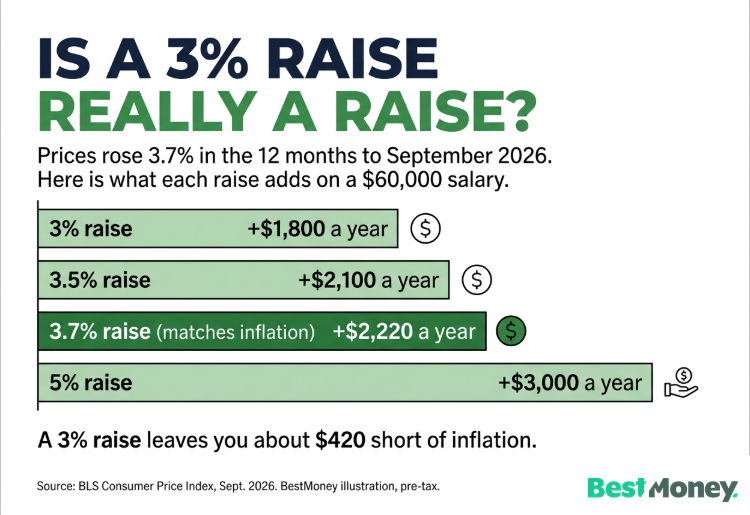
Prices rose 3.7% in the 12 months to September 2026, so a smaller raise may not keep up.
Business results and market pay data make a stronger case than personal expenses.
A specific, researched number gives your manager more to work with than a round guess.
A "no" can still end with clear goals and a date to revisit your pay.
How to Ask for a Raise: What's the Right Approach?
Schedule a dedicated meeting, present two or three quantified wins with market pay data and ask for a specific number or range.
Think of your case as a short business proposal your manager can forward to their own boss.
Here's the process:
Research your market pay. Compare your salary with government wage data for your job and area.
Build your case. Gather quantified wins and list duties you've added.
Time it. Ask after a win or before next year's budget is set.
Make the ask. Name your number and tie it to business value.
Follow up. Recap the conversation in writing and set a check-in date.
How Much of a Raise Should You Ask For?
A request near 2027 employer budgets, roughly 3.1% to 3.5%, is easy to defend. Asking for more calls for a market-gap or promotion-level case.
Three 2026 employer surveys point to similar 2027 budgets:
These are company-wide budgets, not promised raises. The Conference Board notes that a 3.5% median doesn't mean every worker gets 3.5%. Mercer's total also covers promotions, so a promotion-level case or a clear market-pay gap can justify asking above merit.
How Do You Find Your Market Rate?
Start with free government data. The BLSOccupational Employment and Wage Statistics (OEWS) program covers about 830 occupations nationally, by state and in about 530 areas. Its latest estimates, released May 15, 2026, reflect May 2025 pay.
The U.S. Department of Labor-sponsoredCareerOneStop Salary Finder draws on BLS OEWS wage data and lets you look up pay by occupation and location. If you sit well below the median for your role and area, that gap is your argument.
Why Should You Ask for a Specific Number?
A specific figure signals you've done your homework. In a2013 study, Columbia Business School's Malia Mason and colleagues found precise first offers worked as stronger anchors than round ones in lab negotiations.
The study didn't test raise talks, so don't over-engineer it. A figure like $67,500 is enough.
Is a 3% Raise Actually a Raise After Inflation?
Right now, a 3% raise doesn't keep pace with prices. Consumer prices rose 3.7% over the 12 months to September 2026, according to theBLS Consumer Price Index.
BLSreal average hourly earnings, which adjust pay for inflation, fell 0.7% over the same year. That's an all-worker average, not a read on your paycheck.
Say you earn $60,000. A 3% raise adds $1,800 a year, or $150 a month before taxes. Matching 3.7% inflation would take $2,220, so a 3% raise leaves you about $420 short in buying power.
The table below is illustrative, pre-tax arithmetic tied to the September 2026 inflation rate, which will change.
Raise
New salary (from $60,000)
Extra per year
Extra per month
New hourly rate (from $20)
Extra per year at 2,080 hours
3%
$61,800
$1,800
$150
$20.60
$1,248
3.5%
$62,100
$2,100
$175
$20.70
$1,456
3.7% (matches CPI)
$62,220
$2,220
$185
$20.74
$1,539.20
5%
$63,000
$3,000
$250
$21.00
$2,080
A cost of living raise is an across-the-board bump meant to offset rising prices. A merit increase rewards your individual performance. Your employer may fold both into one number, so ask how yours is set.
When Is the Right Time to Ask for a Raise in a Tough Job Market?
The right time is after a measurable win or before budgets are set. The job market is cautious, not collapsing. Unemployment was 4.2% in September 2026 and has stayed between 4.1% and 4.3% since March, according to theBLS jobs report.
Layoff announcements are lower than last year. U.S. employers announced 43,281 job cuts in September 2026, down 18% from August, perChallenger, Gray & Christmas. Year-to-date announced cuts were down 39% from 2025.
The catch is low turnover. The quits rate was 1.9% in August 2026, according toBLS job openings data, so relatively few people are leaving. With less pressure to retain staff, your business case carries more weight.
So timing inside your company matters more than headlines. Good windows include:
After a measurable win, such as a closed deal or finished project.
One to three months before your company sets next year's budget.
After you've absorbed a departed colleague's work.
If your team is mid-layoffs or a hiring freeze just hit, hold off and plan for the next window.
Surviving cuts can also help. Gartner's Jamie Kohn told theAP in October 2025 that a company that kept you has already chosen to invest in you.
How Do You Build a Case for a Raise?
Build your case around three things: quantified wins, proof that your role has grown and market pay data.
Keep a brag file of three wins with numbers, such as revenue earned, costs cut or hours saved.
List duties you've added since your last pay change.
Pull market data from OEWS or CareerOneStop, plus posted salary ranges for similar roles.
Colorado, for example, requires pay information in all job postings, internal and public. Check your state labor department for local rules.
Next, know your BATNA, short for "best alternative to a negotiated agreement."Harvard's Program on Negotiation describes it as the yardstick for judging any offer. Yours might be staying at current pay or an internal move, so don't bluff with it.
Finally, leave out rent, personal costs and coworkers' pay. Results are what your manager can take to HR.
What Should You Say When Asking for a Raise?
Say what you've delivered, what the market pays and the number you want, then pause. These scripts are suggested language, not research-tested wording. Swap in your details where you see brackets.
What Do You Say After a Big Win?
Connect the win directly to your pay while the results are fresh.
"Thanks for meeting. Over the past [timeframe], I [specific result, such as cutting vendor costs by $X]. I'd like to talk about adjusting my pay to reflect that impact. Based on that result and market data for my role, I'm asking for [specific salary]."
What Do You Say When You're Underpaid for the Market?
Lead with the data, then tie it to your performance.
"I've been researching pay for [job title] in [city]. BLS data shows a median of [$X], and similar job postings list [$Y to $Z]. My current salary is [$A]. Given my results on [project], I'd like to discuss moving to [specific salary]."
What Do You Say When Your Workload Has Grown?
Show how the job has changed since your pay was last set.
"Since [colleague] left in [month], I've taken on [duties]. That's added [scope or hours] to my role, and I've kept [metric] on track. I'm asking for [specific salary]."
What Do You Say When Budgets Are Tight or Frozen?
Acknowledge the constraints, then ask for a commitment you can lock in now.
"I know budgets are tight this year, and I appreciate that the team kept me on. Since then, I've taken on [new work] and delivered [result]. If a raise to [specific salary] isn't possible now, can we agree on a date to revisit it? In the meantime, I'd be open to [one-time bonus, extra PTO or training support]."
How Do You Ask for a Raise by Email?
Use email to request the meeting, then make the ask in person or on video.
Subject: Time to discuss my compensation
Hi [Manager's name], could we schedule 30 minutes in the next two weeks to discuss my compensation? Since [date], I've [top result]. I'll bring a summary of my results and market data. Does [day and time] work for you? Thanks, [Your name]
What Should You Do If Your Manager Says No?
Ask what it would take to get a yes, get the answer in writing and set a check-in three to six months out. Try this:
"I understand. What would I need to accomplish, and by when, to revisit this?"
Afterward, email a recap of the goals and timeline you agreed on.
If salary is off the table, ask about other value:
A title change
A one-time bonus
Extra paid time off
More remote days
Training or tuition support
As of its Oct. 8, 2026 update, theAtlanta Fed Wage Growth Tracker showed median pay growth of 4.7% for job switchers versus 3.4% for stayers. With hiring cautious, growing your income where you are may be steadier. Our guides tojob search apps andside hustle apps can help you add options.
What Should You Do With Your Raise Once You Get It?
Update your budget and send part of the raise to savings before lifestyle creep absorbs it. If you use the50/30/20 rule, split the new money the same way: 50% to needs, 30% to wants and 20% to savings or debt.
On a $150 monthly raise, that's $30 to savings. Anautomatic payday transfer to youremergency fund moves the money before you can spend it. Our budgeting and savings guides walk through both steps.
Who This Guide Is For
This guide is for U.S. workers asking for more pay in 2026:
If you've never asked before, start with the five-step process and the big-win script.
If you survived layoffs, read the timing section and the tight-budget script.
If you're paid below market, lead with BLS or CareerOneStop data.
If your role has grown, document every duty added since your last pay change.
If you're paid hourly, use the $20-an-hour column in the raise math table.
What Should You Do Next?
Your next step is turning this guide into a plan for this week:
Look up your market pay on the CareerOneStop Salary Finder.
Draft the script that fits your situation and practice it out loud.
Explore side income with our side hustle guide if the answer is no for now.
The bottom line: employers are budgeting about 3.5% for 2027, while prices rose 3.7% over the past year. A request built on results, market data and a specific number gives your manager something to approve. Even a "no" can end with clear goals and a date to revisit.
Your Questions, Answered (FAQs)
Is it a bad idea to ask for a raise during layoffs?
Not necessarily, but avoid the week your team faces active cuts. Wait for a calmer window and lead with your results.
How much is a 5% raise on $20 an hour?
A 5% raise adds $1 an hour, bringing you to $21. At 40 hours a week for 52 weeks, that's $2,080 more a year before taxes.
Should I ask for a raise by email or in person?
Use email to request the meeting and recap it afterward. Make the ask itself in person or on video so you can respond to questions.
How often can you ask for a raise?
Tie your ask to your company's review and budget cycle. After a no, return at the check-in date you agreed on.
Can I ask for a raise if I just had my performance review?
Yes, if your review was positive but your raise didn't reflect your results or market pay. Request a follow-up meeting within a few weeks and bring your data.
Why Trust BestMoney?
This guide uses 2026 data from the BLS, the Atlanta Fed, the Conference Board and Mercer. We cite each figure to its original publisher and label budgets as budgets, not promised raises.
How We Researched This
BestMoney's editorial team built this guide from secondary sources only. These include BLS data on prices, earnings, jobs and wages, the Atlanta Fed, Challenger and BambooHR's 2026 Compensation Trends report, based on an August–September 2025 survey.
Budget figures come from Conference Board, Mercer and Payscale surveys. Negotiation guidance comes from Harvard's Program on Negotiation and a 2013 Columbia study. No proprietary BestMoney survey was used, and the raise math is illustrative arithmetic.
The BestMoney editorial team is composed of writers and experts covering a full range of financial services. Our mission is to simplify the process of selecting the right provider for every need, leveraging our extensive industry knowledge to deliver clear, reliable advice.