- Home/
- Financial Advisor/
- The 12 Best Side Hustle Apps of 2026 (Ranked by Real Earnings)
The 12 Best Side Hustle Apps of 2026 (Ranked by Real Earnings)
August 9, 2026
August 9, 2026
Your rent just increased by $200. Again. Between rising costs and stagnant wages, nearly one in two Americans (47%) reported earning income from a side hustle over the past year, according to Intuit QuickBooks' 2026 Entrepreneurship Study. The difference between surviving and thriving often comes down to finding flexible income sources that fit around your existing life—and knowing how to compare online savings accounts to park that extra income.
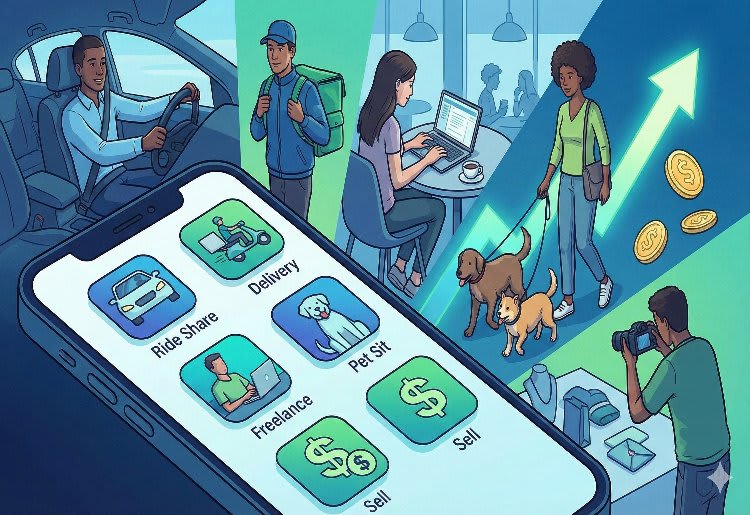
Side hustle apps changed the game. No resumes, no interviews, no waiting weeks for a callback. Download an app, complete a profile, and start earning within hours. But fees have shifted dramatically in 2026: the IRS raised business mileage rates mid-year, Upwork replaced its sliding fee scale with a new per-contract model, and Depop eliminated US seller commissions entirely. These changes directly impact what you actually take home.
DoorDash/Instacart — Best for fast cash and flexible schedules
Rover — Best for pet lovers and work-from-home earners
Turo — Best for asset owners seeking passive income
Poshmark/Depop — Best for selling clothing and fashion items
Fetch — Best for truly passive pocket money
We compared these apps on real earnings potential, fee structures, effort required, and payout speed. We verified current fee schedules against each platform's official pricing pages and cross-referenced earnings data with third-party sources where available.
Side hustle apps remove the traditional barriers to earning extra income. You don't need startup capital, business licenses, or even a laptop in many cases. Your smartphone becomes your business headquarters.
The flexibility matters most. Work during your lunch break, after the kids go to bed, or on weekend mornings. Accept jobs when it suits your schedule and decline when it doesn't. This control over your time makes app-based hustles fundamentally different from traditional part-time jobs with fixed schedules.
The startup speed also sets these platforms apart. Traditional side businesses require weeks or months of planning, purchasing inventory, or building client lists. With apps, you can complete your first paying task today.
But here's the reality check: Not every app delivers on its income promises. Some bury you in fees. Others require expensive equipment or only work in specific locations. The right app for your neighbor might be completely wrong for your situation, skills, and available time.
App Category | Time Required | Earning Potential | Best For |
Gig Economy (DoorDash, Uber) | High (Active work) | Medium ($15–$25/hr) | Fast cash, flexible schedules |
Skilled Work (Upwork, TaskRabbit) | High (Proposals + Work) | High ($30–$100+/hr) | Professionals building a business |
Selling Stuff (eBay, Poshmark) | Medium (Listing/Shipping) | Variable ($100–$1,000+) | Clearing clutter, flipping items |
Asset Rental (Turo, Rover) | Low/Med | High ($500–$2,000+) | People with cars or homes to leverage |
Passive Apps (Fetch, Swagbucks) | Very Low | Low ($15–$50/mo) | Pocket money, zero effort |
If speed matters, several gig apps offer same-day or instant payouts. DoorDash's Fast Pay lets you cash out daily earnings for a small fee. Instacart offers instant cashout. Uber and Lyft both provide instant pay options. For most other platforms—selling apps, freelance sites, and passive apps—expect payouts within a few days to a week.
Here's what nobody tells you until tax season: Side hustle income comes with zero tax withholding. That $500 DoorDash payment? The IRS expects you to pay self-employment tax (15.3%) plus your regular income tax rate on it, according to the IRS self-employment tax guidance.
Set aside 25–30% of every payment immediately. Open a separate savings account labeled "Taxes" and treat it as untouchable, and consider one of the best expense tracker apps to log every payment for tax time. When you earn $1,000, transfer $300 to your tax account before paying any bills.
The math hurts worse than you think. If you earn $15,000 from side hustles in 2026, you'll owe roughly $2,120 in self-employment tax alone (15.3% of 92.35% of your net earnings), plus your regular income tax on that amount. Miss this, and April becomes a financial crisis.
What about 1099 forms? The 1099-K threshold reverted to $20,000 in gross payments AND 200 transactions for 2026 under the One Big Beautiful Bill Act, according to the IRS's 1099-K FAQ. The same 2025 One Big Beautiful Bill Act also raised the 1099-NEC threshold for contractor payments to $2,000 for tax year 2026, per the IRS — but all gig income is taxable whether you receive a form or not, as the IRS Gig Economy Tax Center explains. Consider making quarterly estimated tax payments if you're earning more than $1,000 quarterly from side hustles to avoid underpayment penalties.
Set aside 25-30% of every payment immediately. Open a separate savings account labeled "Taxes" and treat it as untouchable. When you earn $1,000, transfer $300 to your tax account before paying any bills.
The math hurts worse than you think. If you earn $15,000 from side hustles in 2024, you'll owe roughly $2,295 in self-employment tax alone, plus your regular income tax on that amount. Miss this, and April becomes a financial crisis.
Most gig platforms issue 1099 forms if you earn over $600 annually. The IRS gets a copy too. They know exactly what you made, and they expect their cut. Consider making quarterly estimated tax payments if you're earning more than $1,000 quarterly from side hustles to avoid underpayment penalties.
These platforms connect you with immediate, on-demand work in your area. The pay comes quickly, usually within days, but you'll need to factor in vehicle expenses, insurance, and the physical demands of the work.
Food and grocery delivery apps offer the most immediate earning opportunity. Download the app, pass a background check, and start accepting delivery requests within days.
DoorDash and Instacart both let you work whenever you want. Open the app, go online, and accept orders that make sense for your location. DoorDash consistently provides more available orders during peak hours (5–9 PM), while Instacart offers higher base pay but requires more time per delivery due to shopping.
The earning potential varies dramatically by location and time commitment. Delivery drivers typically earn $15–25 per hour before expenses during peak times, dropping to $10–15 during slower periods. Instacart shoppers average $15–20 per hour, with experienced shoppers who work efficiently earning up to $25 per hour.
However, these figures don't account for vehicle costs. The IRS standard mileage rate for 2026 is 72.5 cents per mile (January–June) and 76 cents per mile (July–December), reflecting gas, maintenance, depreciation, and insurance. The IRS raised the business rate mid-year. If you drive 50 miles during a $100 shift, your actual take-home drops to roughly $62 before taxes.
The insurance situation gets messy. Your personal auto insurance policy likely excludes coverage while you're actively delivering. You're in a coverage gap between accepting an order and completing delivery. DoorDash and Instacart provide liability coverage during active deliveries, but it won't cover damage to your own vehicle. You need a commercial or rideshare endorsement on your personal policy, typically adding $10–30 monthly to your premium. Skip this, and you risk claim denial after an accident while delivering.
Best for: People with reliable vehicles, available during meal times, comfortable with repetitive tasks
Watch out for: Vehicle wear and tear, insurance coverage gaps during deliveries, parking challenges in cities, customer tip variability, dead miles between deliveries
Realistic earnings: $12–20 per hour after vehicle expenses in most markets
Ridesharing requires a higher barrier to entry than delivery—your vehicle must meet specific age and condition requirements, and you're responsible for commercial insurance gaps. But the earning potential can exceed delivery apps in the right circumstances.
The key differentiator: surge pricing. When demand spikes (Friday and Saturday nights, major events, bad weather), rates can double or triple. Experienced drivers in major cities report earning $40–60 per hour during events or holidays, though these peaks represent a small fraction of total driving hours.
Standard rates tell a different story. Many rideshare drivers earn $10–18 per hour after expenses, with only strategic drivers who work during surge periods and minimize unpaid miles exceeding $20–30 per hour.
Vehicle depreciation hits rideshare drivers harder than delivery drivers. Putting 30,000 miles annually on your car significantly impacts its resale value.
Best for: People in dense urban areas, available during nightlife hours, comfortable with passengers, strategic about timing
Watch out for: Insurance requirements, background check standards, vehicle wear, passenger safety concerns, income volatility
Realistic earnings: $10–18 per hour after all expenses for average drivers; $20–30 for strategic drivers during peak times
TaskRabbit connects you with people who need help with furniture assembly, home repairs, moving, cleaning, and general handyman work. Unlike delivery apps, TaskRabbit lets you set your own rates and choose which tasks to accept.
The earning potential depends entirely on your skills and how you price yourself. Handyman tasks and furniture assembly command $40–80 per hour in major cities, while basic errands or cleaning pay $25–40 per hour. Experienced Taskers who maintain high ratings and stay active can command strong per-task rates, especially for skilled work.
The catch: You need actual skills for the highest-paying work. Someone requesting furniture assembly expects you to finish efficiently without damaging their new purchase. Moving jobs require physical stamina and proper lifting techniques. The platform reviews your work history, and poor ratings tank your visibility in search results.
TaskRabbit does not deduct a flat cut from your rate. Instead it adds a service fee plus a Trust & Support fee to the client's invoice on top of your hourly rate, and Taskers receive 100% of their rate plus 100% of tips and reimbursements, according to TaskRabbit's fee policy. You are still responsible for your own tools, transportation to jobs, and any supplies the client does not provide.
Best for: People with handyman skills, physically fit, own basic tools, comfortable working in strangers' homes
Watch out for: Tool investment costs, physical demands, liability for damage, income inconsistency between jobs
Realistic earnings: $25–60 per hour depending on skills and local rates
Visit TaskRabbit
Reselling apps turn your unused items into cash. The barrier to entry is zero—you likely have $500–1,000 worth of sellable items in your home right now. But success requires photography skills, pricing strategy, and patience.
Clothing resale apps cater to different demographics but operate on similar models. Poshmark targets women 25–45 with mainstream and designer brands, while Depop attracts Gen Z buyers looking for vintage, trendy, or unique pieces.
Both platforms handle payment processing and provide prepaid shipping labels once items sell. Poshmark takes a flat $2.95 on sales under $15 and 20% on sales above $15, according to Poshmark's fee structure.
Depop's fee structure changed significantly. Depop now charges US sellers 0% selling commission—you pay only a standard payment-processing fee per transaction, according to Depop's official fee page. That makes Depop one of the lower-cost options for fashion resale in the US, well below Poshmark's 20% cut on sales over $15.
The profit margin depends on your sourcing strategy. Selling your own closet generates nearly 100% profit (minus fees). Thrift store flipping—buying items at Goodwill for $5–10 and reselling for $30–50—requires more work but can generate consistent income. Active sellers who list 5+ items weekly typically average $200–500 monthly, while top sellers treating it as a business earn $2,000+ monthly.
Photography matters more than you think. Items with clear, well-lit photos on neutral backgrounds sell significantly faster than poorly photographed items at similar prices.
Best for: People with fashion sense, photography skills, patience for shipping and customer service, existing inventory of quality clothing
Watch out for: Time investment in photographing and listing, storage space needed, shipping logistics, price negotiations, platform fees eating profit
Realistic earnings: $100–300 monthly casually; $500–1,500 monthly with dedicated effort
Facebook Marketplace dominates local selling because everyone already has a Facebook account. No shipping required—buyers pick up items in person—and you keep 100% of the sale price.
The platform works well for furniture, electronics, exercise equipment, and other large items where shipping costs make platforms like eBay impractical. Furniture typically sells within 3–7 days at 60–80% of asking price, while smaller items take 2–3 weeks.
Meeting strangers from the internet carries inherent risks. Always meet in public places, bring someone with you, accept cash only (scammers use fake payment apps), and trust your instincts about sketchy buyers.
Best for: People selling large local items, comfortable meeting buyers in person, want immediate cash
Watch out for: No-show buyers, lowball offers, safety concerns during meetups, scam attempts
Realistic earnings: Varies entirely based on what you're selling; expect to clear $300–800 from a thorough home declutter
Visit Facebook Marketplace →
eBay remains strong for niche items, collectibles, and products where you need to reach a national audience. The platform's auction format lets hot items sell above market value, while fixed-price listings provide predictability.
eBay's fee structure runs approximately 13.6% of the total sale (item price plus shipping), plus a per-order fee of $0.30–$0.40, according to eBay's 2026 fee schedule. Selling a $100 item costs roughly $14 in fees. These higher fees reflect eBay's larger audience and stronger buyer protections compared to Facebook Marketplace.
Shipping costs need careful calculation. New sellers often lose money by underestimating shipping on heavy items. eBay provides shipping calculators, but you need to measure and weigh items accurately before listing.
Best for: People selling collectibles, vintage items, niche products, willing to invest time in listings and shipping
Watch out for: Complex fee structure, shipping logistics, buyer returns, time investment in creating detailed listings
Realistic earnings: Highly variable; casual sellers average $200–400 monthly, experienced resellers run 5-figure businesses
Visit eBay
These platforms let you build actual businesses from existing skills or assets you already own. The earning potential exceeds gig work, but competition is fierce and success requires professional-level service.
Freelance platforms connect professionals with clients needing writing, graphic design, web development, marketing, and hundreds of other services.
Upwork operates on a bidding model. Clients post projects, freelancers submit proposals, and clients choose based on price, portfolio, and reviews.
Upwork's fee structure changed in May 2025. The old sliding scale (20% on your first $500 with a client, 10% on $500–$10,000, 5% above $10,000) no longer applies to new contracts. Upwork now charges freelancers a variable service fee of 0–15% per contract, set at proposal time and locked for the contract's duration, according to Upwork's fee documentation.
There's another cost: Connects. Upwork charges you to apply for jobs. Each proposal costs a few Connects depending on job value, and Connects cost $0.15 each. Those application costs add up before you earn a single dollar. This pay-to-apply model punishes new freelancers who need to send more proposals to land their first clients.
Fiverr flips the model. You create "gigs" with set prices, and clients purchase directly from your profile. Fiverr takes 20% of all transactions regardless of volume, according to Fiverr's seller fee documentation. The platform skews toward quick, commoditized services ($20 logo designs, $50 website copy), making it harder to command premium rates for specialized skills.
Breaking through on either platform requires strategy. New freelancers often spend months applying before landing their first client. Starting with competitive pricing to build reviews, then raising rates once you have 5-star feedback, is a common path to sustainable income.
Best for: People with marketable professional skills, portfolio of past work, patience to build reputation, comfortable with client management
Watch out for: High platform fees when starting, cost of Connects (paying to apply for jobs), competition from international freelancers with lower rates, unpredictable income, time spent on proposals that don't convert
Realistic earnings: $0–500 monthly for first 3–6 months; $1,000–3,000 monthly once established; $5,000+ for experienced freelancers with niche specialties
Pet sitting and dog walking through Rover turns animal lovers into earners. The platform connects pet owners with local sitters for boarding, house sitting, drop-in visits, and walks.
Rover takes a 20% service fee from every booking, according to Rover's official fee documentation. If a client pays $50 for dog boarding, you receive $40. In exchange, Rover provides payment processing, booking management, and insurance coverage for eligible accidents during booked services.
Your earning potential depends on your location, flexibility, and capacity. Sitters who offer overnight boarding earn significantly more than those offering only walks or drop-ins. A dog boarder hosting 2–3 dogs simultaneously can earn $100–150 per night, minus the 20% fee.
Building a client base takes time. New sitters struggle to get their first booking without reviews. Starting with discount rates (30–40% below market) to get your first 10–15 bookings and five-star reviews, then raising your rates to market levels, is a proven strategy.
Best for: People who love animals, work from home or have flexible schedules, own a home with yard space, comfortable with pet care responsibility
Watch out for: Liability for pet injuries or escapes, damage to your home, aggressive dogs, last-minute cancellations, 20% platform fee
Realistic earnings: $200–500 monthly for casual walkers; $1,000–2,500 monthly for regular boarders; $3,000+ for full-time sitters in major cities
Visit Rover →
Turo operates as Airbnb for cars. List your vehicle, set your price and availability, and rent it to travelers or locals who need temporary wheels. In markets with strong tourism or business travel, Turo can generate serious passive income from an otherwise idle asset.
The earning potential varies by vehicle type and location. Earnings vary widely by vehicle and market: many hosts bring in a few hundred dollars a month, while top hosts in high-demand cities like Los Angeles, Miami, and Denver can earn considerably more. Luxury and specialty vehicles (convertibles, trucks, SUVs) command premium rates and higher occupancy.
Turo keeps a percentage of each trip that varies by the vehicle-protection plan you choose. Picking a higher-protection plan means Turo covers more potential damage but takes a larger cut of your earnings, while a lower-protection plan leaves you more exposed to damage costs, similar to a higher insurance deductible.
The risks are real. Hosts deal with renters returning cars with interior damage, smoking smells, or mechanical issues. Turo's insurance covers major damage, but minor issues, deep cleaning fees, and lost rental time during repairs come out of your pocket.
Best for: People with newer vehicles in good condition, near airports or tourist areas, comfortable with strangers driving their car
Watch out for: Vehicle wear and tear, cleaning between rentals, risk of accidents or damage, insurance gaps, depreciation acceleration
Realistic earnings: $300–800 monthly for average vehicles in good markets; $1,000–2,500 for premium vehicles in top markets
Visit Turo
These apps won't replace your income, but they require minimal active effort. Think of them as optimizing actions you already take rather than creating new work.
Fetch turns every shopping receipt into points redeemable for gift cards. Snap a photo of any receipt from any store—grocery, gas station, or restaurant—and earn points based on your purchase total and featured brands.
Users typically accumulate $15–25 monthly in gift cards with normal shopping habits, with zero behavior change required. Each receipt takes 10 seconds to scan.
Buy featured brands during promotions and you can double or triple that amount. Fetch partners rotate frequently (General Mills, Pepsi, Unilever products commonly offer bonuses), so checking the app before grocery shopping helps maximize points.
Fetch doesn't require you to buy specific items or shop at specific stores, unlike traditional coupon apps. Any receipt from any store earns points. This flexibility makes it among the easiest passive earning apps available.
Here's the trade-off: Fetch earns money by selling your anonymized purchase data to market research firms. They track what you buy, where you shop, and how much you spend. This data helps brands understand consumer behavior. For many people, this trade seems fair—getting paid for data you're already generating. But understand what you're exchanging for those gift cards.
Best for: Everyone who makes purchases anywhere
Watch out for: Low earning rate means this supplements income, not replaces it; gift cards only, no cash option
Realistic earnings: $15–30 monthly with normal shopping habits
Visit Fetch
Swagbucks pays you to take surveys, watch videos, shop online, and search the web. The platform aggregates multiple earning methods, letting you choose activities that fit your schedule and interest.
Like Fetch, Swagbucks monetizes your data and behavior. Survey companies pay Swagbucks for your opinions and demographic information, and Swagbucks shares a portion with you. Retailers pay for tracking your shopping habits. You're trading privacy for convenience and small payments.
Survey earnings average $0.50–3.00 per survey, with most taking 10–20 minutes. The math rarely makes sense as "work"—you're earning roughly $3–6 per hour. But if you're watching TV anyway, running Swagbucks videos in the background or completing a survey during commercials turns wasted time into modest earnings.
The shopping portal offers better value. Earn 1–10% cash back at 1,500+ retailers by starting your shopping session through Swagbucks. Users report earning $200–400 over a couple years simply by clicking through Swagbucks before making purchases they were already planning. The earnings stack with credit card rewards, effectively getting paid twice for the same purchase.
Best for: People with downtime to fill, regular online shoppers, comfortable with mind-numbing survey questions
Watch out for: Time investment rarely justifies earnings, some surveys disqualify you mid-completion, payout threshold requirements
Realistic earnings: $20–50 monthly with moderate effort
Visit Swagbucks →
Ibotta focuses specifically on grocery cash back. Unlike Fetch's any-receipt model, Ibotta requires you to unlock offers before shopping, then purchase specific items to earn cash back.
The earning potential exceeds Fetch if you're willing to adjust your shopping based on available offers. Ibotta regularly features $0.25–1.00 back on produce, milk, bread, and other staples, plus larger bonuses ($2–5) on featured brands. Strategic shoppers report earning $30–60 monthly by building their grocery list around Ibotta offers.
The app added a "pay with Ibotta" feature letting you link your loyalty cards and earn automatically without scanning receipts. This eliminates the post-shopping task but limits earning to partnered retailers.
Like other cash-back apps, Ibotta sells anonymized purchase data to brands and market researchers. Your shopping habits have value, and Ibotta shares a portion of that value with you.
Best for: Flexible grocery shoppers, deal hunters, people who don't mind adjusting purchases for offers
Watch out for: Requires pre-planning shopping, smaller store selection than Fetch, minimum $20 withdrawal
Realistic earnings: $25–50 monthly with strategic shopping
Visit Ibotta →
App | Best For | Avg. Hourly Rate* | Payout Speed | Key Cost/Risk |
Meal times | $12–$20 | Same-day (Fast Pay) | Vehicle wear & tear | |
Grocery shoppers | $15–$20 | Same-day (Instant) | Shopping time varies | |
Nightlife/Events | $10–$30 | Same-day (Instant) | High depreciation | |
Handyman skills | $25–$60 | 3–5 days | Physical labor | |
Fashion lovers | Variable | 3 days after delivery | 20% platform fee | |
Gen Z fashion | Variable | Same-day (Depop Pay) | Payment-processing fee only | |
Large items | Variable | Immediate (cash) | Safety concerns | |
Collectibles | Variable | 2–5 days | 13.6% + per-order fee | |
Freelancers | $20–$100+ | Weekly | "Connects" (pay to apply) | |
Pet lovers | $20–$150+ | 2 days after booking | 20% platform fee | |
Car owners | Passive | 3 days after trip | Protection-plan fee | |
Shoppers | ~$15/mo | Gift card threshold | Data privacy |
*After expenses where applicable; before taxes
Your ideal app depends on four factors: available assets, usable skills, time commitment, and income goals.
Own a reliable car? Delivery and rideshare apps make sense. Nice home with flexible schedule? Consider Rover. Recent-model vehicle near an airport? Turo could generate serious passive income. No special assets? Focus on skill-based platforms or selling apps.
Upwork and Fiverr require legitimate professional abilities and portfolios. TaskRabbit needs handyman competence. Reselling apps demand photography and pricing skills. If you're still building these skills, start with lower-barrier options like delivery apps or receipt scanning.
Gig apps require active work hours. Selling requires listing, communication, and shipping time. Freelance platforms need time for proposals, client calls, and project work. Passive apps need seconds daily. Choose platforms matching your realistic time availability, not your optimistic estimate.
Need an extra $200 monthly? Passive apps plus casual reselling gets you there. Want $1,000+? You need gig work or freelancing with significant time investment. Aiming for $2,000–3,000? Treat it like a part-time job with 15–25 hours weekly. One app won't replace full-time income; successful side hustlers often run 2–3 apps simultaneously. And once you're earning consistently, one of the best AI budgeting apps can help you manage multiple income streams more effectively.
Start with one app in your strongest category. Master that platform, understand its payment timing and hidden costs, and actually earn money before adding others. App-hopping without fully learning any platform generates frustration without income.
This guide helps you find the right side hustle app if you're:
A student looking for income around class schedules—delivery apps, Fetch, and selling apps work well (see our guide to the best money-saving apps for students)
A parent wanting to earn from home while kids are at school or asleep—Rover, freelancing, and passive apps fit this lifestyle
Between jobs and need fast cash—gig apps like DoorDash and Uber pay quickly
A car or home owner wanting passive income from assets you already have—Turo for cars, Rover for pet boarding
Looking to work from home—freelance platforms, selling apps, and passive apps don't require leaving the house
There's no single best app—it depends on your skills, assets, and available time. For fast cash with a car, DoorDash or Uber. For professional skills, Upwork or Fiverr. For pet lovers working from home, Rover. For truly passive income, Fetch requires seconds per day.
DoorDash (Fast Pay), Instacart (Instant Cashout), Uber, and Lyft all offer same-day payout options, usually for a small fee. Depop also offers same-day payouts through Depop Pay.
Passive apps earn $15–50 monthly. Casual selling brings $100–400 monthly. Gig work (delivery, rideshare) typically earns $12–25 per hour after expenses. Skilled freelancing ranges from $0 initially to $3,000+ monthly once established.
Most apps are free to download and join, but many take a cut of your earnings. Freelance, selling, pet-care, and task platforms each charge fees (detailed in the reviews above), while delivery apps don't charge a platform fee—though vehicle expenses reduce your take-home pay.
Yes. Side hustle income is subject to regular income tax plus a 15.3% self-employment tax, and you should set aside 25–30% of earnings for taxes (see the IRS links in the tax section above for details).
Fetch and Swagbucks require no skills and fit around any schedule. Delivery apps like DoorDash work well if you have a car. Selling apps like Depop suit fashion-savvy students—and Depop now charges 0% selling commission for US sellers.
Side hustle apps typically let you set your own hours with no minimum commitment—you're an independent contractor. Traditional side job apps may have scheduled shifts and treat you more like an employee. Both are taxed similarly as self-employment income.
Our research draws from:
IRS — standard mileage rates, self-employment tax guidance, and the Gig Economy Tax Center (all linked in the sections above)
Intuit QuickBooks — 2026 Entrepreneurship Study on side hustle participation (linked in the introduction)
Platform fee pages — Upwork, Depop, Poshmark, eBay, TaskRabbit, Rover, and Fiverr official pricing documentation (linked in each app's review)
The right side hustle app depends on matching your assets, skills, and available time to the right platform—not chasing the highest advertised earnings. Start with one app you're well-suited for, understand the real costs (fees, expenses, taxes), and build from there. Set aside 25–30% for taxes from day one, and remember that any income is better than no income when you're working around an existing schedule.
Actual earnings vary significantly based on location, effort level, and individual circumstances. All figures represent pre-tax income and don't account for business expenses unless specifically noted. Fee structures and platform policies change; verify current rates on each platform's official pages before making decisions.
The BestMoney editorial team is composed of writers and experts covering a full range of financial services. Our mission is to simplify the process of selecting the right provider for every need, leveraging our extensive industry knowledge to deliver clear, reliable advice.