- Home/
- Debt Consolidation/
- What Self-Employed Workers Need to Know About Consolidating Debt — and Why Standard Advice Falls Short
What Self-Employed Workers Need to Know About Consolidating Debt — and Why Standard Advice Falls Short
August 6, 2026
August 6, 2026
Only 79% of gig workers paid all their bills in full last month, compared with 85% of everyone else, according to the Federal Reserve's 2024 Survey of Household Economics and Decisionmaking (SHED).
As of May 2026, the Bureau of Labor Statistics counted 9.5 million unincorporated self-employed workers, a category that includes most freelancers, 1099 contractors, and gig workers. If you're part of this group and looking for a debt consolidation loan, it may be harder for you than for someone with a full-time job, not because you earn less, but because lenders measure your income differently.
This guide breaks down what's actually different about debt consolidation for self-employed borrowers, from how lenders calculate your debt-to-income ratio to which documents give you the strongest application.
Applying for debt consolidation looks different because lenders measure your income in a way that's structurally disadvantaged for self-employed workers.
Freelance and gig income can be harder for lenders to approve than traditional W-2 earnings. Nonstandard documentation and irregular earnings can get your application denied, even when you earn enough to repay a loan.
Getting denied isn't always about how much you actually earn, it often comes down to whether your books can prove it. As Dr. Lori Hauck, a CPA with over 20 years of experience, explains:
"Self-employed clients are often tripped up when applying for consolidation loans and any other type of loan because the lender wants to see solid financial statements from their business, since they don't have a traditional W-2. They often get denied even if their income supports it because they aren't keeping accurate books for their business, and thus don't have the financial information readily available to show the lender."
The same write-offs that save you money on tax day, like your home office, vehicle expenses, software, and supplies, can potentially reduce the income number a lender uses to decide whether you qualify.
Many freelancers are paid per-project or generate seasonal income depending on their profession, so lenders may see that inconsistency as risk even when annual earnings are strong. Most underwriting models were built for predictable, employer-verified income, which means self-employed applicants can face tougher scrutiny regardless of their total earnings.
Understanding why the process differs is the first step toward finding consolidation options that match how you earn.
Expert Tip: As Dean Ferraro, CEO of Longhouse Wealth Management, advises:
Debt consolidation works the same way for all borrowers: you combine multiple debts into a single payment, ideally at a lower interest rate. Where things diverge for self-employed borrowers is the qualification process.
The three main routes:
Here's where self-employment changes the equation: lenders evaluate your income differently than they would for a W-2 borrower, which can significantly affect the loan amount and terms you qualify for.
Each of these documents plays a different role depending on whether your income comes through as 1099 or W-2 earnings, which changes how lenders verify it. Lenders reviewing personal loan applications typically expect to see tax returns, profit-and-loss statements, and 1099s in a specific format.
Debt consolidation companies work differently, since they weigh your total debt load over your paperwork.
The details matter more when your income doesn't follow a standard pattern. Here's the full picture.
They can significantly reduce the income figure lenders use to evaluate your application. Lenders don't look at your gross revenue. They calculate your debt-to-income ratio using your adjusted gross income or your net self-employment income from your tax return.
That means every legitimate deduction you claim lowers the income lenders see. The deductions that save you thousands in taxes can work against you when you're trying to borrow. You can find more details on deduction categories and reporting requirements at the IRS self-employment tax center.
Here's how this plays out for a rideshare driver:
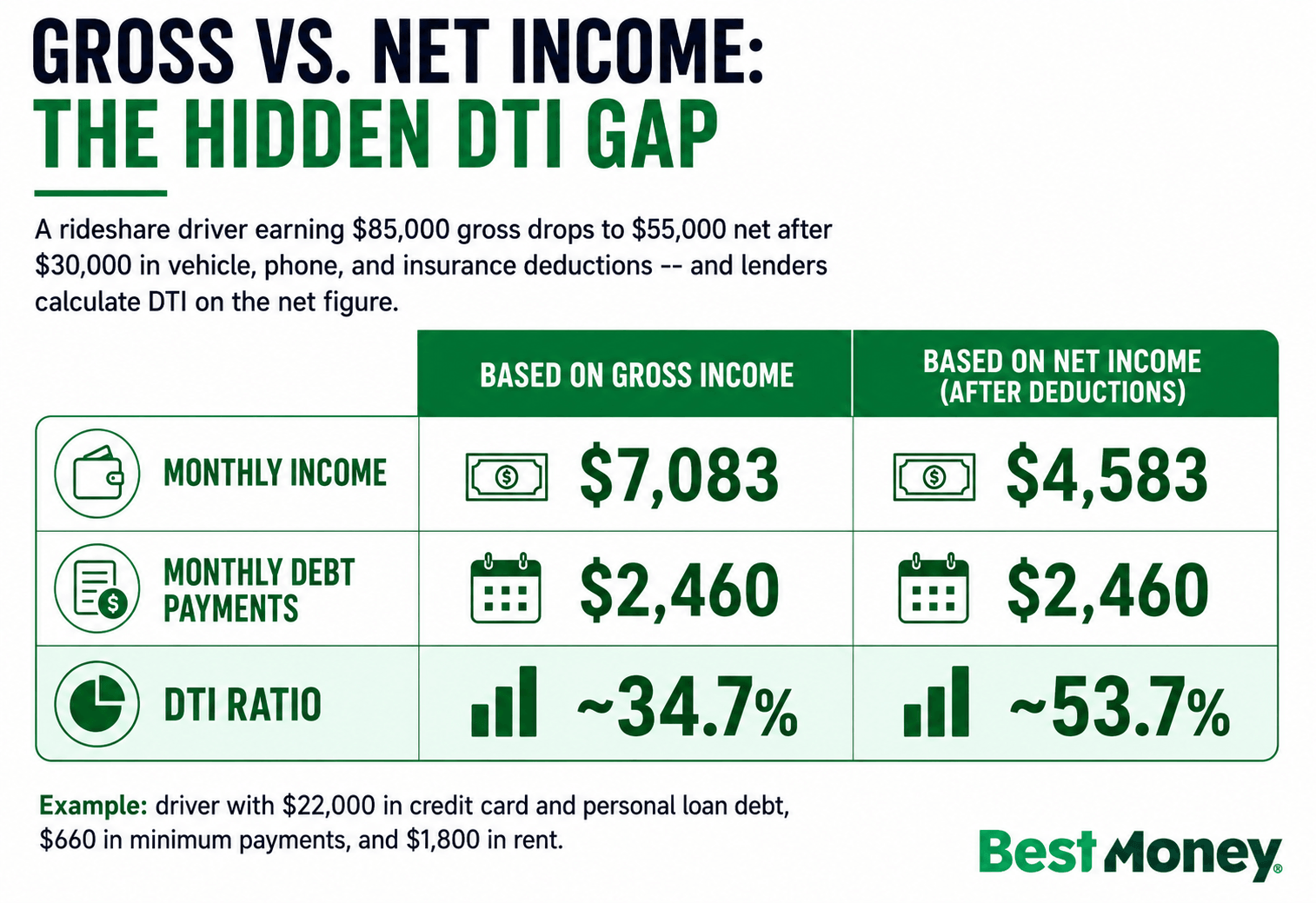
If a lender looked at gross income, this driver's DTI would land around 34.7%, well within range for most personal loans. But lenders use the net figure instead, and against $4,583 a month, the same $2,460 in obligations pushes the DTI to about 53.7%, well above the thresholds lenders commonly set.
The gap can be substantial, which is why timing and preparation matter more for self-employed borrowers than for W-2 applicants.
"I would advise a self-employed person who wants to take out a loan to work with a bookkeeper and tax professional from the beginning of the business and not just in the time of need. It's much easier to convince a lender of your income if you have multiple years of taxes or financial statements to show you have a history of this level of income and the data appears accurate and organized. This gives a lender more ease in assuming it will continue and the founder will be able to pay their loan payments."
You may need a more extensive paper trail than W-2 employees if you’re self-employed and want to take out a debt consolidation loan. The specifics vary by lender, but here's what most providers ask for:
Keeping these organized before you apply saves time and avoids delays. As Hauck mentioned, some lenders also ask for a CPA letter confirming your self-employment status and income, though this isn't universal.
If you've been self-employed for less than a year, speak to your lender. Some debt consolidation companies evaluate your total debt situation rather than just your income documentation, which can work in your favor.
Bank statement lending is an income verification method that uses your actual bank deposits, rather than tax returns, to determine how much you earn. It's designed for borrowers whose tax returns understate their real earning capacity because of legitimate business deductions.
Instead of reviewing Schedule C or W-2 forms, a lender using this approach analyzes 12 to 24 months of your personal or business bank statements, calculates your average monthly deposits, and uses that figure as your qualifying income.
Some lenders offer bank statement programs, particularly in the mortgage space, though availability and terms vary across providers and loan types.
Self-employed borrowers whose gross income substantially exceeds their net reported income on tax returns benefit most. If you gross $120,000 but report $72,000 after deductions, bank statement verification could qualify you based on something closer to your actual cash flow.
Because bank statement lending isn't universally available, researching your options across lenders can help you identify which ones accept alternative documentation before you spend time applying.
You manage it by building a repayment structure that matches your earning pattern, not by forcing your income to fit a fixed-payment schedule. Fixed monthly payments on a consolidation loan may work fine in peak months, but they could strain your budget during slow periods, and missed payments damage both your credit and your consolidation strategy.
Here are three approaches that help:
Debt management plans offered through debt consolidation companies may also give you more flexibility than a fixed personal loan. These programs negotiate directly with your creditors and may adjust payment schedules based on your financial situation, something a standard loan agreement won't do.
The option that works best depends on your income documentation, credit score, and total debt load. A few nuances matter specifically for non-traditional earners:
If mainstream lenders have denied you, you may see ads for "guaranteed approval" loans targeting borrowers with bad credit. These often carry high interest rates, hidden fees, or terms that leave you worse off. Check any provider's BBB rating, read the full terms, and compare offers before committing. If you've already been turned down, here's what to do if you're denied.
It means your path to consolidating debt exists, but it requires preparation that goes beyond what general-audience guides cover. The core challenge is structural: the tax system rewards you for maximizing deductions, while the lending system penalizes you for doing exactly that.
The right consolidation option depends on your income type, documents, and total debt load — not a one-size-fits-all formula. You can evaluate whether debt consolidation makes sense for your situation before committing to a path.
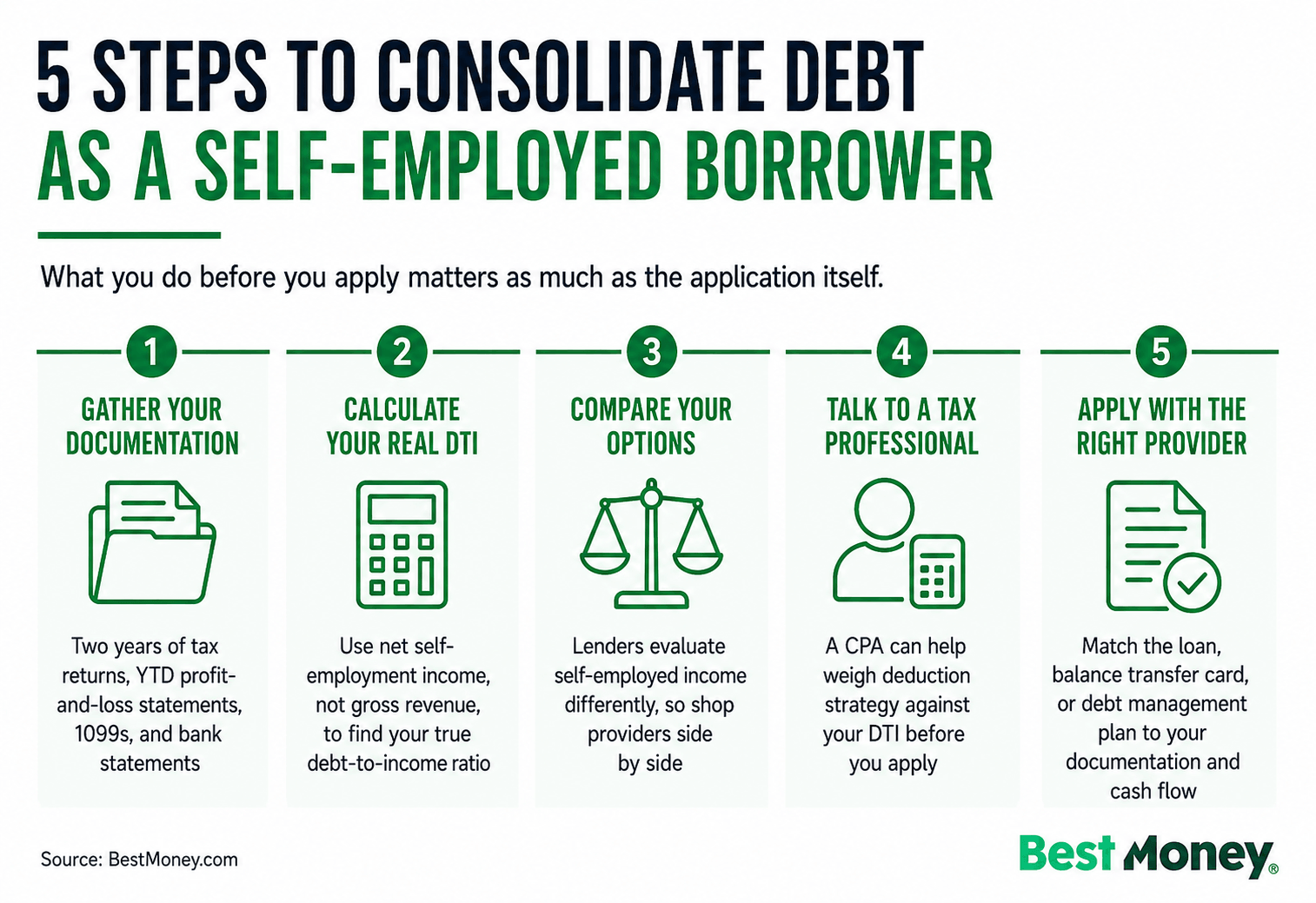
You should start with the preparation steps that most guides skip — because for self-employed borrowers, what you do before you apply matters as much as the application itself.
We reviewed more than five competing articles on self-employed debt consolidation and identified gaps most guides overlook: the impact of tax deductions on DTI ratios, bank statement lending, seasonal income repayment strategies, and 1099-specific documentation needs.
We cross-referenced IRS Schedule C guidelines, lender qualification criteria, and published financial expert commentary. All statistics are attributed to named sources, and expert quote placeholders are clearly marked. No quotes have been fabricated.
Maya Dollarhide is a Journalist for bestmoney.com, specializing in personal finance and consumer lending. She earned her MS in Journalism from Columbia University and has written for TIME, Yahoo Finance, Investopedia, Bankrate, Forbes, CNN, and AARP. Her work focuses on creating SEO-driven content, developing K-12 financial literacy curriculum, and producing B2B content for financial services clients.