Meagan Drew is a personal finance and loans expert at BestMoney.com. She has written for publications such as Investopedia, Apple News+, and SimpleMoneylyfe.com. With seven years of experience as a financial advisor, Meagan specializes in making complex topics like budgeting and investing accessible and engaging for everyday consumers.
A debt management plan can reduce your interest rates and consolidate multiple payments into one — without taking out a new loan.
What Can a Debt Management Plan Do for You?
A debt management plan (DMP) can consolidate multiple unsecured debts into one monthly payment while reducing your interest rate — in many cases from around 22.76% to as low as 0–8%. If you're carrying $15,000–$25,000 in credit card balances and struggling to keep up, a DMP may offer a structured path to a debt-free life.
DMPs work by simplifying unsecured debts, such as credit cards or medical bills, into one monthly payment. This approach helps make debt more manageable and can speed up your path to becoming debt-free.
However, DMPs are just one way to handle debt. It's important to understand how they work, their potential benefits and drawbacks, and how they compare to other options like best debt consolidation options or debt settlement programs.
What Will I Learn From This Article?
A DMP consolidates unsecured debts into one payment with reduced interest rates — but requires closing credit cards.
Typical DMP costs run about $50 to set up and $30–$100 per month, with repayment spanning 3–5 years.
Your credit score may dip initially, but consistent on-time payments through a DMP can improve it over time.
DMPs suit people with multiple unsecured debts and stable income who want lower rates without new borrowing.
Before enrolling, assess your finances, research accredited agencies, and compare alternatives like consolidation loans.
Why Does This Matter?
Americans are carrying more high-interest debt than ever. Total US credit card balances hit $1.252 trillion in Q1 2026, according to the Federal Reserve Bank of New York's Household Debt and Credit Report — part of a total household debt load of $13.19 trillion.
With the average credit card interest rate hovering around 22.76% (per Federal Reserve data), minimum payments barely cover interest charges, and balances can take decades to pay off. For the millions of consumers juggling multiple credit card bills, a debt management plan offers a structured way to reduce interest rates, simplify payments, and get out of debt in 3–5 years — all without taking on new borrowing or risking the severe credit damage that comes with debt settlement or bankruptcy.
Understanding how DMPs work, what they cost, and who they're designed for can help you decide whether this path makes sense for your situation.
How Does It Work?
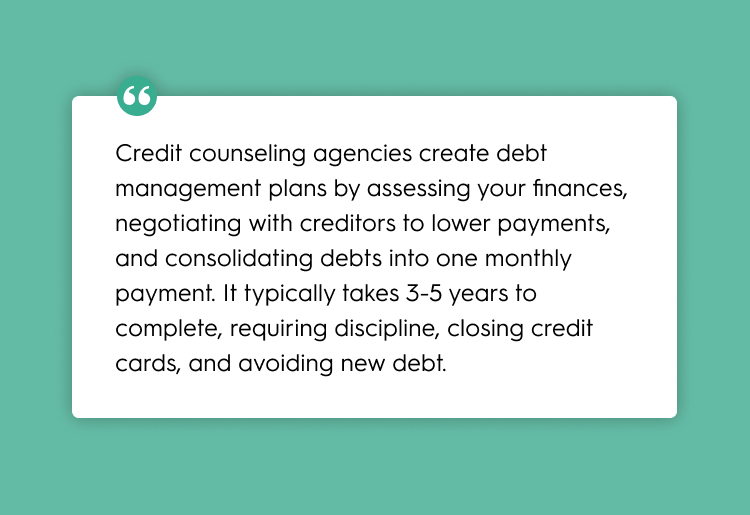
A debt management plan is a structured program that helps you manage unsecured debts — such as credit cards, personal loans, and medical bills — through a nonprofit credit counseling agency. (Not sure whether you need debt consolidation vs. credit counseling? Understanding the difference can help you pick the right path.) The agency negotiates with your creditors to lower interest rates, reduce fees, and consolidate your debts into a single monthly payment. You pay the agency, and they distribute the funds to your creditors.
Here's how the process typically unfolds:
Initial credit counseling session: A certified credit counselor reviews your income, expenses, and total debt. They help you build a budget and determine how much you can realistically pay toward your debts each month.
Budget review and proposal: Based on your financial picture, the counselor designs a repayment plan and contacts your creditors to negotiate reduced interest rates, waived fees, and lower monthly payments. Keep in mind that while most creditors are willing to work with the agency, some may not agree to the new terms.
Single monthly payment begins: Once creditors accept the proposal, all your enrolled debts are combined into one monthly payment. You send that payment to the credit counseling agency, which distributes the funds to your creditors. Your monthly payment will likely include modest agency fees as well.
Ongoing repayment and monitoring: You continue making your single monthly payment for the duration of the plan. During this time, your counselor will likely require you to close your credit cards to avoid taking on new debt. You should also avoid taking out new loans or credit cards while in the DMP.
Completion: If you stick to the plan, make your payments, and avoid new debt, you could be debt-free by the end of your DMP.
Typical timeline: Most DMPs run 3–5 years, depending on your total debt and monthly payment amount.
Typical costs: Nonprofit credit counseling agencies generally charge around $50 for initial setup and $30–$100 per month in management fees. Some agencies may waive or reduce fees based on your ability to pay.
How We Researched This
This article draws on federal data from the Federal Reserve Bank of New York and the Federal Reserve Board, regulatory guidance from the Consumer Financial Protection Bureau (CFPB) and the Federal Trade Commission (FTC), and educational resources from the National Foundation for Credit Counseling (NFCC). We consulted current industry fee structures from accredited nonprofit credit counseling agencies and reviewed DMP program terms across multiple NFCC-member organizations.
Our editorial team updates this article regularly to reflect the latest available data and regulatory developments. Where we rely on secondary sources, we trace statistics back to their primary origin to ensure accuracy.
The Full Breakdown
What Are the Benefits of a Debt Management Plan?
A DMP can offer meaningful relief if you're struggling with unsecured debt. Here are the key advantages:
Simplified payments: Instead of juggling multiple bills, you'll make one payment to the credit counseling agency, and they'll handle the rest. This can make budgeting and staying organized much simpler.
Lower interest rates and waived fees: Credit counselors work directly with your creditors to reduce interest rates and waive late or over-limit fees. This can save you money and speed up your repayment.
Structured repayment: A DMP typically lasts 3 to 5 years, giving you a clear plan to become debt-free. Staying on track with payments is key to meeting that goal.
Credit score improvement: Your credit score may take a hit at first, especially if you close credit accounts. However, consistently making on-time payments through your DMP can help improve your score over time.
Financial education: Credit counseling agencies don't just handle your debt — they also provide resources and education to help you build better financial habits for long-term financial health.
Creditor communication: Your counselor will handle the communication with creditors and collections, so you won't have to deal with the stress of constant phone calls and letters.
Peace of mind: Beyond the financial benefits, a DMP may provide peace of mind by giving you a clear plan to tackle your debt.
What Are the Drawbacks of a Debt Management Plan?
DMPs come with real trade-offs — required account closures, monthly fees, and a repayment commitment of 3–5 years. Here are the key drawbacks to keep in mind:
Impacts on credit score: Enrolling in a DMP may cause your credit score to decrease if your creditors report to agencies that you're using a debt management service.
No new credit: You'll need to avoid taking on new debt while in the plan. Your counselor will likely require you to close your credit card accounts, limiting access to credit during repayment.
Fees: Most agencies charge setup and monthly fees, which are included in your payments. These fees are usually reasonable, but make sure to work with a trusted nonprofit agency.
Not a quick fix: DMPs take 3 to 5 years to complete. It's a long-term commitment that requires you to stick to the plan and make payments consistently.
Not all debt applies: Only unsecured debts — like credit cards and medical bills — are eligible for the plan. Secured debts, like mortgages and car loans, won't be included.
Creditor participation: Not all creditors may agree to the DMP terms, meaning some debts might not be covered, and you'll need to manage them separately.
Commitment: Staying disciplined is crucial. Missing payments or not following through can disrupt your plan and make it harder to reach your debt-free goal.
How Does a Debt Management Plan Affect Your Credit Score?
In the short term, enrolling in a DMP may cause your credit score to dip — but consistent on-time payments typically lead to long-term improvement. Closing credit card accounts reduces your available credit and can increase your credit utilization ratio, and some creditors add a notation that your account is being managed through credit counseling.
However, the long-term trajectory typically moves in your favor. Consistent, on-time payments through the DMP build a positive payment history — the single largest factor in your credit score. As your balances shrink, your utilization improves. Many people who complete a DMP see their credit scores recover and even improve beyond where they started.
The key takeaway: a DMP is not a credit-damaging event like bankruptcy or debt settlement. The short-term dip is usually modest, and the structured repayment creates the conditions for long-term credit health.
How Does a Debt Management Plan Compare to Debt Consolidation and Settlement?
A DMP, a debt consolidation loan, and debt settlement each work differently — here's how they compare:
Feature
DMP
Debt Consolidation Loan
Debt Settlement
How it works
Nonprofit agency negotiates lower rates; you make one monthly payment to the agency
You take out a new loan to pay off existing debts, then repay the single loan
A company negotiates with creditors to accept less than the full amount owed
Credit score impact
Short-term dip; long-term improvement with consistent payments
May improve score by lowering utilization; hard inquiry at application
Significant negative impact; settled accounts noted on credit report
Typical timeline
3–5 years
2–7 years (depending on loan term)
2–4 years
Cost/fees
~$50 setup, $30–$100/month
Interest on the new loan (varies by credit score and lender)
15–25% of enrolled debt; potential tax liability on forgiven amounts
Best for
Multiple unsecured debts, stable income, want lower rates without new borrowing
Good credit, want a single fixed-rate payment, comfortable taking on a new loan
Significant debt, unable to make minimum payments, willing to accept credit damage
A DMP doesn't require taking out a new loan — you stick with your existing debts but make a single, consolidated payment to the credit counseling agency. Debt settlement, by contrast, tries to reduce the total amount you owe by negotiating a partial payment with creditors, but it comes with more risk and greater credit damage.
What Are the Alternatives to a Debt Management Plan?
DMPs aren't the only option for tackling debt. A debt consolidation loan or balance transfer card can also simplify payments — especially if your credit is strong enough to qualify for a lower rate. Debt settlement is another route, though it comes with significant credit damage. For a full comparison, explore our debt relief programs guide.
What Does This Mean for You?
Whether a DMP is the right move depends on your specific financial situation. Here's how to think about it:
A DMP may be right for you if:
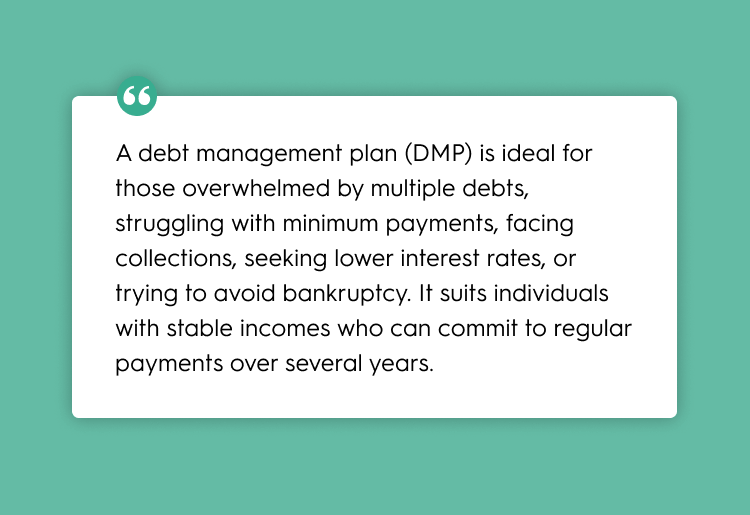
You're overwhelmed by multiple unsecured debts and keeping up with several payments feels chaotic
You're only able to make minimum payments and your balances aren't shrinking
Constant calls from collections agencies are adding to your stress
You want lower interest rates without taking out a new loan
You're trying to avoid the long-term credit damage of bankruptcy
You have a stable income that can support regular payments over several years
A DMP may not be the best fit if:
Your debts are primarily secured (mortgages, car loans) — these aren't eligible for DMPs
Your total unsecured debt is relatively small and manageable with a tighter budget
You have strong enough credit to qualify for a debt consolidation loan at a lower rate
You need access to your credit cards for essential expenses during the repayment period
What Should You Do Next?
Here are the concrete steps to take if you're exploring a DMP:
Assess your financial situation: Account for all sources of income and monthly expenses. Build a budget based on the past three months' spending to see where your money is really going.
Understand your debt: Focus on unsecured debts like credit cards and medical bills. Collect details on your debts — interest rates, monthly payments, and amounts owed — so you have the full picture.
Contact an accredited credit counselor: Look for agencies accredited by theNational Foundation for Credit Counseling (NFCC) or the Financial Counseling Association of America. Both organizations can help connect you with a certified counselor.
Gather your documentation: Before meeting with your counselor, collect pay stubs, bank statements, and debt information so they can create a tailored plan based on your financial reality.
Ask the right questions: In your initial session, ask about the DMP's fees, repayment timeline, how the plan might affect your credit score, and what happens if you miss a payment. Get everything in writing before signing.
Compare your options: Before enrolling, take the time to explore alternatives. A DMP isn't for everyone — compare debt consolidation options and consider whether a consolidation loan, credit counseling without a formal plan, or another approach may be a better match.
The most important step is taking action. Whether you move forward with a DMP or decide on another approach, compare your debt consolidation options to find the path that fits your situation.
Your Questions, Answered (FAQs)
How much does a debt management plan typically cost?
Most nonprofit credit counseling agencies charge around $50 for initial setup and $30–$100 per month in management fees. Some agencies may waive or reduce fees based on your financial situation.
Does a debt management plan hurt your credit?
Your credit score may dip in the short term due to account closures and a possible "managed by credit counseling" notation on your credit report. However, consistent on-time payments through the plan typically improve your score over time.
What happens when you get a debt management plan?
A certified credit counselor reviews your finances, negotiates reduced interest rates and fees with your creditors, and sets up a single monthly payment that the agency distributes to your creditors on your behalf.
Can I still use my credit cards while on a debt management plan?
Typically, no. Most DMPs require you to close the credit card accounts enrolled in the plan and avoid opening new credit lines during the repayment period.
How long does a debt management plan take to complete?
Most DMPs run 3–5 years, depending on your total debt amount and the monthly payment you can commit to.
Why Trust BestMoney on This?
BestMoney's editorial team includes credentialed personal finance writers and editors with experience covering debt management, credit counseling, and consumer lending. Our content is reviewed by subject-matter experts and updated regularly to reflect the latest federal data and regulatory guidance.
We are an education-first comparison platform — our goal is to help you understand your options and make informed decisions. We don't provide financial advice, and we encourage you to consult with a certified credit counselor before making decisions about debt management.
Is a Debt Management Plan Worth It?
A debt management plan is a structured, nonprofit-administered program that consolidates your unsecured debts into one monthly payment with reduced interest rates — typically over 3–5 years. It's best suited for consumers carrying multiple high-interest debts who want a clear repayment path without taking on new borrowing. Costs are modest (around $50 setup and $30–$100 per month), and while your credit may dip initially, consistent payments through the plan typically improve your score over time. The most important step is getting informed — and then taking action.
Meagan Drew is a personal finance and loans expert at BestMoney.com. She has written for publications such as Investopedia, Apple News+, and SimpleMoneylyfe.com. With seven years of experience as a financial advisor, Meagan specializes in making complex topics like budgeting and investing accessible and engaging for everyday consumers.