- Home/
- Debt Consolidation/
- Can You Get a Second Debt Consolidation Loan?
Can You Get a Second Debt Consolidation Loan?
August 7, 2026
August 7, 2026
If you're overwhelmed by debt, you may have already taken out a debt consolidation loan. But what happens when your balances creep back up, whether from a medical bill or a shopping spree, and you need a second debt consolidation loan?
A Century Foundation and Protect Borrowers analysis found that roughly 111 million people can't pay off their credit card bills each month. That's about half of all Americans with a credit card, and over 40% of U.S. adults overall.
There's no exact figure on how many borrowers take a second consolidation loan. But personal loan usage has hit a record high, with more than 1 in 3 consumers now carrying one, including to consolidate or refinance existing debt. That's a clear sign borrowing to manage debt is becoming the norm.
This article walks you through what it takes to qualify for a second loan, how it affects your credit, and when a different path makes more sense.
"Most consumers won't have two or more active consolidation loans at the same time due to DTI (Debt to Income) requirements. Loan companies are strict about who they approve based on credit score, and even when they do approve you after the first one, they'll often offer a smaller amount or none at all."
Consolidating debt multiple times without fixing the habits that created it can land you in a worse position than where you started. If you're unsure whether debt consolidation loans are worth it, consider why you're taking out the money and whether you're at risk of running up debt again.
"The classic one: They take a consolidation loan, pay off all their credit cards, then max the cards right back out while still having an active loan that they have barely paid yet," said Adedeji.
If you consolidate your debt but don't close or freeze your cards, you risk using them. And with current credit card interest rates averaging slightly below 20%, every month of new revolving debt adds to the financial stress a debt consolidation loan was supposed to relieve.
A poorly timed second loan, or one you can't afford, could actually increase your total interest costs rather than reduce them.
A second debt consolidation loan works the same way as your first one. You borrow a lump sum to pay off existing debts (credit cards, medical bills, other high-interest balances) and repay the new loan at a fixed rate over a set term. The risk is not being able to make payments on your first loan if you're still under its terms.
An outstanding balance on your first loan counts against your debt-to-income ratio, a major factor lenders weigh. That's why a sizable remaining balance can make qualifying for a second loan harder. Some lenders also cap how many loans you can hold, or set minimum waiting periods between applications.
A few things worth knowing before you apply:
We reviewed current lender policies from major debt consolidation providers, including specific multi-loan rules and credit score minimums. We analyzed credit bureau data from Equifax and Experian on how consolidation affects credit scores, particularly for repeat borrowers.
We referenced CFPB consumer guidance on consolidation and debt management, and we also interviewed Jethro Adedeji, founder and CEO of Crowned Credit, a nationwide credit repair and education company, for expert perspective on underwriting scrutiny and repeat-borrower behavior. All data referenced in this article was verified as of July 2026.
Lenders evaluate the same core factors they did the first time, but the bar may be higher when you're already carrying a consolidation loan, mainly due to a potentially higher debt-to-income ratio. Here's what matters most.
The answer to this question is "it depends," because a few factors are involved.
When you formally apply, the lender runs a hard credit pull. That typically knocks your score down by a few points. However, if you're rate-shopping across multiple lenders within a 14-day window, credit scoring models consolidate those inquiries into a single hit, according to the Consumer Financial Protection Bureau (CFPB).
If you're using the second loan to pay off revolving credit card debt, your credit utilization ratio drops. That ratio accounts for 30% of your FICO score, according to Equifax, so the improvement can be significant. On $8,000 carried across three credit cards with a combined $20,000 limit, that's 40% utilization. Pay those off with a consolidation loan, and your utilization drops to near zero.
"The highest point of leverage with a consolidation loan is bringing down your credit utilization (which increases your credit score, making it usable again) and reducing interest. Freezing the cards you just paid off is non-negotiable, since a utilization drop only helps if those balances stay at zero."
Opening a new account lowers your average account age, which can cause a minor dip. For most borrowers paying off credit card balances, the utilization improvement outweighs the hard inquiry and new account costs, but only if you don't run up new balances on the cards you just paid off. If your score has taken a hit, here's how to rebuild your credit score.
A second consolidation loan is a good idea when the fundamentals line up, and a risky one when they don't. Here's what to consider.
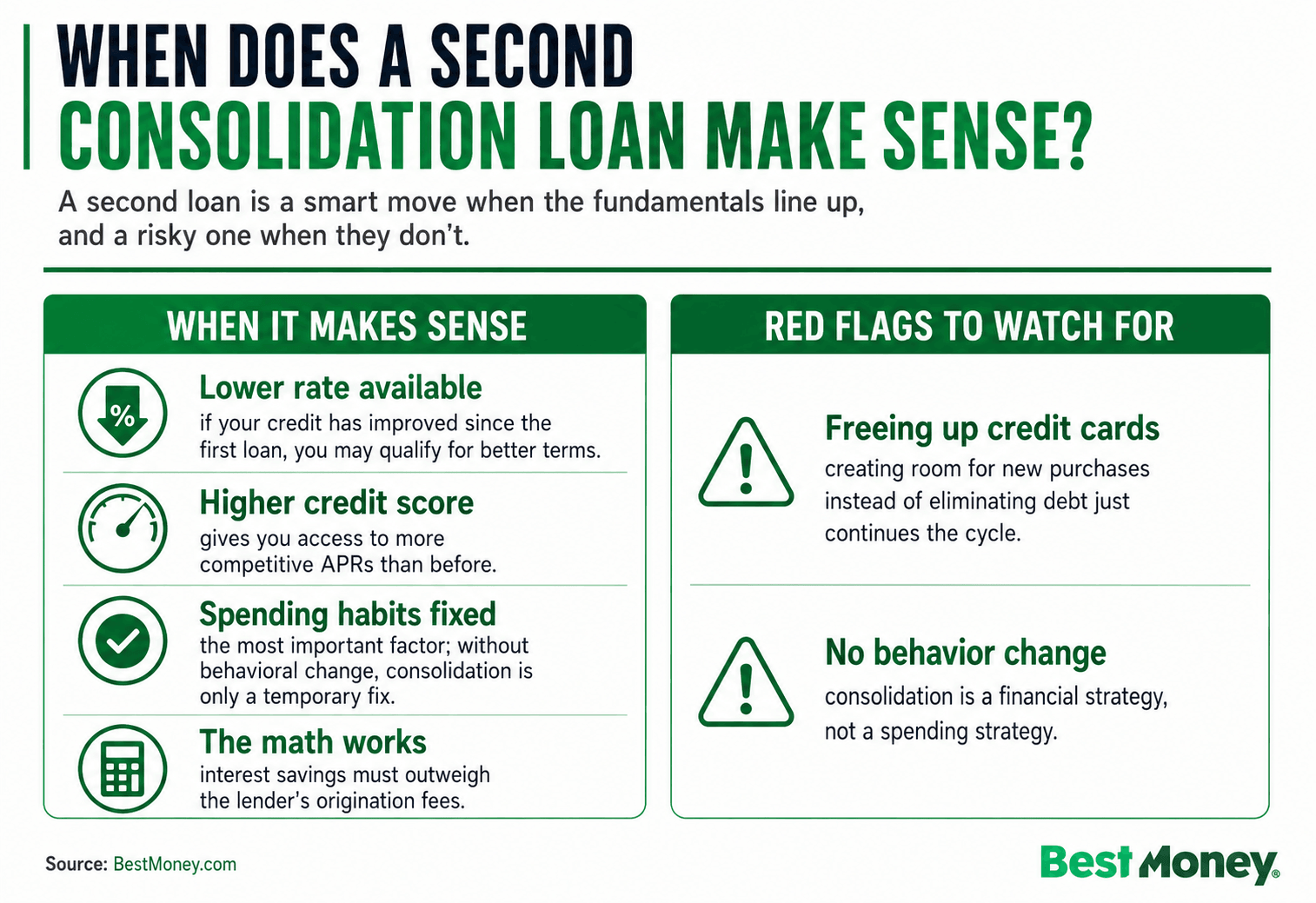
If a second loan isn't the right fit, whether because you don't qualify or because the numbers don't work, several alternatives are worth considering. A good starting point is understanding the difference between debt consolidation and debt settlement.
Some balance transfer cards offer 0% intro APR for 12 to 21 months, which can save significant interest if you pay off the balance before the promotional period ends. Once the intro rate expires, though, the standard APR kicks in, and it's often steep. If you use this option, you'll need the discipline to stick to the repayment deadline.
If you own a home, using a home equity loan to consolidate debt typically gets you lower rates than an unsecured personal loan. But your home is the collateral, if you can't make payments, you're putting your house at risk. This option works for borrowers with significant equity and a solid repayment plan.
Nonprofit credit counseling agencies usually work to negotiate lower interest rates directly with your creditors. In most cases, you make one monthly payment to the agency, and they distribute it over a set period of years, often three to five, depending on the plan.
These DIY payoff strategies don't involve any new borrowing. The snowball method targets the smallest balance first for quick wins. The avalanche method targets the highest interest rate first for maximum savings.
Both work, the right choice depends on whether you need motivational momentum or mathematical efficiency. For a deeper look at these and other strategies to pay off debt, that guide walks through each method step by step.
Your best path depends on where you are financially right now.
Expert Tip: If your spending habits are the real concern, or your debt is making it impossible to cover daily living expenses, a credit counselor recommended by the National Foundation for Credit Counseling can help you find the right next step.
This article draws on the following sources, all verified as of June 2026:
Maya Dollarhide is a Journalist for bestmoney.com, specializing in personal finance and consumer lending. She earned her MS in Journalism from Columbia University and has written for TIME, Yahoo Finance, Investopedia, Bankrate, Forbes, CNN, and AARP. Her work focuses on creating SEO-driven content, developing K-12 financial literacy curriculum, and producing B2B content for financial services clients.