Chase Freedom Rise® Review: Build Your Credit and Earn Cash Back
How to use this card to build credit without paying unnecessary interest
October 15, 2026
•
7 min
October 15, 2026
•
7 min
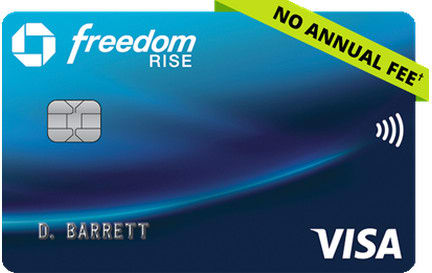
If you have little to no credit history and are searching for a good starter credit card, consider the Chase Freedom Rise® Credit Card. It doesn’t charge an annual fee, delivers 1.5% cash back and requires no minimum credit score. Keep in mind, though, that the card charges a 5% or $5 fee for balance transfers and cash advances, and that other credit-building cards may offer better rewards.
Follow along for details about the Chase Freedom Rise card, such as fees and APRs.
The Chase Freedom Rise Credit Card is a good option for people with limited or no credit history, primarily because you don’t need a credit score to qualify, and you can take advantage of the $0 annual fee and 1.5% cash back. However, its relatively steep APRs, balance transfer fee, and cash advance fee make Chase Freedom Rise less appealing.
Despite any drawbacks, the card offers an annual evaluation for an upgrade to a Chase Freedom Unlimited card.
In addition, you might qualify for a credit limit increase at least six months after opening a Chase Freedom card.
Expert intel: “Chase Freedom Rise gives rewards competitive with Chase Freedom Unlimited and a path to get Chase Freedom Unlimited.” — Jason Steele, producer of the CardCon credit card conference.
Thankfully, the Chase Freedom Rise Credit Card doesn’t charge an annual fee, making the card more attractive than some other credit-building cards. The card also doesn’t charge an over-the-limit fee or a returned check fee. However, both balance transfers and cash advances come with a 5% or $5 fee, whichever is greater. By comparison, other cards charge a 3% or $5 fee, whichever is greater.
The foreign transaction fee is 3%, which is standard for cards that charge this fee.
The purchase and balance transfer APRs for the Chase Freedom Rise Credit Card are 18.49% - 27.99% which is on the high side compared with some other cards. The cash advance and penalty APRs are even higher: 28.74% and 29.99%, respectively.
Among the ways Chase protects cardholders are:
$0 liability for fraudulent transactions.
Around-the-clock fraud monitoring.
Account access via password, facial recognition, and fingerprint recognition.
Optional two-step identity verification.
Text, email, or phone notification of unusual transactions.
Additional identity verification when suspicious logins or account activity are detected.
As of December 2025, reviewers on Trustpilot gave Chase an overall rating of 1.3 out of 5 stars. According to Trustpilot, many customers express frustration with Chase’ customer service.
Meanwhile, users of the Better Business Bureau website lodged 6,670 complaints about Chase credit card and banking operations in the past three years (as of December 2025).
In the J.D. Power 2025 U.S. Online Credit Card Satisfaction Study, Chase ranks fifth among credit card issuers with an above-average score of 680 out of 1,000. So, if the online experience of a credit card issuer matters a lot, you might want to explore American Express, Wells Fargo, U.S. Bank or Discover, all of which ranked higher than Chase in the J.D. Power study.
With no annual fee and 1.5% cash back, the Chase Freedom Rise card stands out compared with other credit-building cards. But the high APRs and high balance transfer and cash advance fees make the card less than desirable for people who’d like to regularly use the card for those purposes.
Another benefit of the card: As soon as six months after getting Chase Freedom Rise, you’ll be evaluated for an increase in your credit limit.
The Chase Freedom Rise Credit Card is best for students or other people with little to no credit history who want to avoid an annual fee while still earning rewards.
“This card is perfect if you’re trying to start a relationship with Chase to get their premium cards down the road,” said travel and personal finance expert Benji Stawski. “It’s essentially a shortcut to the Chase ecosystem for anyone with a limited credit history.”
The Chase Freedom Rise Credit Card isn’t ideal for people who have good or excellent credit, or those who want a solid rewards program. The card is designed for people who are building their credit, don’t want to pay an annual fee, and don’t mind a basic rewards program.
Stawski also noted the card’s 3% foreign transaction fee might make the card a no-go for people who frequently travel internationally.
Fee | Details |
|---|---|
Purchase APR | 18.49% - 27.99% |
Annual fee | $0 |
Balance transfer fee | $5 or 5%, whichever is greater |
Cash advance fee | $10 or 5%, whichever is greater |
Foreign transaction fee | 3% |
The Chase Freedom Rise Credit Card delivers barebones rewards. Cardholders receive 1.5% cash back. Fortunately, cash back rewards don’t expire and there’s no minimum to redeem for cash back. On top of the 1.5% cash back, you earn 2% cash back on Lyft rides through September 30, 2027.
Expert intel: “Most credit builder cards don’t earn any rewards, so getting 1.5% cash back on everything is a major perk. It’s also a smart way to start a banking relationship with Chase, which can help you unlock their best travel cards down the line.” — Benji Stawski, travel and personal finance expert
Here’s the key information you’ll need to supply when applying for a Chase Freedom Rise Credit Card either online or at a Chase branch:
Full legal name.
Social Security number (SSN) or Individual Taxpayer Identification Number (ITIN).
Street address.
Employment status.
Housing costs.
Phone number.
You don’t need a credit score or credit history to qualify for the Chase Freedom Rise Credit Card. But you may enjoy the best odds of being approved for the card if you’ve got at least $250 deposited in a Chase checking or savings account.
Based on studies by market research company J.D. Power, Chase cardholders are generally satisfied with Chase as a credit card issuer.
In the J.D. Power 2025 U.S. Credit Card Satisfaction Study, Chase earned fourth place among credit card issuers with an above-average score of 619 out of 1,000.
The study doesn’t include Chase Freedom Rise, but it does include two other Chase rewards cards with no annual fee: the Chase Freedom Flex and Chase Freedom Unlimited cards, both of which earned above-average scores.
One user on Reddit called Chase Freedom Rise “a solid starter card with good benefits,” while another noted it doesn’t offer a “crazy” credit limit. In a similar vein, a commenter on the FlyerTalk forum emphasized Chase Freedom Rise is an unsecured credit card that offers a “nice” rewards program with “valuable” benefits.
Credit card experts like the Chase Freedom Rise card’s ability to help a cardholder build credit, its lack of an annual fee and its 1.5% cash back rewards on purchases. But they say the absence of both a welcome bonus and an introductory 0% APR might make the card unattractive to some applicants. However, the card does offer a $25 statement credit when you sign up for autopay.
“This card is ideal for young people who are new to credit, immigrants who are new to credit, or those who have had some credit problems in the past that prevent them from having good or excellent credit right now,” said Jason Steele, producer of the CardCon credit card conference.
If you have little to no credit history and want to couple another card with Chase Freedom Rise, look into the Capital One Platinum Mastercard, which also is a credit-building card (designed for people with at least fair credit).
The table below highlights how Chase Freedom Rise compares with three other cash back cards, all of which have cardholder-friendly credit approval requirements, no annual fee, and a welcome bonus.
Card | Purchase APR | Annual fee | Rewards rates | Welcome bonus | Recommended credit score |
Chase Freedom Unlimited® | 18.49% - 27.99% Variable | $0 | 1.5%-5% | Earn a $200 Bonus after you spend $500 on purchases in your first 3 months from account opening. | 670-850 (Good to Excellent) |
Wells Fargo Active Cash® | 18.74%, 24.74%, or 28.74% Variable | $0 | 2% | Earn a $100 cash rewards bonus after spending $500 in purchases in the first 3 months. | 670-850 (Good to Excellent) |
Bank of America® Customized Cash Rewards | 17.74% - 27.74% Variable | $0 | 1%-6% | $200 online cash rewards bonus after you make at least $1,000 in purchases in the first 90 days of account opening. | 670-850 (Good to Excellent) |
Chase Freedom Rise is right for you if you have limited to no credit history and already have a Chase checking or savings account (which gives you an edge in qualifying for the card). But you should explore other credit-building cards if you want a lower standard APR and lower balance transfer and cash advance fees.
You can access Chase customer support for cardholders by:
Calling 1-800-432-3117.
Reaching out to Chase through its Facebook, Instagram, or X social media accounts.
Visiting a Chase branch.
Using the Chase Digital Assistant on the Chase mobile app.
In the world of starter credit cards, you can’t go wrong with the Chase Freedom Rise Credit Card. It charges no annual fee, offers 1.5% cash back on qualifying purchases (which many starter cards don’t provide), and requires no credit history for approval. Yet Chase Freedom Rise may not rise to your level due to its relatively high APRs, and 5% or $5 balance transfer and cash advance fees.
We looked at and rated credit cards in the following categories. Here's how our review process works:
Rates and fees:
We looked carefully at credit card rates such as the purchase and promotional APRs. We also carefully looked at fees (i.e., annual fee, balance transfer fee, cash advance fee, and foreign transaction fee.)
Features and benefits:
We factored in any valuable features and benefits like the rewards structure, base rewards program, sign-on bonus, recurring benefits, and additional perks. Some perks were more related to travel rewards, while others were better suited for cash back or general everyday rewards.
Security:
With security an increasing concern, we considered various factors in our assessment. This included measures to protect card and personal data. Sophisticated security measures like card freezes and card alerts for suspicious activity and large transactions are also factored in.
User experience:
Different aspects of the user experience, from navigating the card issuer’s website and reviews of the app to ease of the application process, are meticulously analyzed and weighed. Other factors include how soon you can use the card and how easy it is to make the most of its features and benefits.
Customer service:
We compare the credit card issuer's Trustpilot score and BBB ratings against those of its competitors and industry averages. We also factor in the company's different customer service channels (e.g., telephone, chat, email, and physical mail) and test response times and quality of experience.
You can learn more in our full credit cards methodology.
Disclosure: This content is not provided by the issuer. Any opinions expressed are those of BestMoney alone, and have not been reviewed, approved or otherwise endorsed by the issuer.
Editorial disclosure: The credit card offers and information presented on this page are current as of the published date. However, credit card terms, including APRs, fees, and promotional offers, are subject to change without notice. Some offers listed may no longer be available or may have expired. Please refer to the issuer's website for the most up-to-date terms and conditions.
John Egan is a freelance writer, editor and content marketing strategist in Austin, Texas. His work has been published by outlets such as CreditCards.com, Bankrate, Credit Karma, LendingTree, PolicyGenius, HuffPost, National Real Estate Investor, and Urban Land.