Winter Financial Planning: Budgeting for Heating, Utilities, and Seasonal Expenses
Winter Financial Planning: Budgeting for Heating, Utilities, and Seasonal Expenses
A simple plan for winter financial planning: budgeting for heating, utilities, and seasonal expenses without surprise debt.
Written by
Bestmoney Staff
The BestMoney editorial team is composed of writers and experts covering a full range of financial services. Our mission is to simplify the process of selecting the right provider for every need, leveraging our extensive industry knowledge to deliver clear, reliable advice.
Winter financial planning—budgeting for heating, utilities, and seasonal expenses—starts with one idea: cold-weather costs stack. Heating runs longer. Lights stay on earlier. Gifts, travel, and school breaks often land together.
You do not need a perfect spreadsheet. A utility buffer, sinking funds, a small contingency, and attention to bill timing make winter costs feel planned. For more plain-language money guidance alongside this system, browsefinancial advisor learning guides.
According to the U.S. Energy Information Administration’sOctober 15, 2025 winter fuels brief, 2025–26 heating spend depended on fuel type. In the published outlook tables, electricity-heated homes were on track for about $1,133 for the winter (+4% vs the prior winter). Natural gas was about $642 (−1%). Use those figures as national context. Your local rates still decide the real bill.
What Are the Key Insights for Winter Financial Planning?
Winter bills stack, so plan the heating and utility uplift—not only the base budget.
Build a utilities buffer before peak cold and automate weekly or biweekly transfers.
Use sinking funds for known seasonal costs such as gifts, travel, and school breaks.
Hold a 5–10% winter contingency so surprises do not become card debt.
Track timing: higher usage often hits the next bill cycle.
EIA’s 2025–26 outlook: electricity heat about +4% vs prior winter—know your fuel type.
Why Does Winter Budgeting Feel Different?
Winter budgeting feels different because heating, utilities, and seasonal expenses often rise together.
Winter is the financial equivalent of adding extra passengers to your car. Everything still moves, but fuel goes faster and bumps feel louder.
Common winter cost stacks include higher heating usage, longer evenings with more lights, weather-related transport costs, and seasonal life spending such as holidays and school breaks. Treat those patterns as planning categories—not as a guarantee for every household.
The goal is not to micromanage every dollar. The goal is to make winter expenses predictable enough that they stop feeling chaotic. A winter budget is a regular budget plus buffers and a plan for seasonal spending.
Who Is This Winter Budget Guide For?
This winter financial planning guide is for households that want a simple system for heating, utilities, and seasonal expenses.
Households whose utilities jump in cold months
Parents budgeting gifts plus school-break childcare
Renters or homeowners without last year’s bill history
Anyone who usually “figures it out in January”
People who want a simple system, not a perfect spreadsheet
What Winter Expense Zones Should You Map First?
Map four winter expense zones first: heating and utilities, transportation, seasonal household costs, and seasonal life spending.
List the categories that tend to shift in winter. Keep the list short. Pair the map with a simple habit forhow to track your spending as the season unfolds.
What Counts as Heating and Utilities?
Heating and utilities cover the energy and home services that often rise when temperatures drop.
Heating fuel, gas, or electric
Electricity for lighting, space heaters, and electric blankets
Water for winterization and hot water usage
Internet or phone if you work from home more in winter
What Transportation Costs Rise in Winter?
Transportation costs can rise through fuel use, vehicle supplies, and weather-related travel changes.
Higher fuel usage from longer warm-ups or detours
Winter tires, chains, wiper blades, and windshield fluid
More rideshares or delivery fees
Parking or transit changes in bad weather
Which Seasonal Household Costs Show Up?
Seasonal household costs include weatherproofing, maintenance supplies, snow tools, and emergency repairs.
Weatherproofing with draft stoppers, door sweeps, and window film
Furnace filters, humidifier supplies, and maintenance visits
Snow removal tools or services
Pipe insulation or emergency repairs
Which Seasonal Life Expenses Should You Expect?
Seasonal life expenses usually include gifts, travel, hosting, childcare changes, and winter clothing.
Gifts and celebrations
Travel and lodging
Hosting costs for food and decor
Childcare changes during school breaks
Clothing such as boots, coats, and layers
A useful mindset shift: some winter costs feel “unpredictable,” but many are simply unplanned. If you plan for them, they become boring. Boring is good.
How Do You Estimate Your Winter Utility Uplift?
Estimate your winter utility uplift by comparing a normal month to a winter month, then budget the difference like any other fixed cost.
If you have last year’s bills, pull two or three winter months and note the range. Without past data—new home, apartment, or utility—use a conservative estimate.
Try this:
Find your “normal” month utility total.
Estimate your winter-month utility total.
Treat the difference as your “winter uplift.”
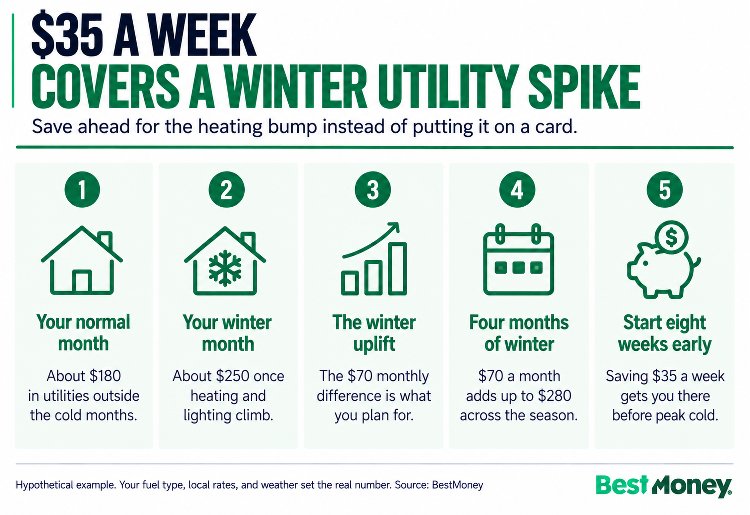
Example (hypothetical): Normal month utilities: $180. Winter month utilities: $250. Winter uplift: $70 per month.
Without planning, that $250 bill is $70 over your usual $180 and often lands on a card. With a utilities buffer, the extra $70 is already set aside.
That $70 is not a failure of willpower. It is the weather. Put it in the budget like rent. For fuel-type context—not a personal forecast—see EIA’swinter residential energy expenditure brief. Those are national outlooks. Your local rates and weather still drive the real number.
How Do You Build a Winter Utility Buffer?
A winter utility buffer is savings you fund before peak cold so higher heating and utility bills stay off the credit card.
A buffer is a dedicated pot of money that smooths a predictable spike.
How to do it
Pick a weekly or biweekly transfer.
Put it in a separate savings “bucket” or sub-account called “Utilities Buffer.”
Use it only to cover winter utility overages.
Example buffer plan (hypothetical): You expect $70 extra per month for 4 months = $280 total. If you start 8 weeks before peak winter, that is $35 per week. If that is too high, start with $10–$20 per week and adjust.
Without a buffer, a $70 winter overage often goes on a card. With $35 saved weekly for 8 weeks, the same overage can be covered from cash.
The point is not perfection. The point is you stop being surprised.
Budget billing callout: Ask your utility whether budget billing or average monthly payment is available. Some providers may spread estimated annual usage into more even monthly payments. Confirm fees, true-ups, and eligibility with your provider before you enroll.
If winter bills are already unaffordable, income-eligible households can review help through the federalLIHEAP energy assistance program. That is a hardship path. It is not a substitute for a buffer when cash flow allows.
What Are Sinking Funds—and Which Ones Matter in Winter Financial Planning?
Sinking funds are savings buckets for known upcoming expenses in winter financial planning, especially gifts, travel, school-break care, and home or car upkeep.
Winter has several repeat offenders.
Common winter sinking funds include:
Gifts and celebrations
Winter travel
School break childcare
Car maintenance
Home maintenance for filters and small repairs
How Do You Set Up Winter Sinking Funds Quickly?
Make 3–5 sinking funds and assign each a weekly amount.
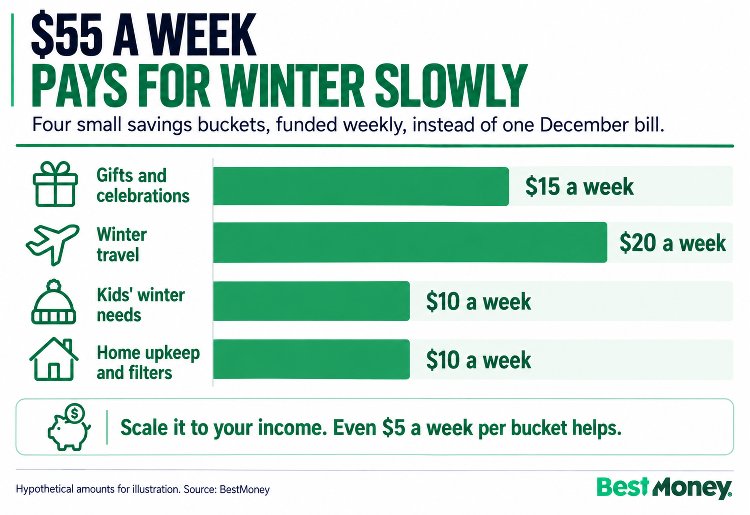
Example weekly amounts (hypothetical; scale to your income):
Sinking fund
Sample weekly amount
Gifts
$15/week
Travel
$20/week
Kids’ winter needs
$10/week
Home
$10/week
That is $55/week, which can be scaled down. Even $5/week per category helps. You pay for winter slowly instead of all at once.
For holidays, start the gifts fund in early fall when you can. Smaller automated transfers over 10–12 weeks beat one December wave. Keep the fund separate so fun money and gift money do not blur.
How Should You Plan Holiday Spending Without January Debt?
Plan holiday spending by setting a total cap early, listing recipients, and funding purchases from a sinking fund—not revolving balances you cannot clear.
The Consumer Financial Protection Bureau outlines a practical path in itsfive-step holiday spending plan. Decide what you can spend. Make a simple list. Track as you go. Avoid stacking high-interest debt for gifts.
Prefer debit or cash from the gifts sinking fund. If you use a card, treat it as a short float only when money already set aside will clear the full balance.
If holiday or winter balances are already hard to manage, review debt-management options carefully. One path iscomparing debt consolidation options, then returning to buffers and sinking funds so next season does not refill the same hole.
What Winter Contingency Should You Add?
Add a winter contingency as a planning rule of thumb: about 5% of monthly essentials if cash is tight, or about 10% if costs swing a lot. These percentages are editorial planning ranges, not surveyed averages.
Winter has a talent for surprise bills. A contingency line can keep small surprises from becoming credit card balances.
A good starting point:
About 5% of monthly expenses if your budget is tight
About 10% if your winter costs fluctuate a lot
Example (hypothetical): If your monthly essentials are $3,000, a 5% contingency is $150. That cushion can cover a higher-than-expected heating bill, a last-minute kid expense, or a car fix that cannot wait.
Without a $150 contingency, an extra heating bill may go on a card. With it, the surprise can be absorbed in the budget.
Why Does Winter Bill Timing Matter as Much as Totals?
Winter bill timing matters because higher usage often shows up on a later cycle. December heat can become a January bill for many households—confirm the pattern with your provider.
Winter expenses often arrive with a delay:
You use more heat in December.
The bill reflecting that usage may land in January.
So when you build your winter plan, look one month ahead:
Which bills are likely to rise next cycle?
When do you usually travel or host?
When does school break begin?
This is why buffers and sinking funds work well. They plan around timing.
How Can You Cut Winter Costs Without Making Life Miserable?
You can cut winter costs without misery by focusing on high-impact, low-annoyance moves: seal drafts, use smarter thermostat habits, and do small preventive checks at home and in the car.
You do not need to live like a Victorian novel character reading by candlelight. Use practical efficiency moves from the U.S. Department of Energy’sEnergy Saver guidance as a checklist, and verify details on the live DOE pages before you change equipment settings.
Which Heating and Utility Reductions Help Most?
The most helpful heating and utility reductions are draft sealing, thermostat management, routine maintenance, and efficient energy use.
Seal drafts around doors and windows.
Replace furnace filters on schedule, often monthly in heavy-use seasons.
Use programmable or smart thermostat setbacks when your system allows.
DOE Energy Saver guidance notes that a 7°–10°F setback for about eight hours a day can save as much as 10% a year on heating and cooling in some setups—confirm comfort and equipment fit on current DOE materials.
Open south-facing curtains on sunny days for free heat gain; close coverings at night.
Keep the fireplace damper closed when the fireplace is not in use.
Set the water heater to about 120°F if your manual allows.
Use LED holiday lights and turn them off when you leave or sleep.
Use space heaters only in occupied rooms.
How Can Food and Household Habits Reduce Winter Spend?
Food and household habits reduce winter spend most when you plan cheap staples, limit impulse buys, and batch cook.
Plan 2–3 low-cost winter staples per week, such as soups, pasta, or sheet-pan meals.
Keep easy snacks on hand to reduce convenience spending.
Batch cook once on weekends.
What Transportation Tweaks Save Money in Cold Weather?
Transportation tweaks can save money in cold weather by reducing wasted trips and avoidable emergency purchases.
Combine errands into one trip.
Keep tire pressure at the recommended level.
Pack the car with basics so you do not pay emergency convenience fees.
What Home and Car Preventive Checks Belong in a Winter Budget?
Home and car preventive checks can help you avoid some emergency costs. Replace HVAC filters. Weatherstrip doors. Test smoke and CO detectors. Check tire tread and pressure. Confirm the car battery before deep cold. Budget small maintenance in a home or car sinking fund so a failed battery or clogged filter does not compete with the heating bill.
What Does a Simple Winter Budget Template Look Like?
A simple winter budget template layers essentials—including utility uplift—plus sinking funds, contingency, savings, and fun money.
Here is a quick structure you can adapt:
Essentials
Housing
Utilities (base + winter uplift)
Groceries
Insurance
Transportation
Winter sinking funds
Gifts
Travel
School break childcare
Winter gear
Contingency (about 5–10% as a planning range)
Savings goals (even small)
Fun money (controlled, intentional)
A winter budget works best when it still includes joy. Give joy a line item so it does not sneak in through the back door.
Your Questions, Answered (FAQs)
What’s the easiest way to start winter budgeting if I’m overwhelmed?
Start with two buckets: a utilities buffer and a winter contingency. Automate small transfers and adjust later.
How much should I set aside for winter utilities?
Use last winter’s bills if possible. Otherwise set a conservative cushion above normal utilities and refine after one billing cycle. Fuel type can change the range. Use EIA outlooks for direction, not as your personal bill.
Should I use a credit card for winter expenses?
Only if you can pay it off quickly. Buffers and sinking funds are safer because they reduce interest risk.
Is it better to budget weekly or monthly in winter?
Weekly budgeting may feel easier for some households because surprises show up in smaller windows and buffers are simpler to fund.
What is budget billing for utilities?
Budget billing may spread estimated annual energy cost into more even monthly payments. Ask your utility how true-ups, eligibility, and fees work before you enroll.
Why Trust BestMoney?
BestMoney’s editorial team researches personal finance topics to help you compare options with clarity.
This page is educational winter budgeting guidance. It is not individualized financial, tax, or energy advice.
We cite primary sources such as EIA, DOE, and CFPB so you can verify the facts.
How We Researched This
This article uses secondary research for winter financial planning on heating, utilities, and seasonal expenses.
Sources include the EIA Winter Fuels Outlook for 2025–26 and related Today in Energy notes from October 15, 2025 and December 15, 2025.
We also used DOE Energy Saver guidance, CFPB holiday spending guidance, and HHS/ACF LIHEAP information.
Before drafting, we reviewed seasonal budgeting explainers from credit unions and banks for topic coverage, plus reader-facing pain points that commonly appear in winter-budget discussions (utility spikes, holiday overspend, and delayed bills).
No proprietary BestMoney winter utility survey was available for this refresh. Expert Insight quotes remain placeholders for human reviewers.
What Should You Remember From This Winter Budget Guide?
Winter financial planning for heating, utilities, and seasonal expenses works when costs become boring.
Size the utility uplift from your bills—or a careful estimate. Use EIA only for fuel-type context. Fund a utilities buffer and sinking funds early. Keep a small contingency. Cut waste with practical efficiency moves. Fund holidays before December hits. Review your plan as winter bills arrive and keep adjusting.
Written byBestmoney Staff
The BestMoney editorial team is composed of writers and experts covering a full range of financial services. Our mission is to simplify the process of selecting the right provider for every need, leveraging our extensive industry knowledge to deliver clear, reliable advice.