What Is Zero-Based Budgeting? A Step-by-Step Guide (With Examples)
What Is Zero-Based Budgeting? A Step-by-Step Guide (With Examples)
Learn what zero-based budgeting is, how to build one in five steps, and see a clear example that puts every dollar to work.
Written by
Bestmoney Staff
The BestMoney editorial team is composed of writers and experts covering a full range of financial services. Our mission is to simplify the process of selecting the right provider for every need, leveraging our extensive industry knowledge to deliver clear, reliable advice.
Zero-based budgeting matters because it stops money from quietly disappearing between paychecks. The idea is simple: you give every dollar of take-home pay a job until your income minus your expenses equals zero, with nothing left unassigned. If you'd rather automate the tracking, you cancompare budgeting apps side by side before you start.
Zero-based budgeting gives every dollar a job, so your income minus expenses equals zero each month.
You build it fresh each month, so it adapts to real life — useful for variable income and debt payoff.
It fits beginners, debt-payers, couples, and people with variable income alike.
The method runs on five steps: list income, list expenses, subtract to zero, track daily, then rebuild.
It asks more effort than percentage methods, but that hands-on tracking is what makes it work.
What Is Zero-Based Budgeting?
Zero-based budgeting is a method where you assign every dollar of take-home pay a specific job — spending, saving, giving, or paying down debt — until your income minus your expenses equals zero. It's sometimes called zero-sum budgeting, and the "zero" refers to unassigned money, not your bank balance.
That distinction matters. Zero-based budgeting does not mean draining your account to $0. Savings, investing, and a small buffer are all valid "jobs," so money you set aside still counts as assigned.
Fidelity describes a zero-based budget as highly intentional, with no unplanned free cash.
Think of it like a foreman assigning every worker a task before the shift starts. Nobody stands around idle, and no dollar sits unaccounted for.
The approach isn't new. Peter Pyhrr developed it at Texas Instruments in the late 1960s. He detailed the method in a 1970 Harvard Business Review article,as documented by McKinsey.
Georgia Gov. Jimmy Carter later adopted it for the state budget in 1973. As president, he expanded it to the federal government. That history shows the method is rigorous enough for institutions yet adaptable to a single household.
How Do You Make a Zero-Based Budget?
Building a zero-based budget takes five steps, repeated fresh each month. Each one is straightforward on its own, and the sequence is what keeps your plan balanced.
Step 1: What Counts as Your Monthly Income?
Your income is all the take-home pay and side money you expect this month. Add up your net paychecks, plus any freelance work, gig earnings, or other reliable deposits.
If your income varies, plan from your lowest recent month rather than an optimistic average. You can always reconcile upward and assign the extra later when a bigger check arrives.
Step 2: How Do You List and Categorize Your Expenses?
Your expenses are every dollar that leaves your account. Pull your last month or two of bank and card statements and write them all down. Group them so nothing hides.
Savings and goals: emergency fund, retirement, sinking funds for known future costs.
Debt payoff: any amount above the minimums you're throwing at balances.
Treat savings and debt payoff as line items, not leftovers. Add a small miscellaneous buffer for the costs you often forget.
Step 3: How Do You Subtract Expenses Down to Zero?
You subtract your total expenses from your total income and adjust until the difference is exactly zero. The goal is that every dollar has a destination.
If the number comes out negative, trim wants or look for ways to add income. If it comes out positive, assign the surplus — send it to savings or debt so nothing sits unallocated. The plan isn't finished until you reach zero.
Step 4: How Do You Track Every Transaction All Month?
You track your spending as it happens, because a zero-based budget only works if the plan matches reality. Check in every day or two, andcompare expense tracker apps to find a method that fits you.
When one category runs short, move money from another to keep the balance at zero — that's the plan flexing, not failing. Some people use a cash envelope system for problem categories as an optional tactic to make limits feel concrete.
Step 5: Why Build a Fresh Budget Before Each New Month?
You rebuild your budget each month because your expenses change — holidays, an annual insurance bill, or a one-off repair rarely repeat month to month. That monthly reset is the method's core strength, not busywork.
Starting fresh forces you to make deliberate choices again instead of coasting on last month's numbers. You may find setup takes less time after the first few months, as your categories stabilize.
What Does a Zero-Based Budget Look Like?
A zero-based budget looks like a simple list where your assignments add up to your income exactly.
What Does a Fixed-Income Example Look Like?
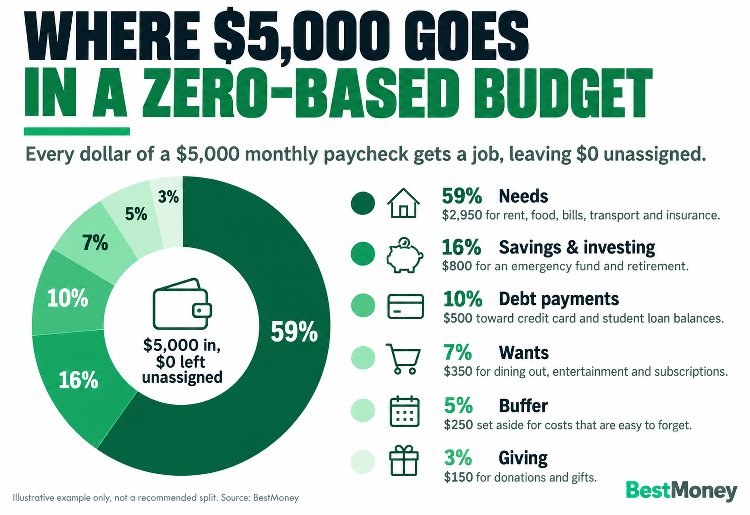
A fixed-income example assigns every dollar of a steady paycheck until nothing is left over. Say you bring home $5,000 a month. You'd assign every dollar across needs, savings, debt, and fun until the total hits $5,000.
Category
Amount
Take-home income
$5,000
Housing (rent)
$1,500
Groceries
$500
Utilities
$200
Transportation (gas + car insurance)
$350
Phone & internet
$150
Health insurance
$250
Credit card & student loan payments
$500
Emergency fund
$400
Retirement & investing
$400
Dining out & entertainment
$300
Subscriptions
$50
Giving
$150
Miscellaneous buffer
$250
Total assigned
$5,000
Income − expenses
$0
The numbers above are illustrative, not a recommendation — your split will look different. What matters is that the assignments equal your income.
What About an Irregular Income?
Irregular income works the same way, but you plan from your lowest recent month and treat extra earnings as a bonus to assign later. Here's a compact freelancer example built on $3,800 of planned income.
Category
Amount
Planned income (lowest recent month)
$3,800
Essentials (housing, food, utilities, transport)
$2,400
Self-employment tax set-aside
$700
Irregular-income buffer
$400
Debt & savings
$200
Wants
$100
Total assigned
$3,800
You can run either version on a free spreadsheet, a printable template, or an app — the math is the same in each.
What Are the Pros and Cons of Zero-Based Budgeting?
Zero-based budgeting trades extra effort for tighter control, which is why it fits some people better than others. The table below weighs the main advantages against the trade-offs.
Advantages
Disadvantages
Full visibility into where every dollar goes
Takes more time and setup than percentage methods
Adapts month to month as your life changes
Requires discipline, especially the first few months
Prioritizes goals like debt payoff and saving
Can feel restrictive when you're getting started
May curb impulse spending by pre-assigning money
Couples need to agree on categories together
If tracking every transaction sounds like too much, zero-based budgeting may not be your starting point. Apps can automate most of the tracking, socompare budgeting and financial-education apps to find one that fits your routine.
How Does Zero-Based Budgeting Compare to Other Methods?
Zero-based budgeting differs from other methods mainly in how tightly it assigns money and how often you rebuild it. The comparison below shows how it stacks up against four common alternatives.
Method
How it works
Well-suited for
Main limitation
Zero-based budgeting
Assign every dollar a job until income minus expenses is zero
People who want full control or are paying off debt
Needs monthly setup and steady tracking
50/30/20 rule
Split after-tax income into 50% needs, 30% wants, 20% savings and debt
People who want a simple starting framework
Fixed percentages adapt less to personal goals
Envelope system
Divide cash or app "envelopes" into spending categories
People who tend to overspend in certain categories
Cash is less practical for online bills; often used inside ZBB
Pay-yourself-first
Move savings out first, then spend what's left
People focused on building savings automatically
Less visibility into daily spending
Traditional budgeting
Set category limits once and roughly follow them
People who want minimal ongoing effort
"Set and forget" can drift as costs change
If you want a lighter starting point,our guide to the 50/30/20 rule walks through the percentage approach in more detail. The envelope system isn't a rival so much as a tactic you can run inside a zero-based budget.
Who Should Use Zero-Based Budgeting?
Zero-based budgeting suits people who want hands-on control and are willing to check in regularly. See where you fit below.
If you're new to budgeting: building from scratch teaches you exactly where your money goes.
If you're paying off debt: assigning surplus straight to balances can speed up payoff.
If your income varies: planning from your lowest month keeps freelancers and gig workers covered.
If you earn well but money disappears: naming a job for every dollar helps you spot where money slips away.
What Should You Do Next?
Zero-based budgeting assigns every dollar a job across five steps: list income, list expenses, subtract to zero, track daily, then rebuild each month. Your next step is to pick how you'll run the plan and start this month. A spreadsheet or notebook works, but an app can automate the tracking that trips people up.
Choose your setup: rather than chasing one "perfect" app, weigh your options and pick the one that matches how you manage money.
Go deeper: read our guide tobuilding an emergency fund, or try the 50/30/20 rule for a simpler first pass.
Your Questions, Answered (FAQs)
Does a zero-based budget mean my bank account has to reach zero?
No. The "zero" means no dollar is left unassigned, not that your balance drops to nothing. Money you route to savings or a buffer is still assigned.
Can you do zero-based budgeting with an irregular income?
Yes, and it's one of the method's strengths. Plan from your lowest recent month, cover essentials first, then assign extra income from bigger months as it arrives.
How is zero-based budgeting different from the envelope system?
Envelopes are a spending tactic for specific categories, while zero-based budgeting is the full plan behind them. You can use envelopes inside a zero-based budget.
How long does it take to get the hang of zero-based budgeting?
Most people find the first couple of months the hardest, then setup gets faster as their categories stabilize. Tracking tools may make it easier to keep up.
Is zero-based budgeting better than the 50/30/20 rule?
It depends on your goals. Zero-based budgeting offers more control and adapts to debt payoff, while 50/30/20 asks less upkeep for people who want simplicity.
Why Trust BestMoney?
This guide comes from BestMoney's Financial Advisor editorial team, which covers budgeting methods, budgeting apps, saving, and debt payoff for U.S. readers. Our team hands-on reviews and compares budgeting apps and methods, including YNAB, EveryDollar, and Monarch Money. We review and compare financial products so you can weigh your options and decide what fits your situation.
For this article, we drew on the Federal Reserve's Survey of Household Economics and Decisionmaking (released 2025) and U.S. Bureau of Labor Statistics inflation data. We also drew on the documented history of zero-based budgeting. Our personal-finance writers focus on turning that data into steps you can act on.
How We Researched This
This guide synthesizes public primary and secondary sources rather than a BestMoney proprietary survey, because no first-party BestMoney data exists on this topic. We relied on the Federal Reserve's Survey of Household Economics and Decisionmaking, released in 2025 (three chapters). We also used U.S. Bureau of Labor Statistics Consumer Price Index data for August 2026.
We also drew on McKinsey's account of the method's origin in Peter Pyhrr's work and its 1970 Harvard Business Review article. Where we describe the psychology behind the method, we reference theSt. Louis Fed's explainer on mental accounting. The link between that concept and zero-based budgeting is our editorial framing.
Federal Reserve, Economic Well-Being of U.S. Households in 2024 — Overall Financial Well-Being (released 2025)
Federal Reserve, Economic Well-Being of U.S. Households in 2024 — Income and Expenses (released 2025)
Federal Reserve, Economic Well-Being of U.S. Households in 2024 — Savings and Investments (released 2025)
U.S. Bureau of Labor Statistics, Consumer Price Index Summary — August 2026
Federal Reserve Bank of St. Louis, Page One Economics — "How Mental Accounting Shapes Our Financial Choices"
McKinsey, "The return of zero-base budgeting" (origin history; Pyhrr / Harvard Business Review, 1970)
Fidelity, Chase, and Experian budgeting explainers (background)
Written byBestmoney Staff
The BestMoney editorial team is composed of writers and experts covering a full range of financial services. Our mission is to simplify the process of selecting the right provider for every need, leveraging our extensive industry knowledge to deliver clear, reliable advice.