The Informal Support Economy: How Financial Struggles Are Reshaping Relationships
The Informal Support Economy: How Financial Struggles Are Reshaping Relationships
Americans are propping each other up with money they can't always spare, and almost none of it is written down.
Written by
Bestmoney Staff
The BestMoney editorial team is composed of writers and experts covering a full range of financial services. Our mission is to simplify the process of selecting the right provider for every need, leveraging our extensive industry knowledge to deliver clear, reliable advice.
It’s not an exaggeration: everyday life has gotten harder to afford. Grocery prices haverisen 33% since 2019, and half of American renters spendmore than 30% of their income on rent and utilities alone. When salaries don’t keep up, people are forced to look for outside financial help – and for many, this means borrowing from loved ones. As the economy changes and larger chunks of American paychecks go toward necessities, people are lending to and borrowing from loved ones just to make sure everyone keeps their head above water.
BestMoney surveyed 1,000 U.S. adults about the money they lend to and borrow from the people closest to them. The survey asked who they call first when an essential expense is out of reach, what the money typically covers, what the person helping gives up to provide it, and what happens to the relationship once money is involved. The answers describe an economy running almost entirely on trust, where nearly everyone participates and almost nobody writes anything down.
Key Takeaways
Nearly all Americans (93%) have given or received financial support from someone they know in the past 12 months. Just 7% say they haven't faced this situation at all, making informal financial support closer to a norm than an exception.
Everyday costs, not one-time emergencies, are driving Americans to lean on people they know: 28% say the rising cost of groceries and everyday living was a main reason they needed financial support, more than job loss (20%) or rising housing costs (19%.
A family member (22%) is the single most common first stop when someone can't cover an essential cost, edging out personal savings (21%) and outpacing every formal borrowing option combined — credit cards, personal loans, payday loans, and BNPL (14% combined).
One in six Americans (16%) say they don't have anyone they could turn to for financial help. Boomers feel this gap most: 30% say they have no one to turn to, versus just 6% of Gen Z.
Parents are propping up their adult children at a striking rate: 43% of Americans say they've given financial support to their adult child in the past year, compared to just 6% who say they received support from a child.
Nearly half of Americans (47%) have changed where they live because of money in the past three years, rising to 71% of Gen Z. People are moving back in with a parent or relative (12%), moving in with a partner sooner than planned (12%), or taking on roommates (7%), among other shifts.
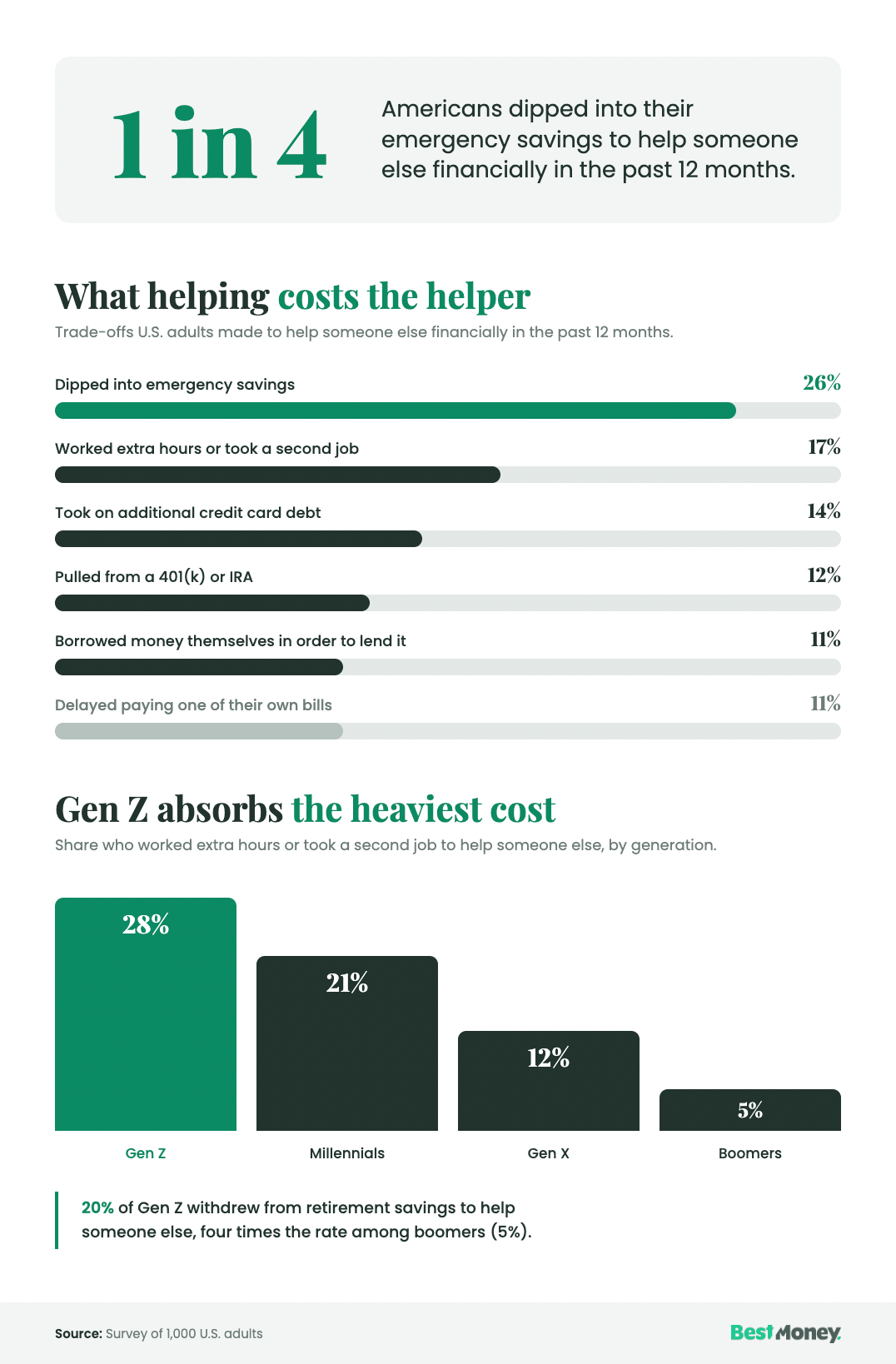
Helping loved ones financially often comes at the expense of personal financial security: 26% dipped into emergency savings and 12% pulled from retirement accounts like a 401(k) or IRA to help someone else, while 17% worked extra hours or took on another job to cover it. Gen Z withdraws from retirement savings to help others at four times the rate of Boomers (20% vs. 5%).
Money quietly threatens relationships as much as it supports them: 13% have kept financial help a secret from a romantic partner. Among couples with uneven contributions, 12% say it was used to justify more control, 11% say it caused conflict, and 3% say it ended the relationship.
What Americans Spend Borrowed Money On
People often assume they’ll only need to borrow money in the event of a financial emergency – a layoff, injury, or hospital bill nobody planned for. While emergencies do move money between households, they don’t represent the majority of these transactions. The reality is more mundane: somebody else covers a grocery run, or a rent check that has to clear a week before payday. Here’s what people’s support has gone toward.
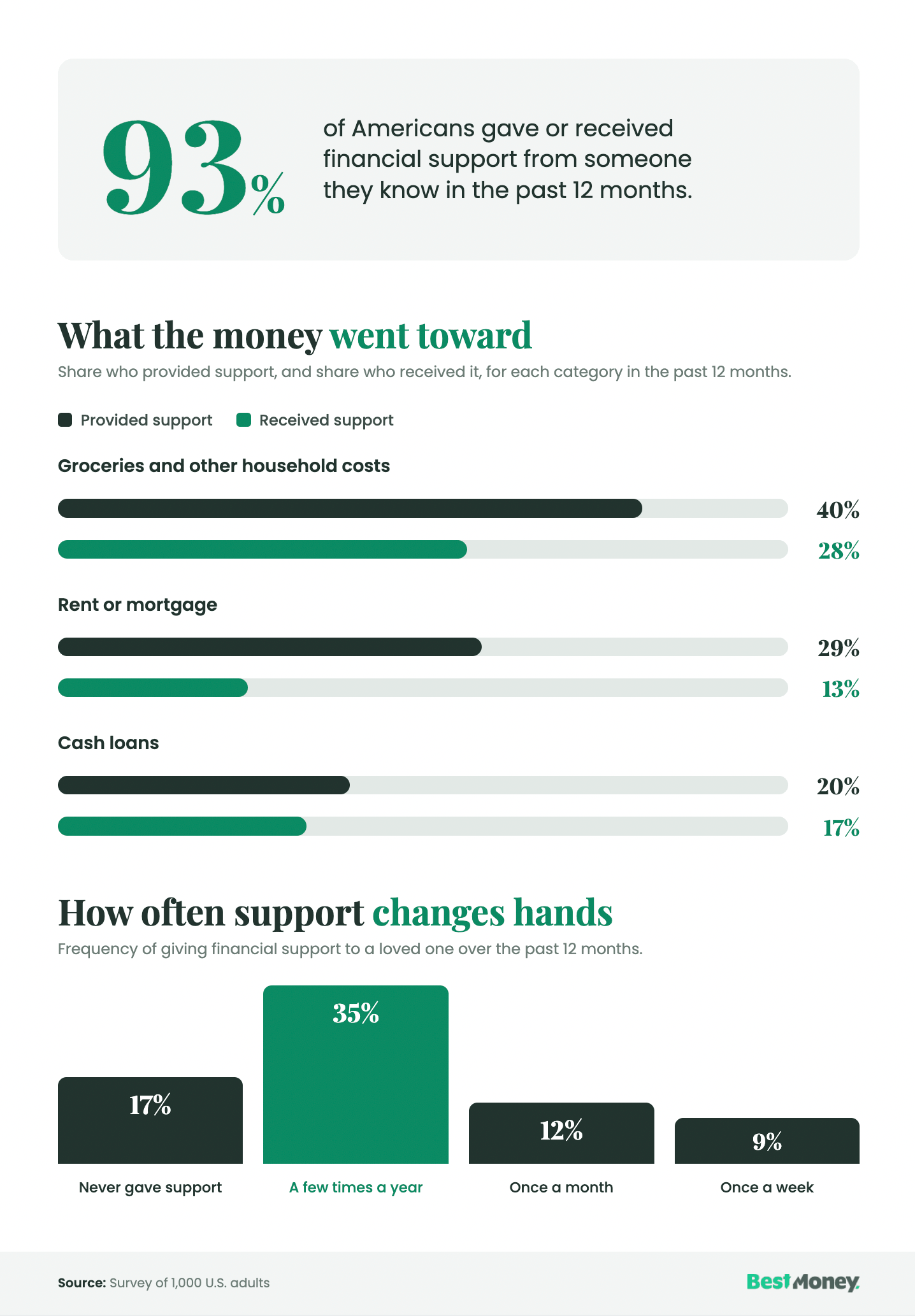
Nearly all (93%) of Americans gave or received help from somebody they know in the past 12 months, leaving only 7% who haven't had to lend or borrow money. Most of this money went toward practical, everyday expenses rather than sudden financial emergencies. Among those who received financial support, 28% said the money was needed for groceries and other household costs, while 20% cited a job loss and 19% cited rising housing costs. A smaller share (13%) needed assistance with their rent or mortgage.
Among respondents who provided financial support, 40% covered groceries and other household costs for somebody else. Rent or mortgage assistance came next: 29% helped a loved one pay their monthly housing bill. Cash loans were the most reciprocal category tested, with 20% providing one and 17% receiving one. Nonspecific cash assistance – like Venmoing a friend $50 when they’re short on cash – is a casual way that friends and family help keep each other in the black.
For some, financial support is a once-in-a-while thing. Over a third (35%) financially supported a loved one a few times over the past year, while half that amount (17%) never gave any financial support at all. Smaller groups have made a habit of giving: 12% were giving financial support once a month, and 9% were doing so once a week.
When asked what that financial support accomplished, respondents said it reduced financial stress (11%), covered an emergency (6%), and paid down debt (4%) – a sign that this money mostly buys breathing room rather than solving any single problem.
Where People Turn for Financial Support
When money gets tight, people weigh their options. They figure out which bills can slide, pull from the emergency fund, or consider their least favorite option – asking for outside help.
Each option comes with a different price. A credit card charges interest, while borrowing from a parent means a flexible repayment plan but additional emotional baggage. Where Americans turn depends largely on what their support system already looks like.
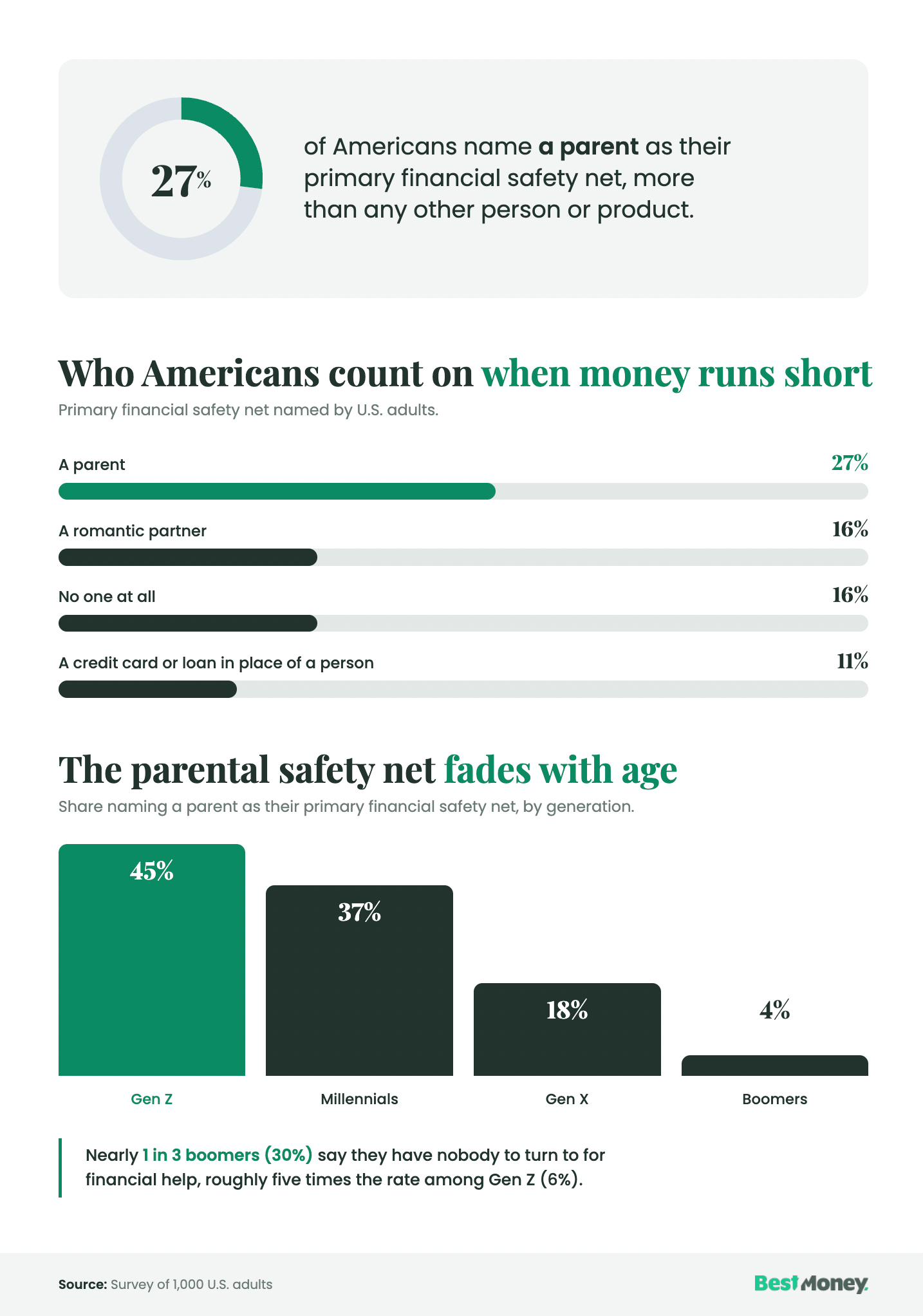
When an essential expense can't be covered, the largest share of Americans turn first to a family member (22%), followed closely by personal savings (21%). All other options trailed by a large margin: 8% named a romantic partner, 8% said they’d use a credit card, and 4% turned to a friend. For many, these emergency options are also their fallbacks. When asked to name their primary financial safety net, respondents cited these sources and relationships:
A parent (27%);
A romantic partner (16%);
No one at all (16%);
A credit card or loan in place of a person (11%);
A sibling (5%).
Parents are the primary safety net for 45% of Gen Z and 37% of millennials, against 18% of Gen X and 4% of boomers. This is partly the arithmetic of aging — a 68-year-old's parents may be gone, or relying on their child to finance their care.
Nearly 1 in 3 boomers (30%) said they have nobody to turn to for financial help, roughly five times the rate among Gen Z (6%). Another quarter (24%) of boomers said they would reach for a credit cardor personal loan instead of a person, against 4% of Gen Z. Retirement-age Americans are the group most likely to experience a financial emergency with no one to fall back on, which converts an ordinary cash-flow problem into a credit problem.
Gender and income sort the first move as well: women turned to a family member first more often than men (25% against 19%), while men went to their own savings (23% against 19% of women), and 20% of women named a romantic partner as their safety net against 12% of men. Low-income respondents were the most likely to call family first (26%), against 21% of middle-income and 12% of high-income respondents. In comparison, high earners were twice as likely to name a partner (24% against 12%) — they are simply more likely to be partnered with somebody whoalso has money.
Who's Holding Up the Safety Net
More often than not, older family members are providing for younger ones. But this is far from the only transaction that happens. Adult children may pay for a parent’s groceries, or an older brother may help his sister make her car payment one month. Other young adults lean on their chosen family – their network of friends made in adulthood.
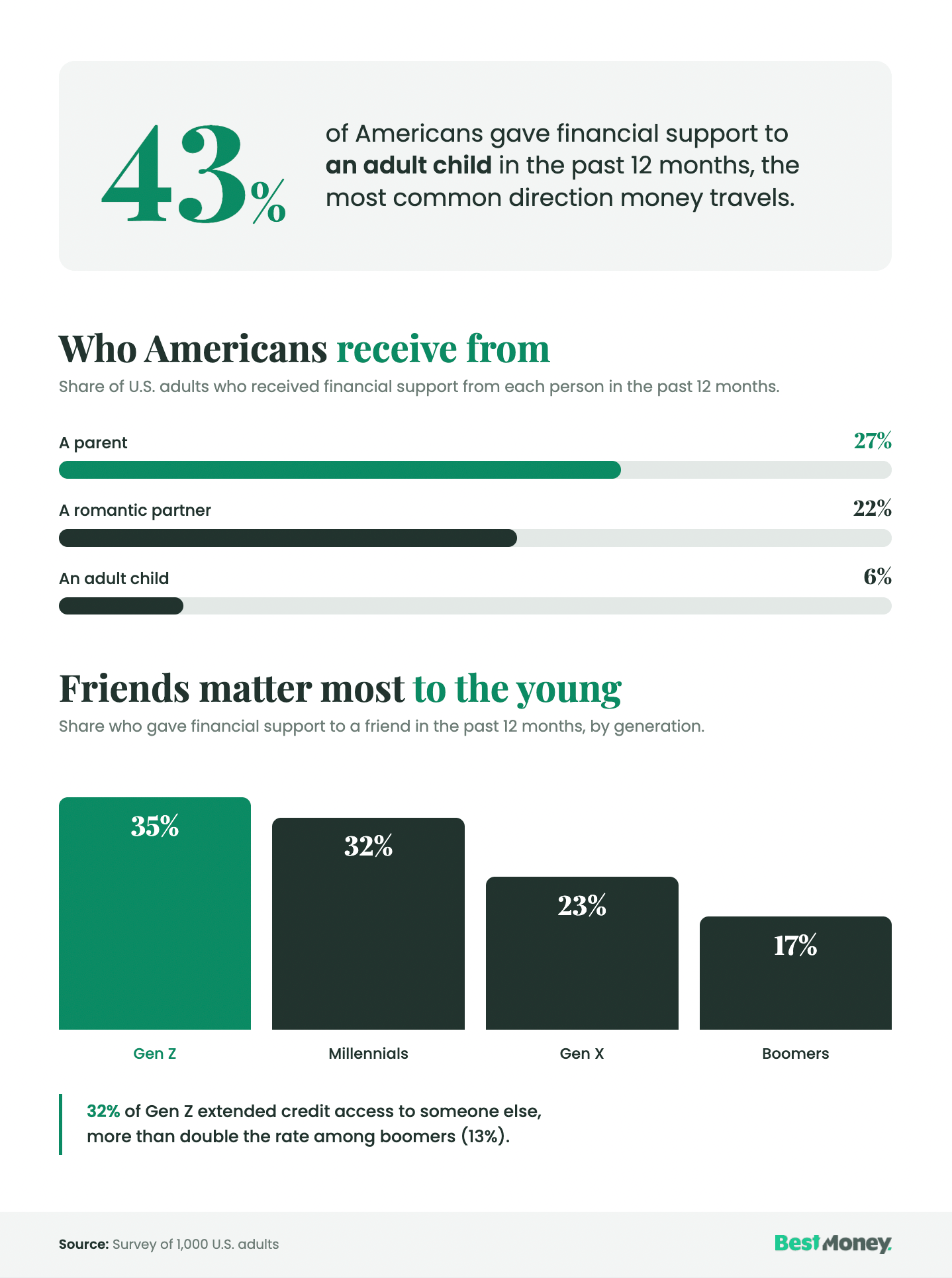
More than two in five (43%) of Americans gave financial support to an adult child in the past year, while only 6% received support from one. Parents came far closer to even — 27% received financial help from a parent, while 25% gave to one. Romantic partners produced the most equal two-way exchange of any relationship tested, with 22% both giving and receiving with a partner.
These loans moved outside of the immediate nuclear family as well. Supporting another family member (28%) slightly outpaced supporting a parent (25%). Friends sat further out, with 47% reporting no financial exchange with a friend over the past 12 months. General acquaintances were rarer still: 21% gave, and 11% received. People are most willing to support those who have supported them.
Friends sit at the thin end of that range for most people, but not for everyone. Gen Z gave financial support to a friend at a rate of 35%, ahead of millennials (32%), Gen X (23%), and boomers (17%), and 32% extended credit access to somebody else, more than double the rate among boomers (13%). Most Gen Z respondents have no children and want tomaintain their independence from their parents, leaving friends as the people close enough to ask.
Moving In for Money
Rent is the biggest expense in most household budgets, and the least negotiable. You can switch grocery brands or stretch a car payment, but you can’t redeem a coupon for a discount on your rent. When the rent gets too high, the fix is usually a different arrangement altogether — especially if there’s a roommate involved. It's also the most visible symptom of financial pressure. No one notices when you cancel a prescription, but moving back into your childhood bedroom at 26 is harder to conceal. But despite their complicated feelings on the subject, Americans arecohabiting to save money.
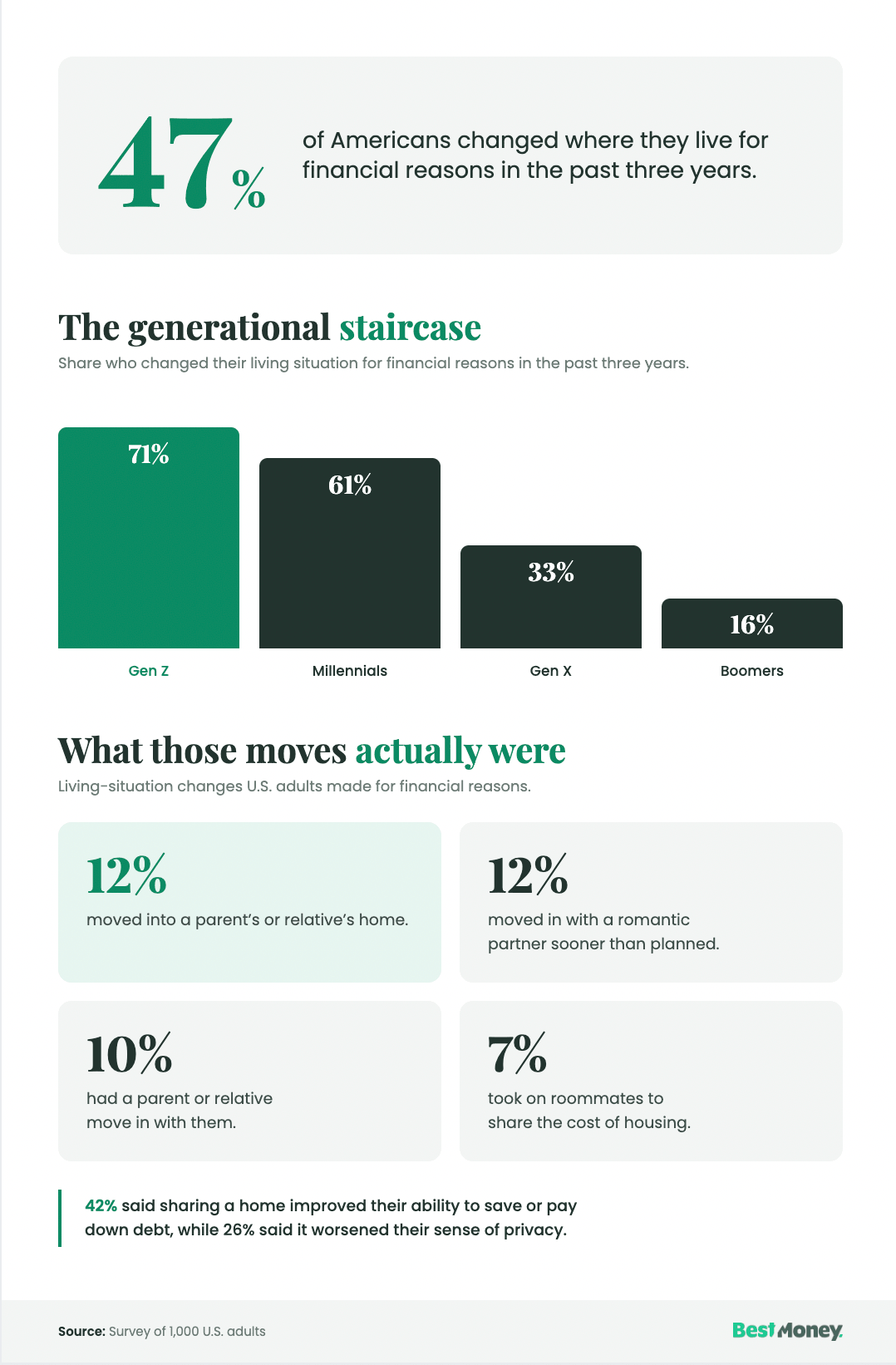
Financial pressure has rearranged where nearly half of Americans live: 47% changed their living situation for financial reasons in the past three years. Moving into a parent's or relative's home accounted for 12%, and the reverse — a parent or relative moving in — accounted for 10%. Another 12% moved in with a romantic partner sooner than they otherwise would have, and 7% took on roommates.
Younger generations were most likely to uproot themselves. Gen Z changed their living situation at a rate of 71% and millennials at 61%, against 16% of boomers. Moving back into a parent's or relative's home is where the generational split runs sharpest: 24% of Gen Z did it, against 15% of millennials. For anyone under 30, a stint in the parental home is now a normal stage of young adulthood.
What people give up for these arrangements and what they get back land in completely different places. Privacy takes the hit, with 26% saying that living with someone for financial reasons worsened their sense of privacy or personal space at least somewhat. However, saving money can make it worth it: 37% said the arrangement improved their financial stress, and 42% said it improved their ability to save or pay down debt. That's the trade stated plainly — space for solvency.
What Americans Give Up to Give
Somebody needed $400, somebody sent $400, and the story usually ends there. Nobody asks the sender where they got the money from. They may have pulled it out of their emergency fund, or out of a retirement account with thirty years left to compound, and won't feel the effects of that until much later. While lending money to others is a noble thing to do, it can lead to financial consequences on their own end.
Here's what Americans did to help somebody else financially:
Borrowed money themselves in order to lend it (11%);
Delayed paying one of their own bills (11%).
Gen Z carries the heaviest version of nearly every one of these trade-offs. One in five (20%) Zoomers have withdrawn from their retirement savings to help someone else, four times the number of boomers who said the same (5%). Gen Z has had less than a decade tosave for retirement, meaning that every dollar removed loses them the chance to compound that money. The pattern repeats on effort and on debt. Over a quarter (28%) of Gen Z worked extra hours or took a second job, compared with 21% of millennials and 5% of boomers. Meanwhile, only 19% of Gen Z borrowed money themselves in order to help, the highest rate of any generation and more than six times the number of boomers who did the same (3%).
Low-income respondents were the most likely to tap into emergency savings (30%), against 25% of high-income and 22% of middle-income respondents. Credit card debt split more cleanly: 16% of low-income respondents took some on to help someone, against 9% of high-income respondents. Those with higher incomes have more sources to pull from if things go south; lower-income respondents were more limited.
What Financial Support Does to a Relationship
People skip the paperwork on purpose. Asking your own mother to sign a contract implies you expect her to stiff you, so nobody writes anything down and may eventually forget the terms. Others purposely keep the transaction quiet – a wife never finds out what her husband sent his brother, parents never learn their daughter borrowed from a friend. Staying quiet protects them from judgment, but can lead to bigger problems down the road.
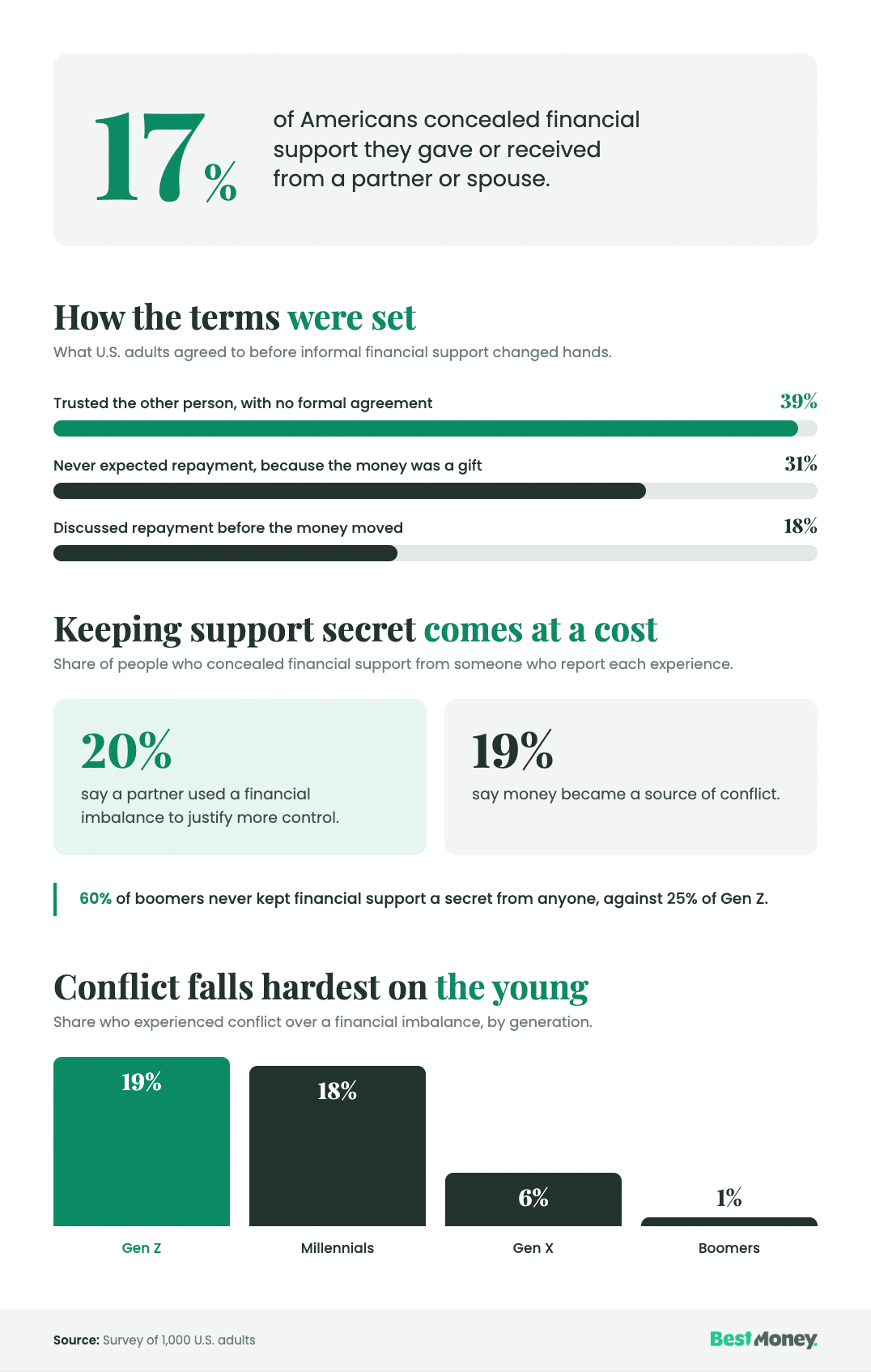
Americans run this economy on trust and not much else. Trusting the other person without any formal agreement was the arrangement respondents described most often (39%), and 31% said repayment was never expected because the money was a gift. Only 18% discussed repayment before the money moved. High earners wrote it off as a gift most readily (40%, against 28% of low-income respondents), which tracks with who can afford to stop thinking about the money once it leaves.
Sometimes, these agreements happen in secret. Two in five (40%) respondents said they never kept financial support secret from anyone. But 17% said they’d concealed it from their partners and spouses. Boomers were the most forthcoming: 60% had never kept a secret about financial support, while only 25% of Gen Z could say the same.
Among respondents who concealed support from someone, 20% said a partner used a financial imbalance to justify more control and 19% said money became a source of conflict; among those who kept nothing quiet, both figures sat at 4%. Imbalance itself is ordinary – 45% reported one with a partner in the past year – and within that group, 27% described a partner turning it into leverage. In comparison, 8% said the relationship ended over it.
Among Gen Z and millennials, 19% and 18% respectively experienced conflict over a financial imbalance, compared to 6% of Gen X and 1% of boomers. Those making the least money were most vulnerable to conflict: 15% of low-income respondents reported a partner using money as leverage, compared with 9% of middle-income and 7% of high earners. Couples who lost the ability to talk about the money also lost the only tool they had for settling it.
What We Owe Each Other
Ask someone how they're doing financially, and they'll tell you about their job, their rent, maybe theircredit score. They probably won't mention the $300 they sent their brother in March, or the fact that their mother covered their car insurance twice last year. There’s a lot of real worry about revealing that you lent or borrowed money, even if most Americans are doing it.
That's a problem, because the money isn't free. Somebody pulled it out of an emergency fund. Somebody picked up a Saturday shift. Somebody let a retirement account sit $2,000 lighter than it should. If those costs build up without acknowledgment, so can resentment.
Before the money moves, somebody should say out loud whether it's a loan or a gift, and where it's coming from. That conversation takes about a minute, and it's the difference between a favor that gets remembered fondly and one that quietly sours a relationship for years.
Methodology
Best Money surveyed 1,000 U.S. adults to examine how Americans give and receive informal financial support from family, romantic partners, and friends. The survey covered who people turn to first in a financial emergency, how often support is exchanged, what that support typically covers, the personal costs of helping someone else, and how financial imbalance affects relationships. Results were analyzed across demographic segments including generation (Gen Z, Millennials, Gen X, Baby Boomers), gender, and income level. Percentages reflect self-reported data and may sum to more than 100% when multiple selections were allowed.
About BestMoney
BestMoney helps people compare loans, credit cards, savings accounts, insurance, and other financial products side by side, with guidance from a network of finance professionals the company calls its Money Besties. Founded in 2009, BestMoney exists to make consequential money decisions clearer — including the ones people make for the family members and friends who ask them for help.
Fair Use Statement
The information in this article may be used for non-commercial purposes only. If you share these findings, please attribute them to BestMoney and include a link back to this original research.
Written byBestmoney Staff
The BestMoney editorial team is composed of writers and experts covering a full range of financial services. Our mission is to simplify the process of selecting the right provider for every need, leveraging our extensive industry knowledge to deliver clear, reliable advice.