- Home/
- Financial Advisor/
- How to Host Thanksgiving on a Budget: A Step-by-Step Plan
How to Host Thanksgiving on a Budget: A Step-by-Step Plan
Seven moves to feed a crowd for less, from turkey math to a fair potluck list
October 28, 2026
Seven moves to feed a crowd for less, from turkey math to a fair potluck list
October 28, 2026
This step-by-step plan shows you how to set a Thanksgiving budget, trim the menu, shop smarter, share costs with guests and pay without carrying debt.
You said yes to hosting. Then the guest list grew, and every grocery run added another receipt. The good news: learning how to host Thanksgiving on a budget starts with a core meal that costs less than you might expect.
The American Farm Bureau Federation's (AFBF) informal 2025 survey put a classic dinner for 10 at $55.18, or about $5.52 per person. That's down 5% from 2024. If you pay your card in full each month, you can also compare cash back credit cards to earn back part of that grocery bill.
AFBF prices core dishes only, so drinks, appetizers and supplies push real totals higher. The fix is a plan: set a number, then make the menu, the shopping and your guests work within it.
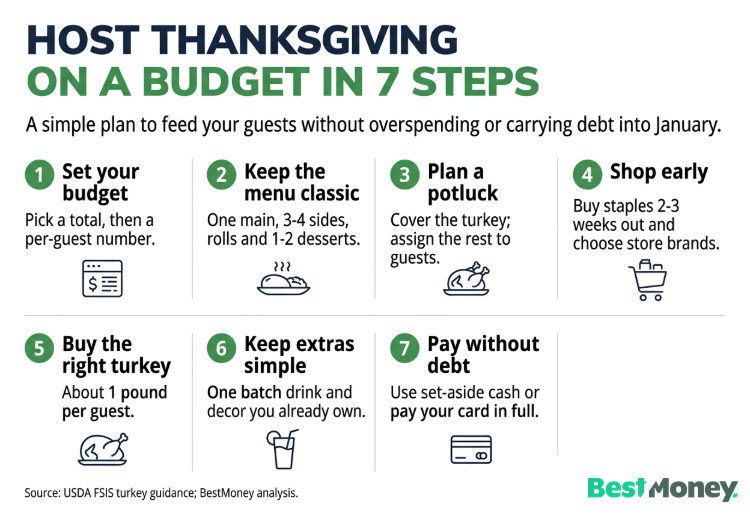
To host Thanksgiving on a budget, set a total and a per-guest budget, cut the menu to the classics and assign dishes to guests. Shop sales and store brands two to three weeks ahead, and buy the right size turkey. Keep drinks and decor simple, and pay in a way that doesn't follow you into January.
Start with one total number, then divide it by your guest count to get a per-guest budget. That per-guest figure becomes your guardrail for every menu and shopping decision.
Treat AFBF's 2025 figure of about $5.52 per person as a floor, not a target. It covers core dishes only, like a home's base price before upgrades. Add room for drinks, appetizers, paper goods and anything you'll buy for the table.
Location matters, too. In AFBF's 2025 survey, the same classic dinner for 10 cost $50.01 in the South and $61.75 in the West. That's an $11.74 gap for an identical menu, so set your floor based on where you shop.
Pull the money from your regular plan instead of hoping it fits. If you use the 50/30/20 rule or a zero-based budget, our guide to building a realistic budget shows how to slot in a one-time expense. Then track each line item:
Line item | Planned | Actual |
|---|---|---|
Turkey | ||
Sides | ||
Rolls and bread | ||
Desserts | ||
Drinks and ice | ||
Appetizers | ||
Paper goods and supplies | ||
Decor | ||
Total |
Fill in the Planned column before you shop and the Actual column as receipts come in.
A simple Thanksgiving menu means one main dish, three or four sides, rolls and one or two desserts. That lineup covers the classic table, and every extra dish adds cost and prep time.
Lean on low-cost, filling sides for a cheap Thanksgiving dinner. Potatoes, stuffing and in-season squash fill plates without specialty ingredients. Pick sides that share ingredients, so one bag of potatoes or one box of broth covers two dishes.
Watch the second protein. In AFBF's 2025 survey, adding ham, potatoes and green beans raised the dinner for 10 to $77.09, or about $7.71 per person. That's roughly $2 more per guest than the classic menu.
Scale every recipe to your actual headcount instead of the yield printed on the recipe. Then cut low-value extras, like a second appetizer spread or a dessert nobody asked for.
A planned potluck means you cover the turkey and one or two anchor dishes, and guests bring the rest. The key word is planned: assigned items keep you from ending up with five pies and no rolls.
Use a shared sign-up list, like a group text or a shared document, so everyone sees what's claimed. Assign drinks, ice and paper goods, too, since small items add up. Give out-of-town guests make-ahead items that travel well.
Item | Who covers it | Why it works |
|---|---|---|
Turkey | Host | You control timing and oven space |
Anchor side, like stuffing | Host | Keeps the core meal consistent |
Other sides | Local guests | Easy to bring warm or reheat |
Rolls and bread | One guest | Low effort to bring |
Pies and cranberry sauce | Out-of-town guests | Made ahead and travel well |
Drinks and ice | Guests | Spreads a cost that adds up |
Paper goods and containers | One guest | Doubles as leftover packaging |
If asking feels awkward, ask early and be specific. A clear request is easier to say yes to than "bring whatever."
Shopping early and stacking discounts lowers the grocery bill itself. Buy non-perishables like stuffing mix, canned pumpkin, broth and baking supplies two to three weeks out, so you have time to wait for sales.
Watch weekly ads and loyalty-card deals for the turkey. In its 2025 survey, AFBF noted that stores often run whole-turkey promotions in the days before Thanksgiving. If your store advertises a free turkey with a minimum purchase, check that the spending threshold fits your list.
Choose store brands for staples.
The Private Label Manufacturers Association (PLMA), an industry group, says store brands held a 21.3% dollar share in 2025. That's about $1 of every $5 spent. Its claim that shoppers save one-third or more is the industry's own figure, and we didn't find independent data confirming it.
Then stack savings. Grocery money-saving apps may return cash on items you already buy, and coupon apps help you match digital deals to your list. Check payout rules before you count on them.
The USDA Economic Research Service (ERS) forecasts grocery prices will rise about 2.3% in 2026 (October 2026 edition). Its forecast range is 1.9% to 2.7%, and restaurant prices are forecast to rise 3.5%, so cooking at home stays relatively cheaper.
The USDA's Food Safety and Inspection Service (FSIS) recommends about 1 pound of turkey per person, which feeds everyone without a mountain of extra bird. Overbuying is a hidden cost: ReFED estimated about 320 million pounds of food, worth about $550 million, would go to waste on Thanksgiving 2025.
By ReFED's estimate, 40% of that wasted food was turkey, and more than 90% of hosts intentionally over-prepare. Use the 1-pound rule as your starting point:
Guests | Turkey to buy | Approximate fridge thaw time |
|---|---|---|
4 | About 4 pounds (turkey breast) | About 1 day |
8 | About 8 pounds | About 2 days |
12 | About 12 pounds | About 3 days |
16 | About 16 pounds | 3 to 4 days |
20 | About 20 pounds | 4 to 5 days |
Thaw times follow FSIS guidance of about 24 hours per 4 to 5 pounds in the refrigerator.
Smaller groups can skip the whole bird and buy a turkey breast or a smaller turkey. In its December 2025 outlook, USDA ERS said bird flu re-emerged in turkeys and expected strong wholesale prices in 2026. Wholesale prices don't translate directly to what you'll pay at the store.
Buying a frozen bird early on sale means planning thaw time. FSIS says a 12- to 16-pound turkey needs three to four days in the fridge, or about 30 minutes per pound in cold water.
Plan leftovers before the meal. FSIS advises refrigerating leftovers within two hours and eating them within three to four days, or freezing them. Send guests home with the containers they brought.
Simple drinks and decor trim the extras that quietly add up. Make one batch drink, like a punch or cider, instead of stocking a full bar. Invite guests to bring their own beer or wine.
For decor, use what's around you: pine cones, fallen leaves, mini pumpkins or candles you already own. Reuse your table linens and serving dishes, or borrow from a guest instead of buying new. If you want a theme, pick one color and stick to it to keep impulse buys in check.
Log these purchases in your line-item table, so small extras stay visible.
Pay for Thanksgiving with cash you've set aside, if you can, so the meal is covered before the plates are cleared. A cash back card helps only if you pay the statement in full by the due date.
A carried balance works like leftovers on the counter: the longer it sits, the worse it gets. The Consumer Financial Protection Bureau (CFPB) reported an average card APR of 25.2% in 2024, and 31.3% for store cards. That's roughly 25 cents in yearly interest for every dollar you carry on a typical card.
Thanksgiving also kicks off the bigger spending season. The National Retail Federation (NRF) forecasts November and December 2026 holiday sales of $1.013 trillion, up 4.2%.
NRF's survey also found 64% of consumers plan to do most of their holiday shopping by Thanksgiving weekend. Keep your hosting budget separate from gift money, and look at credit cards for holiday shopping if you're comparing rewards. Deal sites get busy this time of year, so learn how to spot holiday scams before you click.
This guide is for anyone hosting Thanksgiving on a budget, especially if one of these fits you:
If you're a first-time host, start with Step 1 and the budget table so you know your number before you shop.
If you're feeding 12 or more, lean on the planned potluck in Step 3 and the turkey math in Step 5.
If you're hosting in a small space or for a small group, choose a turkey breast and a shorter menu.
If you're on a tight monthly budget, set the per-guest number first and assign more dishes to guests.
If you're prone to overspending on a card, pay from set-aside cash and review Step 7 before you shop.
Hosting Thanksgiving on a budget starts with one move: set your total and per-guest budget this week. Then build the menu and potluck list around it. Shop sales early, buy about 1 pound of turkey per guest and pay only what you can clear in full.
Compare cash back credit cards if you'll pay the statement in full.
Browse grocery money-saving apps to earn cash back on your list.
Try coupon apps to match digital deals to your shopping list.
Use our budgeting guide to fit Thanksgiving into this month's plan.
Read our post-holiday budget tips to reset your finances in January.
AFBF's informal 2025 survey put a classic Thanksgiving dinner at about $5.52 per person, or $55.18 for 10. An expanded menu with ham, potatoes and green beans came to about $7.71 per person, and neither figure includes drinks or extras.
It depends on the menu and your guest count, so compare the premade price per person with AFBF's 2025 scratch-cooked benchmark of about $5.52. Buying one or two premade sides while cooking the rest can save time without replacing the whole meal.
Shrink the menu, buy a turkey breast instead of a whole bird and serve buffet-style from the kitchen counter. Ask guests to bring make-ahead dishes, so you don't need extra oven or fridge space.
No, it's a common way to share costs when you ask early and assign specific dishes. Covering the turkey and one or two anchor sides yourself keeps the request fair.
Only if you can pay the full statement balance by the due date. The CFPB reported an average card APR of 25.2% in 2024, so a carried balance can cost more than any rewards you earn.
This guide relies on secondary sources rather than a proprietary BestMoney survey. Sources include AFBF's 2025 survey, USDA ERS forecasts, USDA and FSIS guidance, ReFED's waste estimate, the CFPB's card report, PLMA data and NRF's forecast. AFBF figures are from 2025 and will be updated when the 2026 survey is released.
The BestMoney editorial team is composed of writers and experts covering a full range of financial services. Our mission is to simplify the process of selecting the right provider for every need, leveraging our extensive industry knowledge to deliver clear, reliable advice.