How to Budget in Retirement: A Step-by-Step Retirement Budget Guide
How to Budget in Retirement: A Step-by-Step Retirement Budget Guide
Learn how to build a monthly retirement budget that matches your fixed income, covers healthcare and inflation, and helps your savings last.
Written by
Bestmoney Staff
The BestMoney editorial team is composed of writers and experts covering a full range of financial services. Our mission is to simplify the process of selecting the right provider for every need, leveraging our extensive industry knowledge to deliver clear, reliable advice.
Say you're one month into retirement. The paycheck has stopped, but the electric bill, the grocery run, and the Medicare premium haven't. Your income now comes from Social Security and whatever you pull from savings.
This guide shows you how to budget in retirement, step by step. You'll turn Social Security, pensions, and savings into a steady monthly retirement paycheck.
Key Insights
Build your retirement budget around monthly income, then split spending into essentials and extras.
Aim to cover essential bills with reliable income like Social Security and pensions.
Social Security rose 2.8% for 2026, but Medicare Part B rose to $202.90 a month.
Morningstar's latest research puts a safe starting withdrawal rate at 3.9% for new retirees, below the classic 4% rule.
Rebudget every January, since COLA, Medicare premiums, and required withdrawals reset annually.
How Do You Build a Retirement Budget?
To build a retirement budget, total your monthly income, list your expenses, and sort them into essential and discretionary spending. Cover essentials with reliable income like Social Security. Fund the rest from savings at a sustainable withdrawal rate, and review the plan every year.
Think of it as a paycheck you write yourself. An employer used to set what landed in your account each month, and now you do.
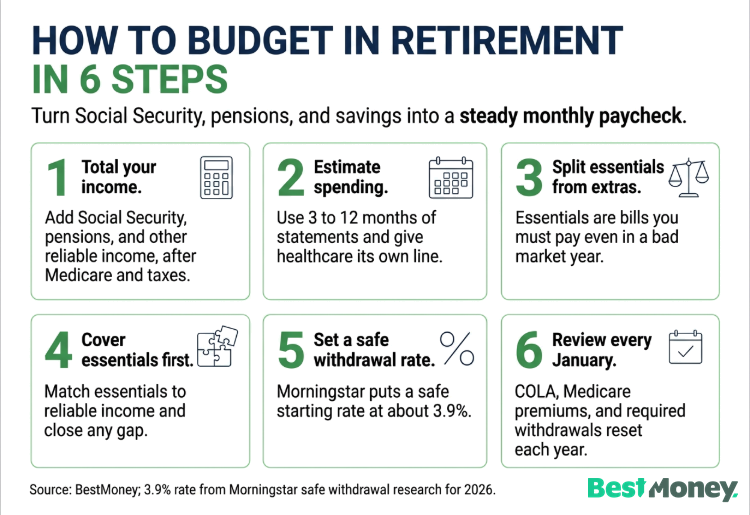
The six steps:
Total your reliable monthly income.
Estimate your monthly spending from real statements.
Split expenses into essential and discretionary.
Cover essentials with reliable income and find any gap.
Set a sustainable withdrawal rate for savings.
Review the budget every January.
Step 1: How Much Monthly Income Will You Have in Retirement?
Your monthly retirement income is every reliable payment you expect, after Medicare premiums and taxes. Common sources:
Claiming age matters. Full retirement age is 67 for anyone born in 1960 or later, and waiting until 70 pays 124% of your full benefit,per the SSA. About 87% of people 65 and older receive Social Security, according to aJuly 2025 SSA fact sheet.
Budget on net. Medicare Part B premiums are often deducted from Social Security, so subtract $202.90 a month plus any taxes before you plan your spending.
Step 2: What Will You Spend Each Month in Retirement?
You'll likely spend close to what your recent statements show, adjusted for life after work. Total three to 12 months of bank and card statements by category. Commuting, payroll taxes, and retirement contributions usually fall away, while healthcare and travel often grow.
Give healthcare its own line.Fidelity's 2026 estimate says a 65-year-old may need $185,500 in after-tax savings for healthcare in retirement. That figure assumes Original Medicare and no employer retiree coverage, and it excludes long-term care.
Don't forget irregular retirement expenses like a car, a new roof, dental work, or hearing aids. Divide each cost by the months until you'll need it, and add that sinking-fund line to your retirement budget worksheet.
Step 3: Which Expenses Are Essential and Which Are Discretionary?
Essential expenses are bills you must pay even in a bad market year, while discretionary expenses are ones you can trim. This split drives every later step.
Essential expenses
Discretionary expenses
Housing (mortgage or rent, property tax, insurance)
Travel
Utilities and phone
Dining out
Groceries
Hobbies
Medicare and other insurance premiums
Gifts and giving
Out-of-pocket healthcare
Subscriptions and streaming
Transportation
Entertainment
Taxes and minimum debt payments
Home upgrades
If markets fall, you can pause a trip, but not a property tax bill. The essential list shows how much income needs to be reliable.
Step 4: How Do You Cover Essentials With Reliable Income?
Compare your essential total to your Social Security, pension, and annuity income, then close any shortfall, known as your floor gap. The idea comes from retirement researcherWade Pfau's safety-first approach. It builds a dependable income floor for essentials first, then uses investments for discretionary goals.
Common ways to close a floor gap:
Delay Social Security to raise your monthly benefit
Work part time for a few more years
Lower fixed costs by downsizing or refinancing
Consider an income annuity that turns part of your savings into regular payments
Savings cover whatever remains, as Step 5 explains.
Step 5: How Much Can You Safely Withdraw From Savings?
You can withdraw about 3.9% of your savings in year one and adjust for inflation afterward, based onMorningstar's safe withdrawal research for 2026, published in December 2025. That base case, up from 3.7% a year earlier, applies to portfolios holding 30% to 50% in stocks over 30 years, with a 90% chance of not running out of money.
The familiar 4% rule traces to financial planner William Bengen's 1994 article in the Journal of Financial Planning,as CNBC reported in 2025. His original research found a 4.15% first-year withdrawal, adjusted for inflation, lasted 30 years historically under specific portfolio assumptions.
Say you're retiring with $500,000 saved (an illustrative example). At 3.9%, you'd withdraw $19,500 in year one, or about $1,625 a month. At 5%, you'd get about $2,083 a month, roughly $458 more.
But a 5% start exceeds Morningstar's base case, raising the risk of running out early, especially after a market drop.
Required minimum distributions (RMDs) generally start at 73,per the IRS, and the age rises to 75 in 2033, according to theCongressional Research Service. Withdrawals from traditional retirement accounts are taxable, so budget for the tax bill.
Many retirees also use a bucket strategy, first developed by wealth manager Harold Evensky in 1985,according to Capital Group. Bucket sizes vary, but a simple version keeps one to two years of withdrawals in cash, such as a high-yield savings account.
Step 6: How Often Should You Review Your Retirement Budget?
Review your retirement budget at least once a year, ideally each January, when key numbers reset. Your checklist:
Your new Social Security amount after the COLA
New Medicare premiums and any income-related surcharge (IRMAA)
This year's RMD amount
Insurance renewals
Property tax bills
Compare your cost increases to inflation: consumer prices rose 3.4% over the 12 months ending August 2026,according to the BLS. Check discretionary spending quarterly so small overruns don't snowball.
Which Budgeting Method Fits a Fixed Income?
Most familiar budgeting methods work on a fixed income once you adapt them to spending down savings instead of building them.
Method
How it works in retirement
Well-suited for
Watch out for
50/30/20 (adapted)
50% essentials, 30% flexible, 20% buffer, sinking funds, and giving
Retirees who want a simple split
Essentials may top 50% on a lean income
Zero-based
Give every dollar of monthly income a job until you reach zero
Tight budgets with little slack
Takes time and attention each month
Bucket strategy
Hold near-term withdrawals in cash and keep the rest invested
Retirees drawing from a portfolio
Refilling the cash bucket needs a plan
Floor-and-upside
Match essentials to reliable income and fund extras from savings
Retirees worried about market swings
Requires closing the floor gap first
With 50/30/20, the 20% savings slice becomes a buffer, sinking funds, and gifts once you're drawing down.
What Does a Sample Monthly Retirement Budget Look Like?
A sample monthly retirement budget lists net income first, then expenses tagged essential or discretionary. Say you're a single retiree with a paid-off home and the average Social Security benefit.
Your income is $2,071 in Social Security (the SSA's January 2026 average), minus the $202.90 Part B premium (CMS), plus $1,000 from savings. That's about $2,868 a month. All other figures are illustrative.
Category
Monthly amount
Type
Housing (property tax, insurance, upkeep)
$900
Essential
Utilities and phone
$280
Essential
Groceries
$450
Essential
Supplemental insurance and out-of-pocket healthcare
$300
Essential
Transportation
$250
Essential
Sinking fund (car, home repairs, dental)
$150
Essential
Tax set-aside
$60
Essential
Dining out and entertainment
$150
Discretionary
Travel fund
$150
Discretionary
Gifts and giving
$100
Discretionary
Hobbies and subscriptions
$78
Discretionary
Total
$2,868
In this retirement budget example, essentials total $2,390, and net Social Security covers $1,868. Savings fill the $522 floor gap plus $478 in extras.
The total runs about $2,250 below the roughly $5,100 a month that households 65 and older averaged in 2024, per BLS data. At Morningstar's 3.9% rate, a $1,000 monthly withdrawal implies about $308,000 saved.
How Does Spending Change Over a Retirement?
Spending tends to fall as retirement goes on, though healthcare costs may push it up late in life.David Blanchett's 2026 paper in Financial Planning Review finds inflation-adjusted retiree spending tends to decline. Whether it rises again later (a "smile") or keeps falling (a "smirk") depends on whether you look at the average or the median retiree.
Phase
What tends to change
Budget move
Early active years
Travel and hobbies peak
Fund a travel line and cap it yearly
Middle years
Discretionary spending eases, and RMDs start at 73
Plan for RMD taxes
Later years
Healthcare and care costs grow
Build a care fund and review coverage
Thinking about needing daily care, for yourself or a spouse, is hard, and many people put it off. Planning ahead can protect your choices and your family.
Someone turning 65 has a nearly 70% chance of needing long-term care, per 2020 federal health department (HHS) datareported by CNBC in 2026.CareScout's 2025 Cost of Care Survey put national medians at $74,400 a year for assisted living and $129,575 for a private nursing home room.
How Do You Protect Your Retirement Budget From Surprises?
You protect a retirement budget from surprises with three layers: an emergency fund, sinking funds, and fraud defenses.
Fidelity's general guideline is emergency savings that cover three to six months of essential expenses. That rule was built for workers who could lose a paycheck. With steady Social Security or pension income, some retirees choose a smaller cushion, but keep enough for deductibles and repairs you can't push off. Keep it separate from your cash bucket so a surprise bill doesn't eat next year's withdrawals; ouremergency fund guide covers where to keep it. Sinking funds from Step 2 handle known costs like a roof.
To recap, total your net income, sort essentials from extras, and cover essentials with reliable income. Then withdraw at a sustainable rate and reset your retirement budget each January.
Your Questions, Answered (FAQs)
What is the $1000 a month rule for retirees?
Popularized by CFP Wes Moss, it says you need about $240,000 saved per $1,000 of monthly income, assuming a 5% withdrawal rate. It isn't inflation-adjusted and exceeds Morningstar's 3.9% base case, so test it against the Step 5 example.
What is the biggest expense for most retirees?
Housing is the largest spending category for U.S. households overall, averaging 33.4% of total spending in 2024, according to the BLS. Healthcare's share rises with age, which is why Step 2 gives it a separate line.
What should my monthly budget be in retirement?
Your monthly budget should match your net income after Medicare premiums and taxes. Households 65 and older averaged about $5,100 a month in 2024, per BLS, versus the leaner $2,868 sample budget.
How much emergency savings should a retiree keep?
Fidelity's general guideline is three to six months of essential expenses, kept apart from your withdrawal cash. Retirees with steady Social Security or pension income may choose less. Base the amount on the essential total you built in Step 3.
Does spending go down in retirement?
Blanchett's research finds inflation-adjusted spending tends to fall over time, though care costs may offset that late in life. The spending-phase table shows how to plan for each stage.
Why Trust BestMoney?
BestMoney's editorial team built this guide from SSA, CMS, BLS, IRS, and FBI IC3 data, plus EBRI, Morningstar, Fidelity, and CareScout research. Each figure is attributed to its publisher.
Our Research
This guide relies on secondary research, and no proprietary BestMoney survey was used. BestMoney's editorial team reviewed 2026 SSA and CMS releases, 2024 BLS spending data, Morningstar's safe withdrawal research for 2026, and EBRI's 2026 confidence survey. We also used FBI IC3 2025 elder fraud data, Fidelity's 2026 healthcare estimate, and CareScout's 2025 cost survey.
The BestMoney editorial team is composed of writers and experts covering a full range of financial services. Our mission is to simplify the process of selecting the right provider for every need, leveraging our extensive industry knowledge to deliver clear, reliable advice.