Foreclosure filings hit 227,548 in the first half of 2026, up 21% year over year — here's where the pressure is building and what you can do about it.
Written by
Meagan Drew
Meagan Drew is a personal finance and loans expert at BestMoney.com. She has written for publications such as Investopedia, Apple News+, and SimpleMoneylyfe.com. With seven years of experience as a financial advisor, Meagan specializes in making complex topics like budgeting and investing accessible and engaging for everyday consumers.
The post-pandemic housing market is showing troubling signs as foreclosure numbers climb nationwide. From Florida to Ohio, foreclosure filings are climbing — and some states are seeing rates far above the national average. Here's where the pressure is building and what you can do about it.
If you're a homeowner watching the news about rising foreclosure numbers, it's natural to feel uneasy — especially if you're already juggling debt payments or dealing with a financial setback. The reality is that foreclosure activity has been climbing steadily, and certain parts of the country are feeling the squeeze more than others.
In the first half of 2026,227,548 properties received foreclosure filings — up 21% from the same period in 2025 and 28% higher than H1 2024. As of June 2026, the national rate stands at one in every 3,656 housing units. For homeowners carrying other debts alongside their mortgage,comparing debt consolidation options can help free up cash flow before things escalate.
Below, we break down the seven states with the highest foreclosure rates right now, what's driving these numbers, and what steps you can take to protect yourself.
What Will I Learn From This Article?
Foreclosure filings hit 227,548 in H1 2026 — up 21% from the prior year.
Florida leads the nation at one filing per 2,106 housing units in June 2026.
Expiring forbearance, FHA/VA distress, and insurance costs are key drivers.
Early action and free HUD counseling can help homeowners avoid foreclosure.
Why Does This Matter?
Foreclosure trends aren't just housing-market statistics — they directly affect your financial stability, your neighborhood's property values, and your options if you're carrying debt. When foreclosure activity climbs in your state, it can signal broader economic pressures that may impact your own mortgage, home equity, and ability to sell or refinance. For anyone already managing multiple debt payments, understanding where foreclosures are rising helps you gauge your risk and act before small financial gaps become serious problems.
How Does It Work?
A foreclosure filing is a legal action triggered when a homeowner falls behind on mortgage payments. The process typically unfolds in three stages: a notice of default (the lender formally notifies the borrower), a scheduled auction (the property is listed for public sale), and a bank repossession (the lender takes ownership if the property doesn't sell). ATTOM's monthly foreclosure data counts all three stages as "filings," which is why the numbers reflect the full pipeline of distress — not just completed foreclosures. The timeline varies by state: some states require a court process (judicial foreclosure), which can take a year or more, while others allow faster non-judicial proceedings.
How We Researched This
This article draws on the most recently available state-by-state foreclosure data fromATTOM Data Solutions' U.S. Foreclosure Market Report (June 2026 release) and ATTOM's Mid-Year 2026 national analysis. We cross-referenced filing counts and rates per housing unit for all 50 states, identified the top seven by rate, and reviewed county-level breakdowns to surface local patterns. Prevention guidance references resources from the Consumer Financial Protection Bureau (CFPB) and HUD-approved housing counseling programs.
States Have the Highest Foreclosure Rates Right Now?
Seven states currently have foreclosure rates well above the national average of one in 3,656 housing units, according to ATTOM's June 2026 data. Here's how they stack up.
Rank
State
Foreclosure Rate
Total Filings
Housing Units
1
Florida
1 in 2,106
4,871
10,256,470
2
South Carolina
1 in 2,374
1,029
2,443,039
3
Indiana
1 in 2,377
1,252
2,976,568
4
Nevada
1 in 2,508
529
1,326,471
5
Illinois
1 in 2,624
2,080
5,457,452
6
Delaware
1 in 2,699
172
464,203
7
Ohio
1 in 2,784
1,901
5,292,391
Source: ATTOM Data Solutions, June 2026
Why Is Florida Leading the Nation in Foreclosures?
Florida tops the list with one in every 2,106 housing units in foreclosure — and it has held the number-one spot throughout 2025 and into 2026. The hardest-hit counties in June 2026 include Charlotte, Polk, Okeechobee, and Osceola. Surging property insurance premiums, stacking HOA and condo fees, a tourism-dependent economy, and a large share of post-pandemic home purchases made at elevated prices are all contributing to the pressure on Florida homeowners.
What's Happening With Foreclosures in South Carolina?
South Carolina ranks second nationally, with one in every 2,374 homes facing foreclosure. Lexington, Dorchester, Kershaw, and Richland counties are reporting notable filing activity. The state's rapid in-migration has pushed home prices past what local incomes can sustain, leaving some homeowners stretched thin — particularly those who bought during the 2021–2022 price surge.
Why Is Indiana Now Among the Highest?
Indiana ranks third with one foreclosure filing for every 2,377 housing units. Clinton, Madison, Noble, and Morgan counties lead the state's filings. Indiana's relatively affordable housing market means even modest income disruptions can push homeowners into missed payments, and some of the state's manufacturing-dependent communities have faced persistent job-market instability. Post-COVID artificial appreciation has also left some buyers with mortgages harder to sustain once rates climbed.
What's Driving Nevada's Foreclosure Numbers?
Nevada holds the fourth-highest rate at one in 2,508 homes. Mineral, Clark, Lyon, and Lincoln counties are among those with higher filing counts. A tourism-dependent economy contributes to income volatility for many Nevada homeowners, as explained in the drivers section below.
Why Is Illinois on the List?
Illinois ranks fifth with one in every 2,624 housing units in foreclosure. Macoupin, McDonough, Whiteside, and Kendall counties are seeing elevated activity. As a judicial-foreclosure state, Illinois has longer timelines that can mask distress until filings finally hit the courts. The state faces a mix of Chicago-metro affordability strain and downstate economic softness in areas tied to manufacturing and agriculture.
Why Is Delaware a State to Watch?
Delaware sits at sixth with a rate of one in 2,699 housing units — down from its Q1 2026 peak when it had the highest per-unit rate in the country. With only 464,203 total housing units, even a relatively small number of filings (172 in June 2026) produces an outsized rate. New Castle, Kent, and Sussex counties account for virtually all of the state's activity. Delaware'sfirst property-tax reassessment in roughly 40 years has added to the cost burden for homeowners, and the state's small size means localized economic shifts can ripple through the housing market quickly.
Why Is Ohio Rounding Out the List?
Ohio ranks seventh with one in every 2,784 housing units in foreclosure. Fayette, Putnam, Seneca, and Fulton counties are reporting the highest activity. Industrial and Rust Belt income pressures have left some communities vulnerable, and Ohio's relatively affordable housing market makes homeowners sensitive to even modest income shocks.
What's Driving the Increase in Foreclosures?
The rise in foreclosure activity isn't caused by a single factor — it's the result of several overlapping pressures hitting homeowners at the same time. In some of these same states,consumer bankruptcy filings are also rising, signaling broader financial distress.
What Happened When Pandemic Forbearance Programs Ended?
Many homeowners who paused mortgage payments during 2020–2021 are now facing the consequences of those deferred balances. As ATTOM's reporting shows, this transition has triggered foreclosure spikes in several states, with some borrowers unable to resume regular payments or work out modification agreements with their lenders.
How Are Government-Backed Loans (FHA and VA) Adding Pressure?
Government-backed FHA and VA loans are now among the biggest drivers of rising foreclosures. The VA's VASP program — which helped struggling veterans reduce payments —has been discontinued, leaving VA borrowers with virtually no payment-reduction options. Meanwhile, FHA borrowers face high trial-plan failure rates and are limited to one loss-mitigation option per 24 months, pushing many government-backed loans toward foreclosure when other paths close.
How Are Interest Rates and Inflation Affecting Homeowners?
Higher interest rates have limited refinancing options for struggling homeowners, while inflation continues to strain household budgets. This combination has made it increasingly difficult for many to maintain their mortgage payments while managing other essential expenses like groceries, utilities, and insurance.
How Does Job Market Instability Play a Role?
Employment instability in certain regions and sectors has directly impacted homeowners' ability to meet mortgage obligations. This is particularly visible in states like Indiana and Nevada, where manufacturing slowdowns and tourism-sector volatility can leave workers facing sudden income drops.
Why Are Insurance and Housing Costs Making Things Harder?
In states like Florida, property insurance premiums have surged dramatically over the past three years. For some homeowners, insurance costs have doubled or tripled — adding hundreds of dollars per month to carrying costs that were already stretched thin. HOA and condo association fees are also stacking on top of rising insurance, compounding the monthly burden. When the total cost of homeownership rises faster than income, foreclosure risk climbs with it.
How Do Regional Economic Disparities Factor In?
Local economic conditions play a crucial role in foreclosure patterns. The gap between states is significant — Florida and South Carolina have rates roughly 50–70% above the national average of one filing per 3,656 housing units, while other states see far fewer filings. These variations extend to the county level, where neighboring areas often show markedly different foreclosure rates based on local job markets, industries, and housing supply.
What Role Does Tourism and Service Economy Volatility Play?
States like Florida and Nevada depend heavily on tourism and hospitality for employment. When travel demand softens or seasonal patterns shift, homeowners working in those industries can see their hours and income fluctuate rapidly — making consistent mortgage payments a challenge.
Where Are Foreclosures Rising Fastest?
The states with the highest foreclosure rates aren't necessarily the same as those where filings are rising fastest. In the first half of 2026, several states saw year-over-year jumps far exceeding the 21% national average:Idaho filings rose 59%, Colorado 57%, and Georgia 52%. These states don't rank among the top seven by rate, but their rapid acceleration signals emerging stress that homeowners and market watchers should monitor closely.
How Are Foreclosures Affecting Housing Markets?
Rising foreclosure filings are creating a mixed picture — most markets remain stable thanks to strong demand, but pockets of distress are opening up new dynamics for both homeowners and buyers.
What's Happening With Home Prices Despite Rising Foreclosures?
Despite rising foreclosure activity, home prices have remained resilient in many markets. Limited housing inventory and strong buyer demand continue to support prices across most price tiers. However, areas with concentrated foreclosure activity may see localized price softening as distressed properties enter the market.
Are There Opportunities for Buyers in High-Foreclosure States?
The rise in foreclosure filings has created entry points for new market participants. With 227,548 properties receiving foreclosure notices nationwide in H1 2026, buyers are finding increased inventory in previously competitive markets, especially in states like Florida and Nevada where foreclosure rates are notably high.
What Are the Long-Term Market Implications?
While some states are handling the foreclosure increase better than others, the key for homeowners is early action. If you're starting to face financial challenges, exploring options like mortgage modifications or refinancing with your lender can help you avoid potential issues.
How Do Current Foreclosure Rates Compare to Pre-Pandemic Levels?
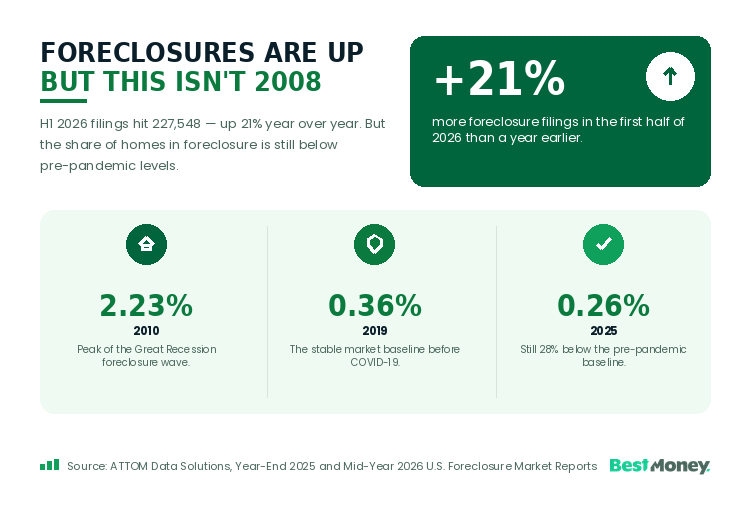
Despite the headlines, today's foreclosure numbers are still well below historical peaks. Here's the context:
Year
Foreclosure Rate (% of Housing Units)
Context
2010 (crisis peak)
2.23%
Height of the Great Recession foreclosure wave
2019 (pre-pandemic)
0.36%
Stable market baseline before COVID-19
2025
0.26%
Rising from pandemic lows, but still below 2019 levels
Source: 0.
In other words, while filings climbed 21% year over year in H1 2026, the overall rate remains roughly 28% lower than the pre-pandemic baseline of 0.36% — and nowhere near the 2.23% rate seen during the 2010 crisis. What we're seeing is a return toward normal market conditions after years of artificially suppressed foreclosure activity, not a repeat of the housing crash.
That said, the trend line matters. In H1 2026, foreclosure starts rose 18% year over year and bank repossessions (REOs) jumped 33%, according to ATTOM's Mid-Year 2026 report. The average foreclosure timeline has dropped to 563 days — the lowest since 2013 — meaning the pipeline is moving faster. The market is accelerating, even if the absolute numbers remain manageable compared to historical peaks.
What Can Homeowners Do to Prevent Foreclosure?
Many government and non-profit programs are available to assist homeowners facing potential foreclosure. These include mortgage assistance programs, housing counseling services, and legal aid. TheConsumer Financial Protection Bureau (CFPB) website also offers resources and information on foreclosure prevention.
What Steps Should You Take if You're Facing Potential Foreclosure?
Taking action early gives you the most options — here are the five steps that make the biggest difference.
Contact your lender early: Don't wait until you miss a payment to reach out. Being proactive gives you access to more options, like loan modifications or temporary payment reductions.
Connect with a HUD-approved housing counselor: These experts offer free or low-cost consultations and can guide you through available assistance programs, both local and federal.
Track your finances: Create a detailed breakdown of your monthly income and expenses. Understanding your financial situation helps you identify which relief options work for you.
Know your rights: Research foreclosure laws in your state and familiarize yourself with borrower protections. A housing counselor can help explain these rights.
Document everything: Keep detailed records of all communications with your lender and counselors, including dates, names, and what was discussed.
What Does the Foreclosure Outlook Look Like?
Foreclosure activity is likely to keep rising gradually, but the data suggests a normalization trend — not a crisis. H1 2026 filings were up 21% year over year, foreclosure starts rose 18%, and REOs jumped 33%. However, the current foreclosure rate remains well below the pre-pandemic baseline of 0.36%, indicating the market still has room before reaching historical norms.
Which Economic Indicators Should You Watch?
Five indicators are worth tracking closely if you want to anticipate where foreclosure trends are headed.
Interest rate movements: Changes in mortgage rates could significantly impact homeowners with adjustable-rate mortgages or those hoping to refinance.
Regional employment trends: Job market stability in different states and sectors will likely influence homeowners' ability to maintain mortgage payments.
Housing inventory levels: The balance between housing supply and demand could affect property values and homeowners' ability to sell if they face financial difficulties.
Consumer debt levels: Rising household debt burdens might signal increased risk of mortgage payment challenges.
Local market dynamics: Population shifts, development patterns, and regional economic growth will continue to shape foreclosure patterns across different states.
Your Questions, Answered (FAQs)
Which states have the highest foreclosure rates right now?
As of June 2026, the states with the highest foreclosure rates are Florida (1 in 2,106 housing units), South Carolina (1 in 2,374), Indiana (1 in 2,377), Nevada (1 in 2,508), Illinois (1 in 2,624), Delaware (1 in 2,699), and Ohio (1 in 2,784), according to ATTOM Data Solutions.
What are the primary causes of the spike in foreclosures?
The main drivers include the end of pandemic-era forbearance programs, elevated interest rates limiting refinancing options, government-backed loan distress (FHA trial-plan failures and the discontinuation of VA's VASP program), rising insurance costs (particularly in Florida), inflation straining household budgets, and regional economic challenges in tourism- and manufacturing-dependent areas.
How do current foreclosure rates compare to the national average?
The national average in June 2026 is one foreclosure filing per 3,656 housing units. States like Florida (1 in 2,106) and South Carolina (1 in 2,374) have rates roughly 50–70% higher than that average, while other states remain well below it.
What measures are being taken to address foreclosure risks?
Federal and state governments continue to fund housing counseling services, foreclosure mediation programs, and financial assistance for struggling homeowners. The CFPB maintains updated resources for borrowers at risk, and HUD-approved counseling agencies provide free guidance nationwide.
Is this another 2008 housing crash?
No. While foreclosure filings are rising, the current rate remains dramatically lower than the 2.23% rate seen during the 2010 crisis peak. Today's increases reflect a normalization from pandemic-era lows — not a systemic financial collapse. Lending standards are tighter, and most homeowners have significant equity compared to the underwater mortgages that fueled the 2008 crisis.
How long does the foreclosure process take?
The average foreclosure timeline in Q2 2026 is 563 days — the lowest since 2013 — according to ATTOM's Mid-Year 2026 report. However, timelines vary significantly by state: Texas processes foreclosures in roughly 155 days on average, while Louisiana can take considerably longer due to judicial requirements.
What Does This Mean for You?
Your next steps depend on where you stand right now. If you're currently behind on mortgage payments, contacting your lender and a HUD-approved housing counselor should be your immediate priority — the earlier you engage, the more options you'll have. If you're keeping up with your mortgage but carrying high-interest credit card or medical debt alongside it, reducing those payments through consolidation can give you more breathing room to stay current. And if you're a potential buyer looking at high-foreclosure states like Florida or Nevada, rising filings may create opportunities — but do your homework on local market conditions before jumping in.
The Bottom Line
Foreclosure filings reached 227,548 in the first half of 2026, up 21% from the same period last year, with Florida, South Carolina, Indiana, Nevada, Illinois, Delaware, and Ohio posting rates well above the national average. The trend reflects a normalization from pandemic-era lows — not a repeat of the 2008 crisis — but the steady climb in filings means homeowners in affected states should pay attention and act early.
What Should You Do Next?
If you're in one of these states — or anywhere foreclosure activity is climbing — the single most important step is acting early. Contact your lender before you miss a payment, and connect with a HUD-approved housing counselor for free guidance on your options.
If you're carrying other debts alongside your mortgage, reducing those monthly obligations can help protect your ability to keep up with housing payments.Consolidating credit card debt doesn't directly prevent foreclosure — it combines unsecured debts like credit cards and medical bills into a single payment — but freeing up cash flow gives you more room to manage your mortgage.Compare debt consolidation options to see what might work for your situation.
Why Trust BestMoney on This?
This article was researched and written by BestMoney's editorial team, which includes writers and editors with backgrounds in personal finance, real estate, and consumer advocacy. Our team analyzed publicly available foreclosure data from ATTOM Data Solutions, cross-referenced it with federal housing resources, and consulted industry reporting to ensure accuracy.
Where We Got Our Information
ATTOM Data Solutions — U.S. Foreclosure Market Report, June 2026
ATTOM Mid-Year 2026 U.S. Foreclosure Market Report (via PRNewswire)
CBS News — U.S. Foreclosures Rise as Homeowners Face Financial Strain, July 2026
Consumer Financial Protection Bureau — Mortgage help resources
ATTOM — Year-End 2025 U.S. Foreclosure Market Report
Delaware Public Media — Delaware property reassessment coverage
Top 5 FAQs About Debt Consolidation
Is debt consolidation worth it?
If you carry a large amount of debt across different credit cards or loans, debt consolidation may help you lower your monthly payments and interest rates and may help you pay off your debt sooner.
How does debt consolidation affect your credit?
While initially taking out a debt consolidation loan may show up on your credit report as a new inquiry and may cause your score to temporarily drop, you can raise your credit score by paying your bills on time each month and lowering your total debt.
How do I qualify for a debt consolidation loan?
To qualify for a debt consolidation loan, you’ll need to meet certain criteria, such as a credit score of at least 670, an ability to prove income, and a government-issued ID. You may also need to have a certain debt-to-income ratio or other qualifications. Each lender may have its own criteria to approve loan applications.
What is the best way to consolidate debt?
You can consolidate multiple loans and credit card balances by taking out a debt consolidation loan. You then use the loan to pay off previous balances, leaving you with one single monthly payment and interest rate.
How much does debt consolidation cost?
Each debt consolidation lender may charge loan origination fees and other fees. The interest rate you pay will depend on the lender’s rates, your credit score, and your debt balance.
Written byMeagan Drew
Meagan Drew is a personal finance and loans expert at BestMoney.com. She has written for publications such as Investopedia, Apple News+, and SimpleMoneylyfe.com. With seven years of experience as a financial advisor, Meagan specializes in making complex topics like budgeting and investing accessible and engaging for everyday consumers.