Common Car Loan Mistakes by Generation: What Gen Z to Boomers Get Wrong
Just 37.8% of car buyers under 30 would walk away from a loan over an unexpectedly higher interest rate—compared to 62% of buyers 45 and older.
October 19, 2026
Just 37.8% of car buyers under 30 would walk away from a loan over an unexpectedly higher interest rate—compared to 62% of buyers 45 and older.
October 19, 2026
That’s according to a new BestMoney survey of 1000 U.S. adults. It’s a wide gap, and it’s not the only one. Across nearly every question about how Americans actually shop for a car loan, the youngest and oldest buyers split in opposite directions.
Younger buyers are slower to say no to a higher-than-expected rate. Older buyers are less likely to shop around for one. Experience doesn’t produce a uniformly better car-loan shopper. It just moves the risk to a different part of the process.
The survey asked buyers to choose between two options: a lower monthly payment on a longer loan, or a higher payment on a shorter one.
Ages 18 to 29: 55.6% chose the lower payment.
Ages 60 and older: Only 29.8% chose the lower payment. Most (70.2%) would pay more each month to finish sooner.
Income shows the same pattern. 78.3% of households earning under $10,000 a year chose the lower payment, compared with 30.3% of households earning $200,000 or more.
A longer loan lowers the monthly bill, but it adds months of interest. The buyers most focused on affordability today can end up paying more over time.
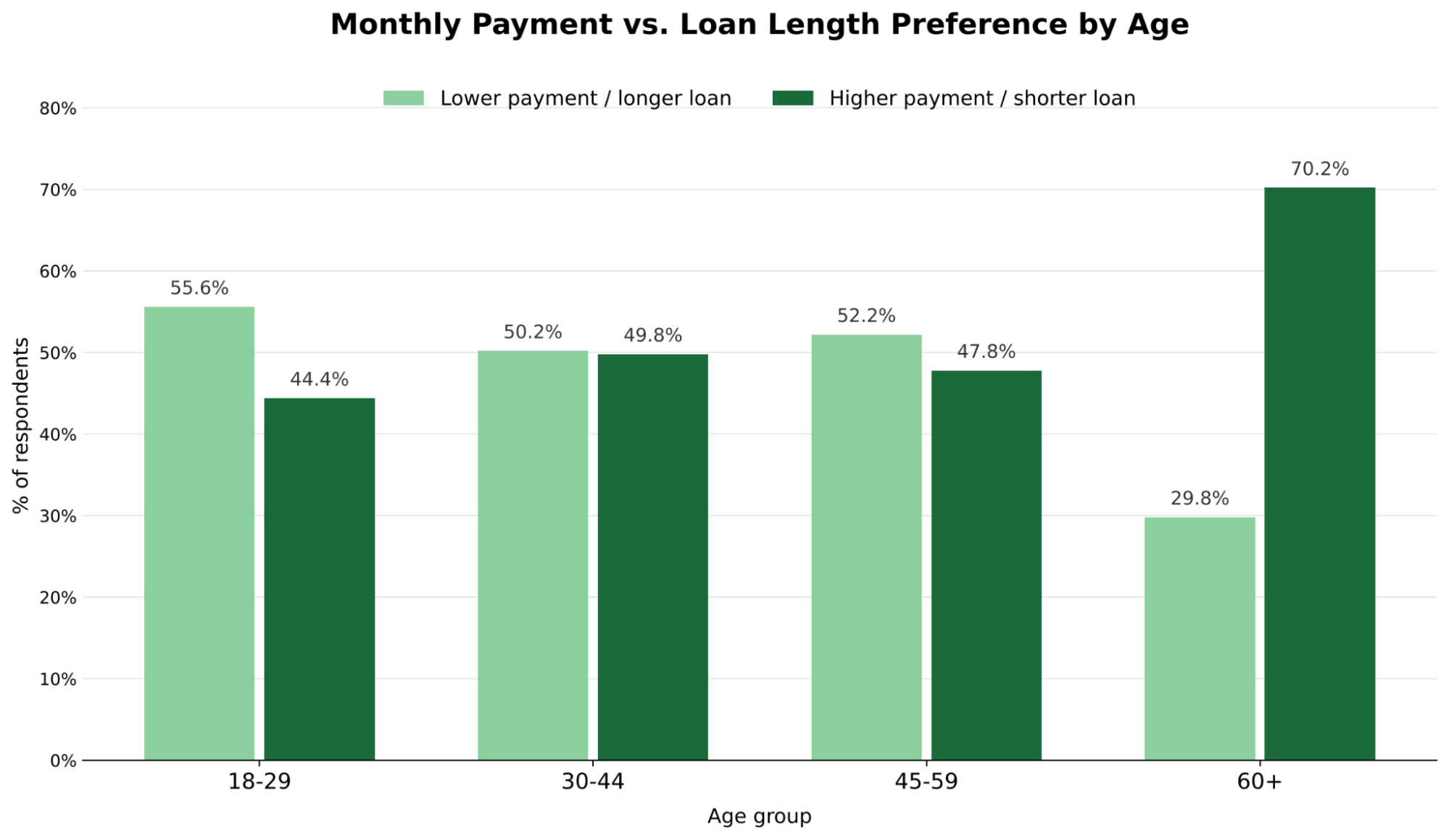
Source: BestMoney survey of 1000 U.S. adults, September 2026.
The survey asked whether any rate higher than expected would make buyers walk away from a deal. Here's the share who said yes:
Ages 18 to 29: 37.8%
Ages 30 to 44: 46.5%
Ages 45 to 59: 62.2%
Ages 60 and older: 62.0%
Steven Fox says buyers who are newer to financing often focus on the wrong number:
Less experienced buyers tend to focus on the monthly payment amount, rather than the total purchase cost or interest rate. They're generally used to looking at most expenses through that lens, and shady dealerships intentionally try to push them in that direction because it draws attention away from how much more they're actually paying over time.
The 'four-square' car sales technique is a classic tactic to mislead buyers. A payment-first framing makes it easy to accept a worse rate with a longer term. On a 6,400 in interest, while 9% over seven years lowers the payment by roughly 14,000. In addition, younger buyers tend to have thinner credit files that reduce their available options.
The survey offered a choice between a slightly higher rate with faster approval and a lower rate with a longer approval process. Here's the share who chose speed:
Ages 18 to 29: 32.2%
Ages 30 to 44: 29.8%
Ages 45 to 59: 32.7%
Ages 60 and older: 11.6%
Income shows an even sharper split. Nearly half of households earning $150,000 to $199,999 would take the faster, pricier option, versus only 8.7% of households earning under $10,000.
Overall, though, most buyers aren't willing to pay for speed: 71.8% said they'd take the lower rate even if approval took longer.
Buyers 60+ in the survey are among the most rate-disciplined once an offer is in front of them, but they're also the age group most likely to skip comparing offers. Here's the share who took the first loan offered to them with no comparison:
Ages 60 and older: 26.4%
Ages 45 to 59: 24.5%
Ages 18 to 29: 21.1%
Ages 30 to 44: 15.6%
When presented with a specific dealer offer, buyers 60+ were also the least likely to say they'd ask to see other offers before deciding (34.7%, versus 41.1% for both 18- to 29- and 30- to 44-year-olds).
"I think [sticking with a familiar lender] probably comes down to trust in their primary bank/credit, the convenience of having everything in one place, and a couple of common misconceptions around how credit scores work. People often assume that their credit score sets their rate… [but] they don't realize that different lenders could have quite different rates for any given borrower's credit score, debt-to-income ratio, zip code, or specific vehicle."
— Steven Fox, CFP®, EA, AdviceOnly
Younger buyers are far more comfortable finishing a car loan online. Here's the share who said they'd feel comfortable finalizing their loan paperwork online:
Ages 18 to 29: 28.9%
Ages 30 to 44: 28.4%
Ages 45 to 59: 21.9%
Ages 60 and older: 12.4%
Online and app-based approvals can move financing from a last-minute decision at the dealership to an earlier step buyers handle on their own schedule. That puts more control in buyers' hands. They can seek pre-approval before shopping and arrive better prepared to negotiate the vehicle's price. Whether buyers prefer a screen or a stack of paper, they should review the APR, loan term, and any optional add-on costs before signing. A faster process should never mean a rushed decision.
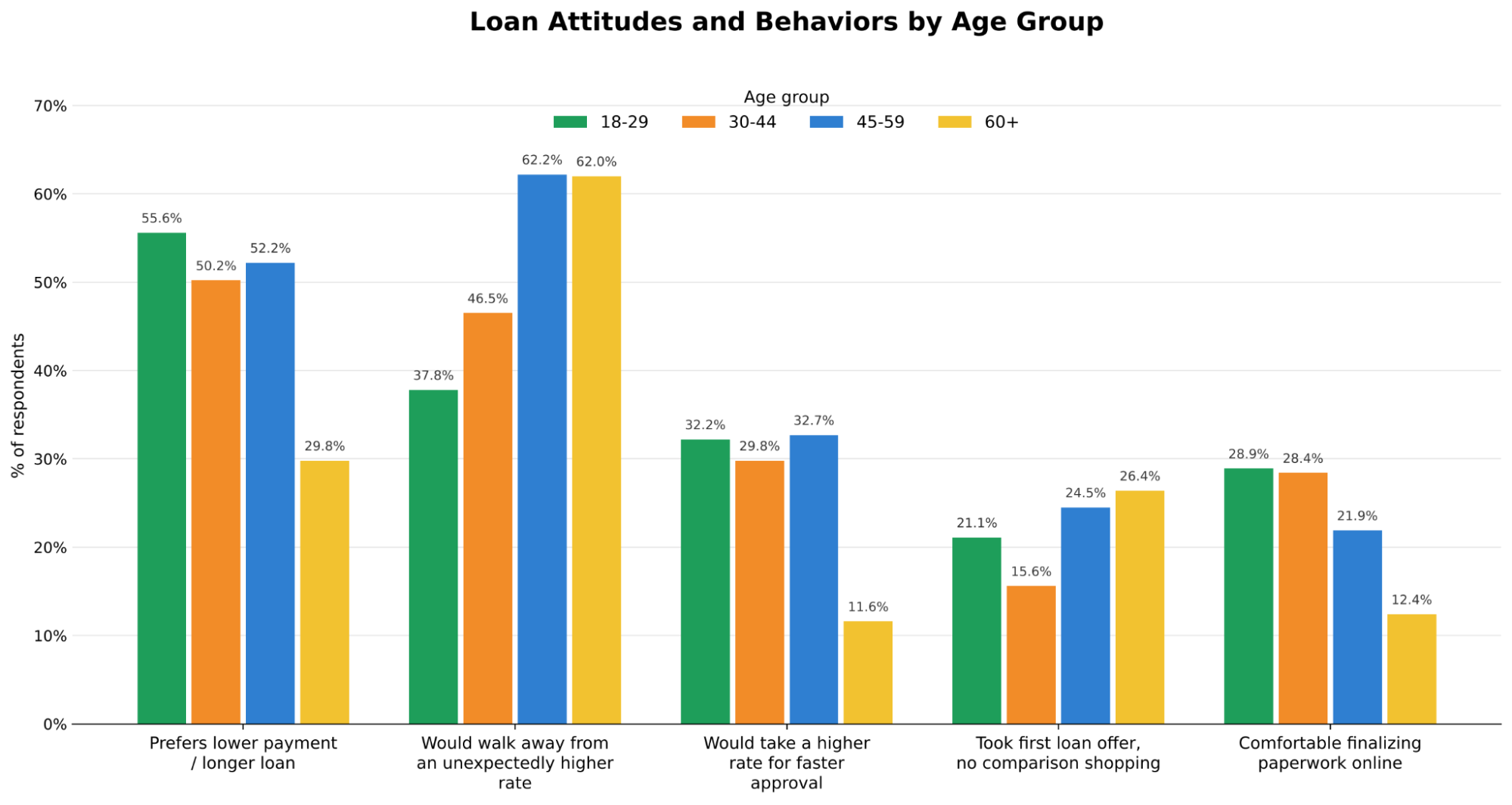
Source: BestMoney survey of 1000 U.S. adults, September 2026.
Alt if text chart preferred:
Loan attitude or behavior | Age Group | |||
18–29 | 30–44 | 45–59 | 60+ | |
Prefers lower payment / longer loan | 55.6% | 50.2% | 52.2% | 29.8% |
Would walk away from an unexpectedly higher rate | 37.8% | 46.5% | 62.2% | 62.0% |
Would take a higher rate for faster approval | 32.2% | 29.8% | 32.7% | 11.6% |
Took first loan offer, no comparison shopping | 21.1% | 15.6% | 24.5% | 26.4% |
Comfortable finalizing paperwork online | 28.9% | 28.4% | 21.9% | 12.4% |
BestMoney surveyed 1000 U.S. adults online between September 3-4, 2026. Respondents reported their preferences, behaviors, and comfort levels when financing a car, or hypothetically financing one. Figures are self-reported and reflect stated preference rather than verified loan outcomes.
Every age group has a blind spot. Younger buyers are slower to walk away from a high rate and more willing to pay for speed. Older buyers hold firm on rate but are the most likely to take the first offer without comparing it.
Whatever your age, two habits help: compare more than one auto lender before you sign, and decide on your walk-away rate before you sit down with a dealer.
Yes. A longer term lowers the monthly payment, but you pay interest for more months, so the total interest goes up even if the rate stays the same.
The survey doesn't measure why. But younger buyers are more likely than buyers 60+ to focus on the monthly payment over the total cost and to put approval speed first, both of which can make it harder to tell whether a higher rate is fair.
Generally, yes. Offers from a bank, a credit union and the dealer give you a baseline for what rate to expect, so you can spot and push back on an inflated offer.
It can be, as long as the lender is reputable and you review the loan terms carefully before signing. Security doesn't depend on whether you sign online or in person, though comfort with signing online varies by age in this survey.
Lorraine Roberte is a trusted debt and mortgage expert for Besmoney.com. As the CEO and Founder of Crafty Writing, she specializes in personal finance and insurance content. She has written for leading publications like AAA, GoodRx, Investopedia, PNC Bank, CNN Underscored, Bankrate, and many more. She does the hard work of breaking down complex financial topics like loans, mortgages, debt, and insurance coverage to help readers make confident decisions.