How Much Gold Should You Own as a Percentage of Your Portfolio?
How Much Gold Should You Own as a Percentage of Your Portfolio?
A plain-language guide to deciding how much gold fits your portfolio, based on your goals, your risk comfort, and your time horizon.
Written by
Bestmoney Staff
The BestMoney editorial team is composed of writers and experts covering a full range of financial services. Our mission is to simplify the process of selecting the right provider for every need, leveraging our extensive industry knowledge to deliver clear, reliable advice.
If you're wondering how much gold you should own as a percentage of your portfolio, the honest answer is that there's no single magic number. What's right for you depends on your goals, your timeline, and how much risk you can handle. A good first step iscomparing gold and silver IRA providers to weigh fees, storage, and account features side by side.
If you're still deciding whether gold belongs in your plan at all, our guide towhether gold is a good investment covers the basics. This article assumes you've decided to include some gold and focuses on sizing it.
Key Insights
Gold usually plays a small, steadying role — not the core that drives long-term growth.
The right amount depends on your goals, time horizon, and risk comfort.
Gold generates no income, so it complements rather than replaces stocks and bonds.
You can hold gold in several ways, including coins, funds, and a gold IRA.
What Does Gold Actually Do in a Portfolio?
Gold usually works best as a small, steadying slice of a portfolio. Its job is to help hold your money steady when other investments wobble, not to power your long-term growth.
Gold behaves differently from many assets, and that shapes its role. According to the World Gold Council's 2026 research, gold can improve diversification and complement a mix of stocks and bonds.
TheWorld Gold Council's 2026 safe-haven analysis adds more detail. It notes that gold tends to move differently from stocks and can hold up or rise when riskier assets sell off. That's why many people call it a diversifier, or a shock absorber for tough markets.
Here's the trade-off to keep in mind. Gold pays no interest or dividends, so it generates no income while you hold it.
In short, gold acts more like insurance for rough markets than a growth engine. That's the core idea to carry through the rest of this guide.
How Much Gold Should You Own as a Percentage of Your Portfolio?
There's no universal number, and the right amount comes down to you. As a general rule of thumb, many investors keep gold to a limited portion of their overall mix, sized to the job they want it to do.
The SEC's investor education site notes thatyour asset allocation is a personal decision that shifts with your time horizon and risk tolerance. So rather than copy someone else's target, start with your own situation. The three profiles below can point you in the right direction.
How Much Gold Makes Sense If You Are a First-Time Buyer?
If you're new to gold, start small and keep it simple. As covered above, gold works best as a limited slice, so treat a modest starter position as a way to learn how it behaves. You can adjust later as you get comfortable.
How Should a Mid-Career Diversifier Approach Gold?
If you're mid-career, the goal is balancing growth with a little protection. You likely already own stocks and bonds, so gold should fit around that mix rather than crowd it out. It plays a supporting role while the rest of your money does the heavy lifting for growth.
How Much Gold Should You Hold Near or In Retirement?
If you're near or in retirement, stability and protecting what you've built usually matter more than chasing gains. Because gold pays nothing while you hold it, lean on income-producing assets for cash flow. Keep gold as a limited, steadying slice rather than a core holding.
What Factors Should Shape Your Gold Allocation?
Your gold allocation should reflect your own timeline, risk comfort, and the mix you already own. A few key factors do most of the work:
Time horizon: The longer you plan to invest, the more short-term swings you can ride out, as the SEC's investor education notes.
Risk tolerance: If sharp drops keep you up at night, a steadier, smaller position may suit you better.
Your current mix: Gold should fit around the stocks and bonds you already hold, not replace them.
Income needs: Because gold pays no interest or dividends, it won't produce cash while you own it.
Your reason for owning it: Decide whether gold is insurance, a diversifier, or both before you size it.
Is Gold a Good Hedge Against Inflation and Market Swings?
Gold can help during certain stress periods, but its record is uneven, so treat it as one tool rather than a sure thing. It has sometimes shielded portfolios during turmoil, and sometimes it hasn't.
On the plus side, institutional research describes gold as a steadier diversifier during market stress, when its tendency to move against falling stocks can cushion a portfolio. That's the case many investors find appealing.
Now the honest limits apply, too. J.P. Morgan Asset Management's 2026 commentary points out thatgold's track record as an inflation hedge has been patchy. It also notes gold can be more volatile than expected, so it's not a reliable stand-in for bonds.
As covered above, that mixed record is why gold works best as a limited slice.
Gold vs. Stocks: How Are They Different in Your Portfolio?
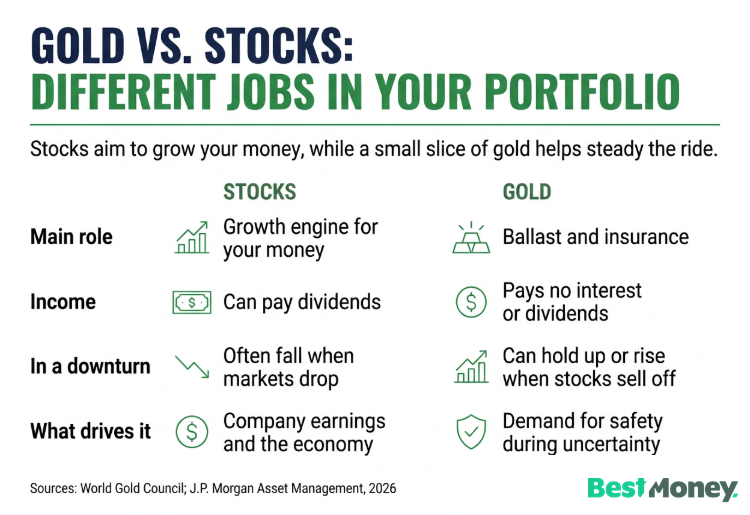
Stocks are your growth engine, while gold is ballast meant to steady the ride. They play different roles, so they work together rather than compete.
The table below lays out the key differences in plain terms. Gold pays no interest or dividends, and market commentary notes it tends to behave differently from stocks, sometimes holding up when they fall.
What to compare
Stocks
Gold
Main role
Growth engine for your money
Ballast and insurance
Income
Can pay dividends
Pays no interest or dividends
Growth potential
Meant to build wealth over time
Meant to steady, not to grow, your mix
Behavior in downturns
Often fall when markets drop
Can hold up or rise when stocks sell off
What drives it
Company earnings and the economy
Demand for safety during uncertainty
The takeaway is simple. As covered above, you lean on stocks to grow your money and on a small slice of gold to smooth the bumps.
What Are the Ways to Hold Gold?
There are several ways to hold gold, and each comes with trade-offs in convenience, cost, and control. The right choice depends on how hands-on you want to be and where gold fits in your plan.
How Does Owning Physical Gold Work?
Physical gold means buying coins or bars that you actually hold. It gives you a tangible asset, but you're responsible for storage and security.
You'll also want to weigh dealer costs and safekeeping. If coins or bars appeal to you, you cancompare places to buy physical gold to see how fees, storage, and features differ across providers.
What About Gold ETFs and Funds?
Gold ETFs and funds let you get gold exposure without storing metal yourself. They trade like other funds, so they're convenient to buy or sell.
The trade-off is that you don't hold the physical metal, and funds carry their own ongoing costs. For many investors, that convenience is worth it.
Can You Hold Gold in a Retirement Account?
Yes, you can hold gold inside a retirement account through what's often called a gold IRA. Broadly, IRS rules let you keep approved metals in a tax-advantaged account through a custodian and an approved storage facility. The specifics vary by provider.
A gold IRA is just one way to hold gold in retirement savings. It's a natural place tocompare gold and silver IRA providers so you can weigh fees, storage, and setup before choosing one.
How Do You Keep Your Gold Allocation on Track?
Pick a target, then check in and rebalance from time to time as prices drift. Over time, some holdings grow faster than others, which can pull your mix away from your plan.
The SEC's investor education explains that rebalancing brings your portfolio back to its original mix. It also nudges you to sell high and buy low. Many investors rebalance at set intervals rather than reacting to every headline.
The goal is to stay disciplined. Try not to chase gold after a big price spike, and don't let a hot streak quietly turn a small slice into a large one.
What Mistakes Should You Avoid With Gold?
A few common missteps can undercut the role gold is meant to play. Watch for these:
Over-allocating: Making gold a large share of your mix can crowd out the assets that grow your wealth.
Buying on hype: Chasing gold after a big run-up can mean paying up right before prices cool off.
Ignoring costs and storage: Coins, funds, and gold IRAs each carry fees and safekeeping needs to plan for.
Treating it as a growth engine: As covered above, gold is meant to steady a portfolio, not power returns.
Gold isn't the right fit for everyone, and that's okay. If it's not for you right now, you can stillcompare precious-metals and gold IRA options so you can revisit the decision with clear information later.
Who Is This Gold Guide For?
This guide is for U.S. investors who already own stocks and bonds and want to know how gold fits. See which profile sounds like you:
New investors: You're curious about gold and want a simple, low-pressure way to start.
Mid-career diversifiers: You want to balance growth with a little protection around your existing mix.
Pre-retirees and retirees: You care most about stability and protecting the savings you've built.
What Should You Do Next?
Here's the recap: gold usually works as a limited, steadying slice, sized to your goals, time horizon, and risk comfort. It's insurance for rough markets, not a growth engine. With that in mind, a few clear steps can help you act.
Revisit your target mix and decide what limited role, if any, gold should play.
Choose how you want to hold gold, whether that's coins, a fund, or a retirement account.
There's no single right figure. As covered above, many investors keep gold to a limited portion of their mix, sized to their goals and comfort with price swings.
Does the right amount of gold change as I get older?
It can, since your time horizon and risk comfort tend to shift as you approach retirement. The SEC's investor education notes that your allocation is a personal decision that changes over time.
Is gold a reliable hedge against inflation?
Gold can help in some stress periods, but J.P. Morgan Asset Management's 2026 commentary notes its inflation-hedging record has been uneven. It's best treated as one tool rather than a guarantee.
Should I hold physical gold or a gold ETF?
Physical gold gives you a tangible asset but requires storage. A gold ETF is more convenient to buy and sell, so the choice depends on how hands-on you want to be.
Can I hold gold in an IRA or retirement account?
Yes, you can hold approved metals in a gold IRA through a custodian and an approved storage facility. It's one of several ways to hold gold in retirement savings.
Why Trust BestMoney?
For this guide, BestMoney's editorial team reviewed investor-education material from three sources. Those were the SEC's Investor.gov, the World Gold Council's 2026 research, and J.P. Morgan Asset Management's 2026 commentary.
We compared how these sources describe gold's role, its diversification benefits, and its limits so we could explain the trade-offs plainly. We help readers weigh their options rather than push a single choice.
How We Researched This
This guide relies on secondary sources rather than a proprietary BestMoney survey. No first-party BestMoney survey data was used for this topic. We drew on investor-education material from the SEC's Investor.gov, research from the World Gold Council, and market commentary from J.P. Morgan Asset Management.
We used these sources to explain how gold behaves in a portfolio, its role as a diversifier, and its limits as an inflation hedge. Where a current figure on typical gold allocation belongs, we've flagged it for a human expert to supply from a verified, non-competitor source.
The BestMoney editorial team is composed of writers and experts covering a full range of financial services. Our mission is to simplify the process of selecting the right provider for every need, leveraging our extensive industry knowledge to deliver clear, reliable advice.