- Home/
- Debt Consolidation/
- Consolidated Your Debt, But Balances Are Back? Here's What To Do
Consolidated Your Debt, But Balances Are Back? Here's What To Do
August 6, 2026
August 6, 2026
First, take a deep breath: you're not alone, and this doesn't mean you've failed. The reality is that the psychological relief of a zero balance often masks the underlying cash flow issues that caused the debt in the first place.
When those available credit lines open back up, everyday emergencies quickly fill them. A TransUnion study shows that while credit card debt consolidators cut their balances in half, many of them saw their balances return to close to previous levels 18 months later.
You may be facing a similar challenge: juggling your original consolidation loan payment alongside returning credit card balances. This guide will walk you through exactly why this happens without judgment, and will outline realistic, actionable steps you can take today to regain control of your financial future.
When credit card debt returns after consolidation, it can put added pressure on your budget. Instead of managing one monthly payment, you may now be juggling your personal loan alongside new credit card balances that accrue interest.
This can increase your debt-to-income (DTI) ratio, which lenders consider when evaluating loan, mortgage, and other credit applications. A higher DTI may make it more difficult to qualify for new borrowing or secure the most competitive rates.
If your balances continue to grow, it's worth taking a closer look at what led to the new debt. Addressing the underlying cause early can help you regain control, protect your credit over time, and prevent debt from becoming more difficult to manage.
To understand why credit card debt can return after debt consolidation, you need to understand how the "clean slate" psychological trap works against you.
As the National Foundation for Credit Counseling (NFCC) explains, debt consolidation doesn't actually erase debt, it just moves it to a new location. When your credit cards hit a $0 balance, your brain registers a victory. Without the visual stress of maxed-out limits, the urgency to restrict daily spending naturally fades.
The Federal Reserve reports that the average credit card interest rate is currently 22.15%, while the average 24-month personal loan interest rate is 11.86%. Unless you've aggressively budgeted for emergencies, a single unexpected medical bill or car repair has nowhere to go but that 22.15% credit card.
These high interest rates mean much of your monthly payment goes toward interest, trapping you again in a cycle of debt.
Paying off your credit card balances with a debt consolidation loan restores your available credit on those cards if the accounts remain open. Without closing accounts, freezing the cards, or creating a realistic plan to limit spending, it's easy to make impulse purchases or gradually rebuild balances.
To provide the most accurate, empathetic guidance on what to do when debt consolidation fails, we analyzed the latest TransUnion debt consolidation study from August 2023 on borrower behaviors 18 months post-consolidation.
We also reviewed Federal Reserve data on average consumer interest rates, examined Consumer Financial Protection Bureau (CFPB) complaints, and consulted guidelines from the National Foundation for Credit Counseling (NFCC) regarding alternative relief paths.
When you're carrying both a consolidation loan and returning credit card balances, a debt management plan (DMP) and debt settlement are likely better debt relief options than taking a second debt consolidation loan.
Feature | Debt Management Plan (Credit Counseling) | Debt Settlement |
|---|---|---|
How It Works | You pay the full principal you owe. A counselor negotiates much lower interest rates (often under 10%), so your payments actually make a dent toward your principal. | You or a company negotiates to pay a lump sum that's less than your total balance. |
Credit Score Impact | Moderate. You must close the credit cards, which impacts utilization, but consistent payments help rebuild your score. | Severe. You typically must stop paying creditors entirely until accounts charge off, tanking your score before a settlement is reached. |
Is It a Loan? | No, it's a structured repayment plan. | No, it's a negotiated forgiveness of a portion of the debt. |
Best For | Borrowers who have steady income but are drowning in 20%+ APRs and can't make headway on the principal. | Borrowers facing genuine financial hardship (job loss, medical crisis) who mathematically can't repay the principal. |
Ben Tejes, CEO of Ascend Finance, says your credit score may be negatively affected by both debt settlement and a debt management plan, but the severity and timeline differ significantly.
"In debt settlement, your credit score will decrease the most if your accounts are current when you enroll in the program, because creditors must be past due before they will negotiate and settle. In debt management plans, the credit impact is much less severe. Your credit score may decrease when you enroll and close your accounts."
However, Tejes says he's seen credit scores increase dramatically while in the program, because your debt-to-income ratio improves as you pay off debt faster than the minimum payments require.
If your debt returned because your monthly expenses consistently exceed your income, creating a budget may help you get back on track before you need a formal debt relief program. A budget helps you identify where your money's going and prioritize debt repayment, reducing the likelihood of relying on credit cards again.
Daniel Maura, an IRS enrolled agent and the CEO and founder of Sevfin, an accounting and tax advisory firm, says your budget "doesn't have to be anything complicated, but it should be something you can stick to, with set amounts for things like food, gas, toiletries and entertainment."
Here's more on how to build a budget:
If you've already cut expenses and your budget still doesn't leave enough room to make meaningful progress, a Debt Management Plan or debt settlement may be the better next step.
Let's look at the math of what happens if you try to take out a second consolidation loan versus enrolling in a Debt Management Plan.
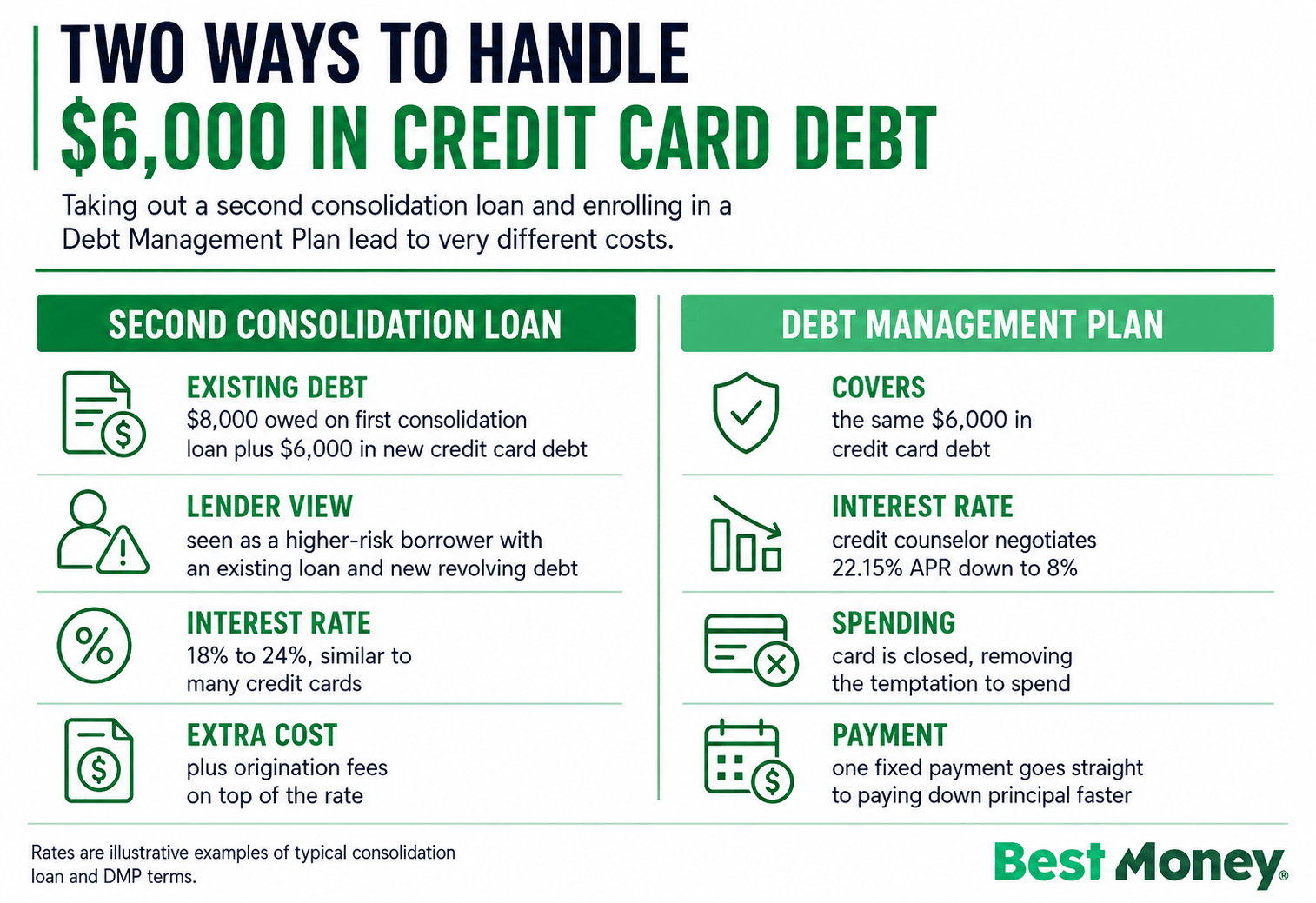
On $8,000 owed on your first consolidation loan plus $6,000 in new credit card debt, applying for a second consolidation loan puts you in a tougher spot.
Lenders may view you as a higher-risk borrower because you already have an existing loan and new revolving debt. If approved, the loan may carry an interest rate of 18% to 24%, similar to many credit cards, plus origination fees, making it a more expensive way to manage your debt.
Instead of borrowing again, enrolling in a DMP for that same $6,000 in credit card debt looks different. The credit counselor negotiates your 22.15% credit card APR down to 8%.
You close the card, removing the temptation to spend, and make one affordable, fixed payment to the counseling agency that goes directly toward paying down the principal faster.
Seeing your balances climb again can be discouraging, but taking action early can help you regain control before the debt grows further.
Remove your credit cards from Apple Pay and other digital wallets. Avoid using them for new purchases while you work on paying down your debt.
A realistic budget can help you free up money for debt payments while reducing the need to rely on credit cards again. As your finances improve, aim to save $500 to $1,000 for unexpected expenses so future emergencies don't become new debt.
If you've tried budgeting and are still struggling to pay down your new credit card balance, your ideal next step depends on your current financial stability and your current credit card balances:
If you're unsure which option is right for you, a nonprofit credit counselor can review your finances and help you determine the best path forward.
Balances returning after consolidation doesn't mean you've failed, it just means your situation needs a different approach than a second loan. If you're still having trouble paying down your debt, a debt relief program can help you find the structural solution that fits your budget.
If you're weighing whether to settle your debt for less than you owe, understanding exactly how debt settlement affects your credit report can help you decide. If you'd rather work with someone directly, a credit counseling guide can connect you with an NFCC-certified counselor who can walk through your options with you.
Lorraine Roberte is a trusted debt and mortgage expert for Besmoney.com. As the CEO and Founder of Crafty Writing, she specializes in personal finance and insurance content. She has written for leading publications like AAA, GoodRx, Investopedia, PNC Bank, CNN Underscored, Bankrate, and many more. She does the hard work of breaking down complex financial topics like loans, mortgages, debt, and insurance coverage to help readers make confident decisions.